There was a photograph that was never published.
The meeting between Pope Leo XIV and Bad Bunny was confirmed. The media reported on her. It happened at the Bernabéu, one of the most media-intensive stadiums in the world, a secular and global space where everything is documented and nothing escapes the phones. However, the image everyone was hoping to see never appeared.
In an era obsessed with documenting everything, the absence of a photograph ended up becoming news. And the relevant question is not why we didn’t see the image. The question is what meaning his absence produced.
That question leads to another deeper one, which the pope’s visit to Spain was responsible for answering precisely: the Catholic Church continues to be one of the most sophisticated institutions in the world in the construction and management of symbolic power. Not because I control politics. Not because I control the media. But because it is still capable of producing meaning.
The visit was much more than a pastoral tour. It was a strategic communication exercise on a global scale. And the key to that exercise was not in what was shown, but in who decided what was shown. The agenda was established by the Vatican. I determined what yes, what no, with whom and in what scenario. Democratic governments with all the resources of the State ceded narrative control to an institution without an army, without significant territory, without economic power comparable to that of the great powers. And they did it voluntarily. Even with gratitude.
That’s not communications management. It is symbolic power.
Long before social networks, the Catholic Church already understood that the way of communicating can be as important as the content itself. Each setting, each route, each meeting and each silence transmitted messages during this visit. The photography absent too.
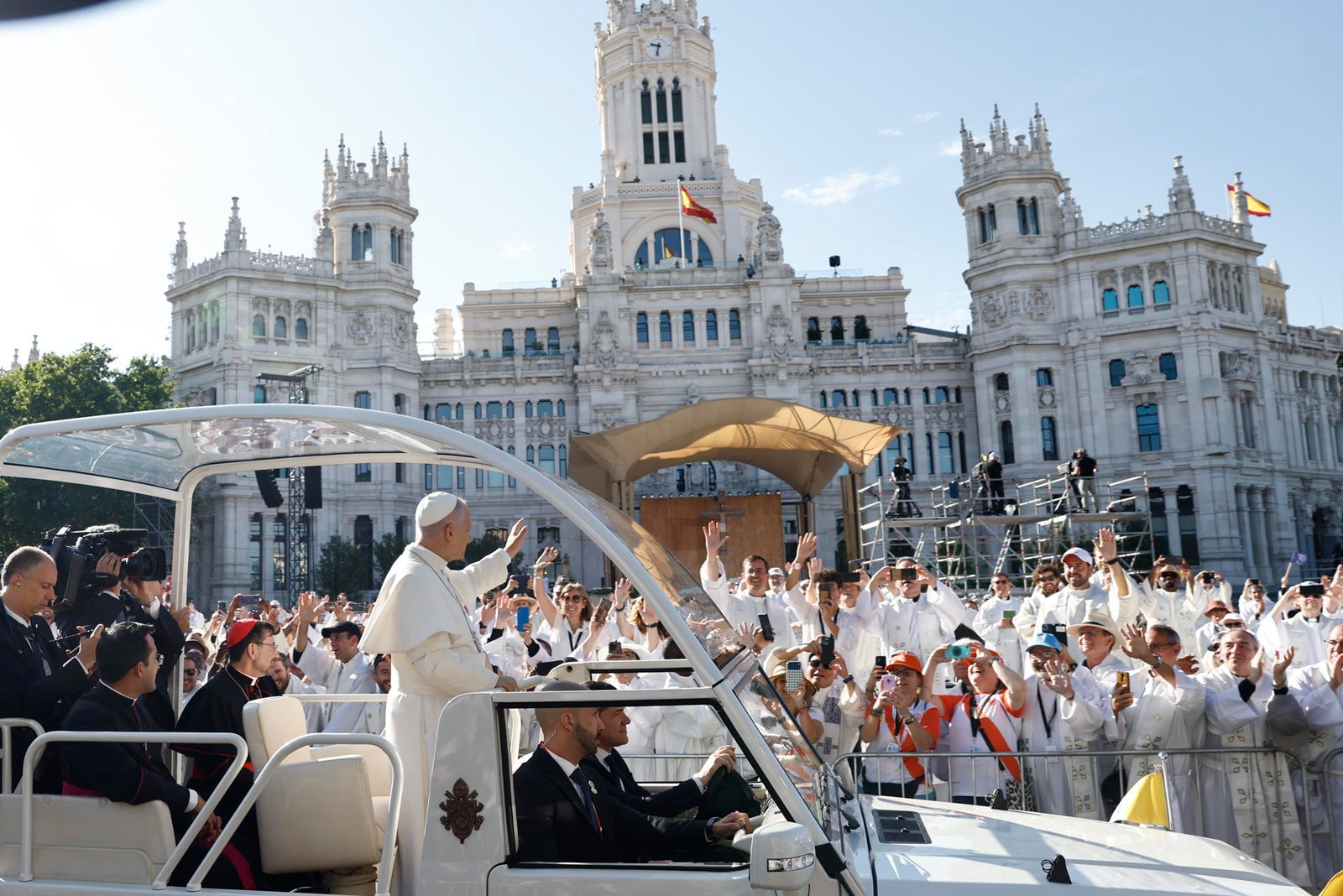
Madrid offered the first act, and it turned out to be more complex than it seemed. In two days, Leo It wasn’t a visit. It was a communication campaign with audience segmentation.
The speech before the Cortes was the most dense and revealing piece of the Madrid trip. Leo XIV became the first Pontiff to speak before the Congress of Deputies. He criticized the permanent disqualification of the adversary, demanded a culture of reciprocity, defended the protection of life from its conception to its natural decline and placed the protection of the unborn and the migrant in the same moral equation. No one could appropriate the complete message. Pedro Sánchez and the leaders of the Spanish right shared the stage in the same room, before the same figure, without any of them reading it as their own defeat.
In a country where political polarization is so acute that leaders barely agree without it being news of conflict, that is soft power in its purest expression: the ability that Joseph Nye defined as influencing through attraction, legitimacy and the construction of meaning, without the need to impose.
Barcelona offered the second act, and perhaps the most symbolically charged. The day began in a women’s prison and would end in the Sagrada Família. Between both scenarios is a good part of the symbolic grammar that characterizes Vatican communication.
In front of the inmates, the Pope said something that within a prison acquires a density that no speech can manufacture: the mistakes of life do not determine a person’s identity.
The Sagrada Família is worth a stop. Antoni Gaudí died exactly a century ago, run over by a tram, mistaken for a beggar because no one recognized him on the ground. A century later, the Pope, the Kings, the President of the Government and the President of the Generalitat observed a cross lighting up on the tallest tower of the tallest church in the world while drones drew Gaudí’s face over Barcelona along with a phrase that summarized his legacy: first love, then technique. The epic 144 years in the making found its symbolic consecration that day. And it was the Pope who presided over it.
In that Barcelona day there is the grammar of contrasts that defines the Vatican’s communication method. The prison and the basilica. Invisibility and spectacle. They are not contradictory elements in the symbolic logic of the Church: they are pairs that tension each other and in that tension produce meaning that no political statement could match. Roland Barthes maintained that modern societies construct mythologies through seemingly everyday signs. In Barcelona several of them converged simultaneously: redemption, identity, creation and mercy.
Canarias was the third act. And it turned out to be the symbolic culmination of the entire trip.
The Pope arrived at the Arguineguín pier, known for years as the pier of shame since almost four thousand immigrants were overcrowded in 2020 in the middle of the pandemic. He renamed it the port of hope.
The gesture seems simple, but it contains a sophisticated communication operation. The facts remained intact. The boats kept arriving. Political tensions continued to exist. What changed was the meaning attributed to the place. Leo XIV did not dispute the data. He disputed the meaning of the data.
Before Red Cross volunteers, Maritime Rescue captains, trafficking victims and migrant families, he said what European governments could hardly say at that time: human dignity does not have a passport nor does it lose value when crossing a border. The visit occurred the day before the European Pact on Migration and Asylum came into force, which toughens reception conditions. The Vatican knew the date. Pedro Sánchez received the Pope at the foot of the stairs. The Minister of Inclusion spoke of support for the Government’s immigration policies. A Canarian deputy asked out loud if you can applaud the Pope’s speech and then act as you were acting. The Pope did not intervene directly in politics. But politics ended up reorganizing around his message.
Leo XIV projects a communication style that deserves attention in itself. First American Pope in history, but deeply influenced by the Latin American experience, polyglot, comfortable with the media and willing to intervene in complex issues without apparent fear of controversy. In the Royal Palace he spoke with institutional solemnity. In the Plaza de Lima with the young people he declared himself to be another Madrid native and confessed that he had not learned the speech by heart either. In Arguineguín he bowed before the dignity of those who arrived by cayuco. Every record, every gesture and every choice of setting communicated something that no official statement could have said.
The Church has demonstrated a particular capacity over the centuries: it usually changes language before doctrine. He did it after the printing press, with radio, with television and with the Internet. Now it seems to do it again. While governments, companies and celebrities compete daily for attention through the overproduction of content, the Vatican continues to operate with a different logic: selection. Influence does not depend solely on how much you communicate, but on what you decide to communicate.
Rome no longer governs armies or controls territories. The former capital of an empire that ruled by force continues to occupy a central place in the global conversation thanks to completely different instruments: symbols, rituals, narratives and moral authority. When the Pope travels, the world continues to watch. It is a remarkable historical paradox.
For centuries, power has been associated with the ability to impose decisions. Leo XIV’s visit to Spain recalled another form of influence: the ability to define meanings. Empires rule territories. Durable institutions govern imaginaries.
Rome lost its legions, its emperors and its provinces centuries ago. What he never lost was the ability to produce symbols capable of crossing borders, cultures and generations. Perhaps that is why a photograph that was never published ended up saying so much. Because, two thousand years later, Rome continues to master one of the oldest and most difficult arts of human communication: deciding which story deserves to be told.