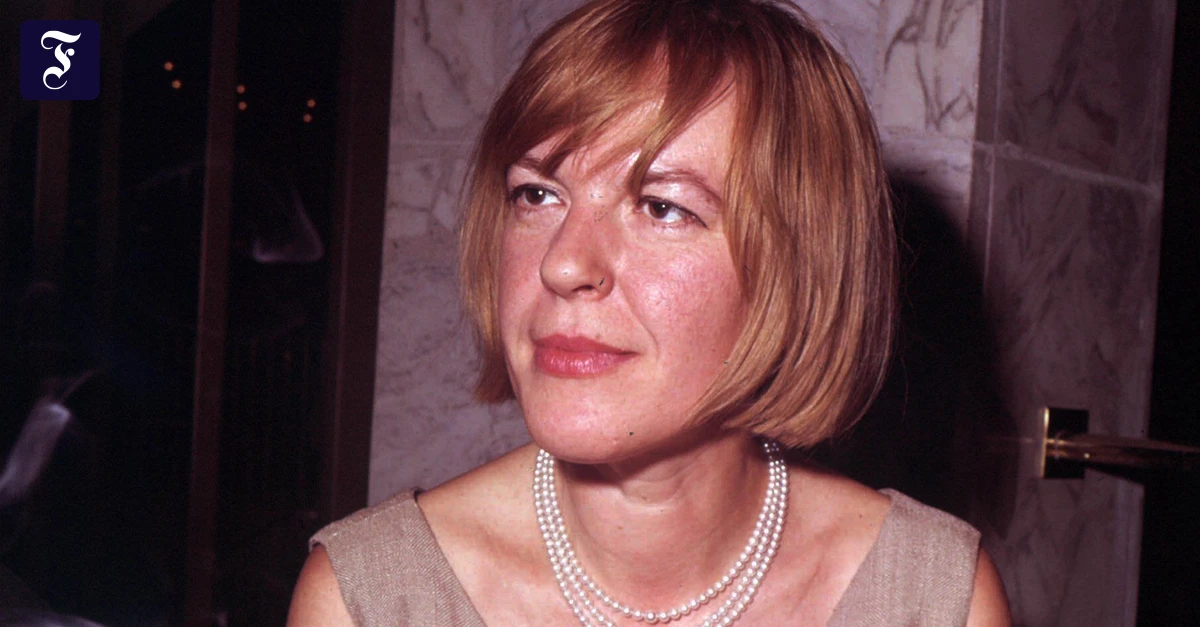
“Malina” is called Ingeborg Bachmann A classic that challenges the mind like no other work by the Austrian author. Nothing in it appeases. Initially received with mixed reviews by critics in 1971, the novel soon became a bestseller. It tells of the inner disintegration of a writer in Vienna who literally disappears into the wall between pathological love, the violence of a society characterized by National Socialism and silence and the impossibility of female autonomy.
Bachmann, who died a hundred years ago Klagenfurt was born, is one of the most important writers of the twentieth century. But what is the fascination of this author, who to this day encourages generations of readers to fathom her literary secret? Her political sensitivity was sharpened by witnessing National Socialism and the Shoah. In a present that is learning anew what silence costs and what language can do, Bachmann sounds disturbingly relevant. Her literary characters are almost always in conflict with society, through love relationships that challenge order, through the agonizing search for truth or the refusal to settle into what is.
Their unwillingness to compromise could be disturbing
Her biographer Andrea Stoll speaks of a radical concept of freedom that is equally articulated in her life and work. From her first poem cycle “The Hours of Time” to later works such as “Simultan” or “Malina”, Bachmann never understands language purely aesthetically, but always politically as well. For her, words become an instrument to make relationships of power and violence visible. For her, violence begins when two people speak to each other or remain silent. The dense, poetic Bachmann sound, made up of enigmatic monologues, disturbed phone calls and nightmares, only makes the present seem even more torn.
Her moral determination challenged Bachmann’s contemporaries early on. Added to this was the provocation of leading an unattached life as a woman, in different countries, with different partners. She forbade any interference in her way of life. She was taken over by the public and the media like a pop star, admired and reviled. But she also knew how to use her weapons.
She successfully manipulated the head of “Group 47”.
When the aspiring poet found out about an appointment with the head of “Group 47” in Vienna, she arranged for him to come half an hour early to an office that was empty – except for a few poems that seemed to be lying around without purpose. Hans Werner Richter began to read. The invitation to the meeting of the legendary literary group came promptly. Even though the author was aware of the impact of her performances, she also had an almost excessive shyness of people, which must have seemed erratic. This also corresponded to their idea of autonomy. For her, freedom was always the freedom to withdraw from others.
Ingeborg Bachmann was only 47 years old. She died in 1973 after a fire in her apartment. During her short life she commuted restlessly between Klagenfurt, Vienna, Paris, Rome, Naples, Zurich and Berlin. She followed no other compass than her own, which not only overwhelmed her, but also her great artistic loves Paul Celan, Hans Werner Henze and Max Frisch. She always let the public believe that private experiences could hardly be found in her texts. That was also freedom for her: to control her own image.
The reactions were all the more violent when this picture recently changed dramatically. Not least thanks to the Salzburg Bachmann Edition, which began in 2017, readers and biographers like Andrea Stoll can now differentiate between legend and reality much more thoroughly than before. The correspondence with Frisch, but also with Marie Luise Kaschnitz and Ilse Aichinger, reveals how much Bachmann’s life influenced her work. The concept of freedom often has painful connotations in these letters and diaries. In the novel “Malina,” the self finally dies symbolically in the crack of a house wall.
Throughout her life, Bachmann opposed an aesthetic of appeasement and silence. The question of individual responsibility is also at the center of “Malina”. The last sentence – “It was murder.” – makes it clear that the narrator does not simply disappear, but was made to disappear. Bachmann’s novel is extremely dense and complex. The fact that it ends with such a short and legally precise sentence cannot be a coincidence. Rather, it is as if language only finds its full clarity the moment it goes out. The truth always comes too late. For Ingeborg Bachmann it was still reasonable for people.