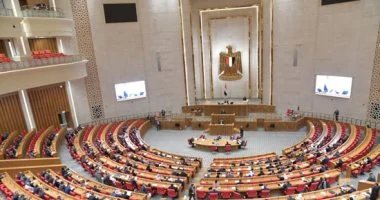
The bakery file was not on the table Economic Affairs Committee In the House of Representatives, during its meeting today, Sunday, headed by its representative, Ayman Mohsab, it was just a passing discussion. Rather, it turned into an arena for a heated discussion that brought with it complaints and criticism from the representatives due to the lack of bakeries in some areas and the closure of bakeries serving entire villages and residential complexes, in addition to the controls for establishing new bakeries, and the mechanisms for dealing with violating bakeries, before the confrontations ended in a parliamentary government consensus, and the file was settled with new controls that guarantee the continuation of service and hold the violator accountable without the citizen paying the price.
This file came in light of six briefing requests submitted by a number of representatives, including Faisal Abu Arida, Ahmed Bilal Al-Burlisi, Hossam Hassan Al-Khasht, Muhammad Mustafa Kamel, and Nader Abdo Siddiq, who raised the problem of the shortage of bakeries, in light of the difficulty of establishing new bakeries in some areas, and the resulting service gaps that affect the daily lives of citizens.
In this context, the intervention of Ahmed Aboul Gheit, Assistant Minister of Supply for Oversight, came to set a decisive framework for the ministry’s policy, stressing that it does not close the door to the establishment of new bakeries, but rather deals with requests for deprived areas seriously and immediately, through field committees that move to the ground to accurately determine the actual needs, and that he is ready to form a committee immediately to study the requests of representatives and go immediately to the field to cover any deprived areas with bakeries immediately.
Aboul Gheit also referred to previous experiences in which the Ministry succeeded in restarting bakeries that had been suspended for years, including a bakery in Gharbia Governorate that remained closed for 15 years in light of the governor’s move to notify the Ministry about it in the city of Qatour, in addition to operating strategic bakeries in Dakahlia Governorate in Dekernes and Mansoura.
Regarding the closure policy, the representative of the Ministry explained that the matter is not taken absolutely, but rather is linked to the nature and size of the violation, in light of a new trend that requires not resorting to immediate administrative closure, in implementation of the decision of the Minister of Supply, and replacing it with a system of graduated financial fines, but the directorates must take their measures, until they are presented to the competent authority, and continue to take deterrent measures in the face of serious violations.
At the heart of the discussion, a pivotal problem emerged raised by the representatives submitting the briefing requests, which is that closing the bakery, whatever its justification, does not only affect the person who committed the violation, but also affects the citizens themselves, especially in villages and areas where there is no adequate alternative, so that the punitive measure turns from a means of control into a daily burden that affects the basic needs of the people.
Hence, the representatives stressed that discipline in the system should not come at the expense of continuity of service, calling for more balanced oversight mechanisms that impose a penalty on the violator without its effects extending to the citizen, with the need to develop solutions that ensure the continued operation of bakeries in the areas most in need.
In this context, the government has thrown cases that require closure into Parliament’s court, whether in the case of repeating the violation or attacking the inspection campaigns, as it asks the representative of the ministry: “But we found some violations that require closure, such as attacking the campaign or repeating the violation and dealing with quotas of flour. Does it make sense that we open the laboratory after that? If I open it, the representative will come and hold me accountable?”
The representatives followed up again, warning that closing the bakery may not be a punishment for its owner alone, but rather its impact will extend to the citizens who depend on it on a daily basis, stressing the need to achieve a balance between the requirements of oversight and the people’s right to continue the service.
However, the intervention of MP Ayman Mohsab, representative of the committee, was decisive, saying: “You are punishing the entire village. When the violations reach the level of repetition, withdraw the license.”
As visions crystallized within the committee, Representative Ayman Mohsab, the committee’s representative, said that the committee will officially recommend to the government that the bakery’s license be withdrawn in the event of repeated serious violations, while re-providing the opportunity to issue new licenses, ensuring that the areas are not left without service coverage.
This proposal was welcomed by the government representative, as a step that supports controlling the system more clearly, saying: I am happy with this solution, but at the request of you, support us in implementing this recommendation.
To complement this vision, the representatives called for the necessity of issuing a unified circular to be circulated to all directorates, so that bakery owners are fully aware of the rules regulating work, and that the license will be withdrawn if the violation is repeated, within a framework that balances oversight, continuity of service, and the citizen’s right to a loaf of bread.