European leaders came out with a strong political message of support for Ukraine, but the G7 summit did not lead to a breakthrough that would change the dynamics of the war. Europe is looking for stronger pressure on Moscow, while the key role again remains with Donald Trump.
The G7 summit in the French city of Evian-les-Bains, which was held from Monday to yesterday, ended with the message – the most powerful Western economies remain united in their support for Ukraine, including its territorial integrity, and are ready to increase pressure on Russia.
However, it all seems like “one step forward, two steps back” because there is no practical progress to move things from a standstill. Europe wants more pressure on Moscow, and President Donald Trump is once again the central figure on whom it depends whether the threats will come true. The American president said that he will “continue efforts to end the Russian war against Ukraine”, although he assessed that the conflict “has nothing to do with the United States”, thus again showing reservations about the Ukrainian issue.
– Look… Russia needs to reach an agreement – said Trump.
He added that “Ukraine will be put on the back burner, while Washington is focused on Iran.”
– We will see. Right now we are focused, that is, we were focused on Iran. It will remain in the background, in the rearview mirror, but we will be… Look, we have nothing to do with it – said the American president.
However, he claims he remains committed to ending the war “because he doesn’t want to see people die”.
– The only reason I’m involved is that I don’t want to see 25,000 people die every month. Young people, just starting their lives… The whole thing is absurd. So, yes, I will do everything I can – added Trump.
The West is preparing for a prolonged war
G7 leaders in a joint statement supported Ukraine at a time when Kiev is trying to enter into possible peace negotiations with Moscow. They want increased deliveries of air defense systems, interceptors and long-range capabilities, as well as the possibility of expanding Ukrainian domestic military production.
The leaders also announced additional aid for the Ukrainian energy system before the coming winter, which shows that the West is preparing for a prolonged war.
The joint statement also reflects the changed atmosphere around Ukraine. Ukrainian President Volodymyr Zelenskyi and his allies arrived at the summit to convince Trump that Ukrainian defenses are paying off and that Russia is in no position to dictate the terms of a peace deal on its own. In that context, the successful Ukrainian drone strikes are seen as a factor that has weakened Moscow’s negotiating position and increased Kiev’s weight in front of Western leaders.
Trump described the meeting with Zelensky and other leaders as “very good”, while Canadian Prime Minister Mark Carney assessed that Washington has a “firmer position towards Russia” and a more realistic view of the situation on the ground. But one never knows how long that Trump position will last.
“I’m the Boss”
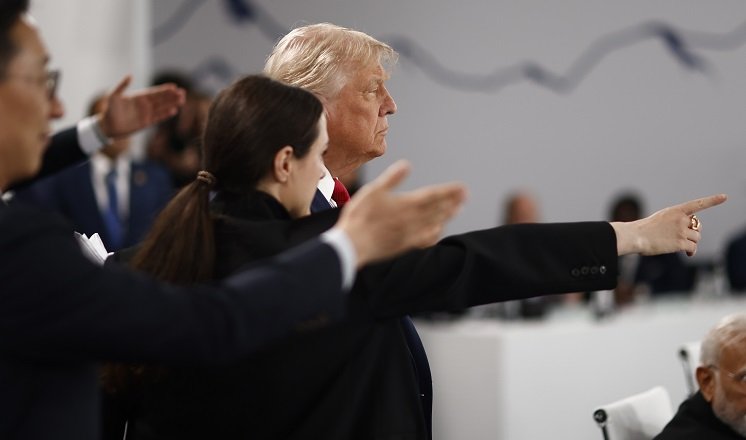
Trump, on the other hand, used the G7 stage to show his dominant position among Western leaders. At a meeting on global economic security, he told attendees, “I’m the boss,” a comment that was spoken in a joking tone but reflected reality. Although the G7 formally functions as a club of the most developed democracies, the pace of talks on Ukraine, Iran, energy and economic security largely depends on how far Washington is willing to go.
In parallel with Ukraine, the second major pillar of the summit was Iran. The G7 leaders welcomed the preliminary peace agreement between the US and Iran, which Trump signed before the summit, and announced that they are ready to help implement it. The deal reopens the Strait of Hormuz and reaffirms Iran’s position that the country does not want nuclear weapons, but leaves unresolved key issues, including the fate of highly enriched uranium, ballistic missiles and Tehran’s support for allied armed groups in the region.
Tehran does not farm Europe
The G7 joint statement called for a broader supplementary deal with Iran that would cover its missile program and regional activities. Such an approach is likely to be rejected by Tehran, which has so far negotiated directly with the US and sees Europe as a marginal actor. Trump may present the deal as a diplomatic victory, but European leaders apparently believe the memorandum is too narrow to ensure long-term stability in the Middle East.
France and Britain are backing an independent defense initiative to escort merchant ships through the Strait of Hormuz to restore confidence in commercial shipping. But here too there are limitations – the mission would not have to be offensive and would practically depend on wider international acceptance, and perhaps on Iranian consent. Trump is not entirely convinced that such a mission is necessary.
The deal with Iran also gave the G7 an economic argument for new pressure on Russia. The leaders assessed that the reopening of the Strait of Hormuz creates a better moment to strengthen sanctions on the Russian military economy, especially in the oil and gas sector. If global energy flows stabilize, Western countries have more room to hit the Russian energy machinery without immediately causing a market shock.
Fear of a new “Chinese shock”
The third major topic of the summit was economic security, especially critical minerals and dependence on China. France is pushing for a declaration that would help the West reduce its dependence on Chinese supply chains and protect investors from dumping and countermeasures. China has already roiled the global economy with restrictions on exports of rare earths and materials critical to industry, technology and defense.
However, here too unity is easier on paper than in practice. The United States has proposed a trade bloc for critical minerals, but partners disagree on how that model would work, especially as the White House pursues an “America First” policy.
Europe, at the same time, faces a growing trade deficit with China and the fear of a new “China shock”, this time not only in cheap products, but also in advanced industries.
In sum, the G7 summit sent a strong political message, but left more questions open than it closed.