June 17, 2026 at – 22:13
The president of the Paraguayan Industrial Union (UIP), Enrique Duarte, expressed his concern about the Government’s intention to double the readjustment of the minimum wage based on the CPI of 2.4%. The business union maintains that the measure breaks current rules, affects economic predictability and could generate higher costs for companies.
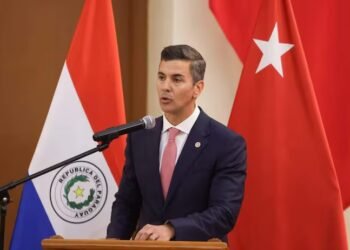
The announcement of the President of the Republic, Santiago Penato apply a readjustment of the minimum wage higher than the percentage of the Consumer Price Index (CPI) generated an immediate reaction from the business sector. The head of the Paraguayan Industrial Union (UIP), Enrique Duarte, stated that the measure puts economic predictability at risk and contradicts the mechanism established by law for salary updating.
During an interview on the program Table with EVPDuarte pointed out that the approach of the Executive power causes him “sadness” and “anger“, considering that it deviates from the consensual rules that governed for almost a decade and that, according to him, contributed to strengthening the country’s credibility before investors and international organizations.

Read more: Union calls the 5% increase in the minimum wage a “scam”
They demand respect for the current rules
The leader recalled that in 2016 the article 255 of CLabor code to establish that the minimum wage is readjusted annually based on the interannual variation of the CPI at the end of May.
As he explained, this change was the product of an agreement between various sectors and made it possible to provide predictability to the salary system. He added that the only exception occurred in 2020, during the covid-19 pandemicwhen it was resolved by consensus to suspend the adjustment due to the economic crisis.
“What the law says is clear. If we want to do something different, let’s sit down and talk“, said Duarte when referring to the possibility of applying an increase higher than the inflation rate.
Read more: Minimum Wage: Conasam does not agree on a percentage and submits a report to the Executive
Fear of economic impact
The president of the UIP insisted that the discussion is not about determining whether the increase is fair or insufficient, but rather about respect for current regulations and economic variables that serve as a basis for making business decisions.
He indicated that the unions presented technical studies to the National Council of Minimum Wages (Conasam)supported by official data from the Central Bank of Paraguay and other macroeconomic indicators. According to him, these analyzes warn of the effects that an indexation higher than that provided for in the legislation could generate.
Duarte maintained that a duplicate readjustment would not only affect the minimum wage, but also multiple costs linked to that parameter, generating additional pressures on companies and potential inflationary effects.
Read more: Minimum wage: opposition questions Peña’s “arbitrary” adjustment and asks for new parameters
They ask for dialogue with the Government
Despite the criticism, the head of the UIP affirmed that the private sector will keep the negotiation channels open with the Executive.
In that sense, he highlighted that President Peña has already demonstrated the ability to review government decisions, referring to recent changes related to decrees linked to the National Electricity Administration (ANDE).
“I will continue dialoguing and seeking consensus.. It’s not a whim. We fight so much for the credibility of the country, for the economy and for employment,” he said.
The businessman insisted that any measure aimed at improving workers’ income must be analyzed comprehensively, considering its effects on competitiveness, investment and the generation of jobs.
“The big winner must be employment”
Duarte affirmed that the debate should not be presented as a confrontation between workers and employers. In his opinion, the priority should be to find mechanisms that allow improve living conditions without deteriorating the business climate.
He maintained that Paraguay achieved important advances in macroeconomic stability, poverty reduction and investment attraction, achievements that, he indicated, should not be put at risk through decisions that alter previously agreed rules.
Finally, he stressed that the best tool to reduce the social gap continues to be the generation of formal, quality employment. “There don’t have to be winners or losers. The big winner has to be the economy and work”, he concluded.