Tuesday, June 2, 2026 10:09 pm –
Jerusalem time

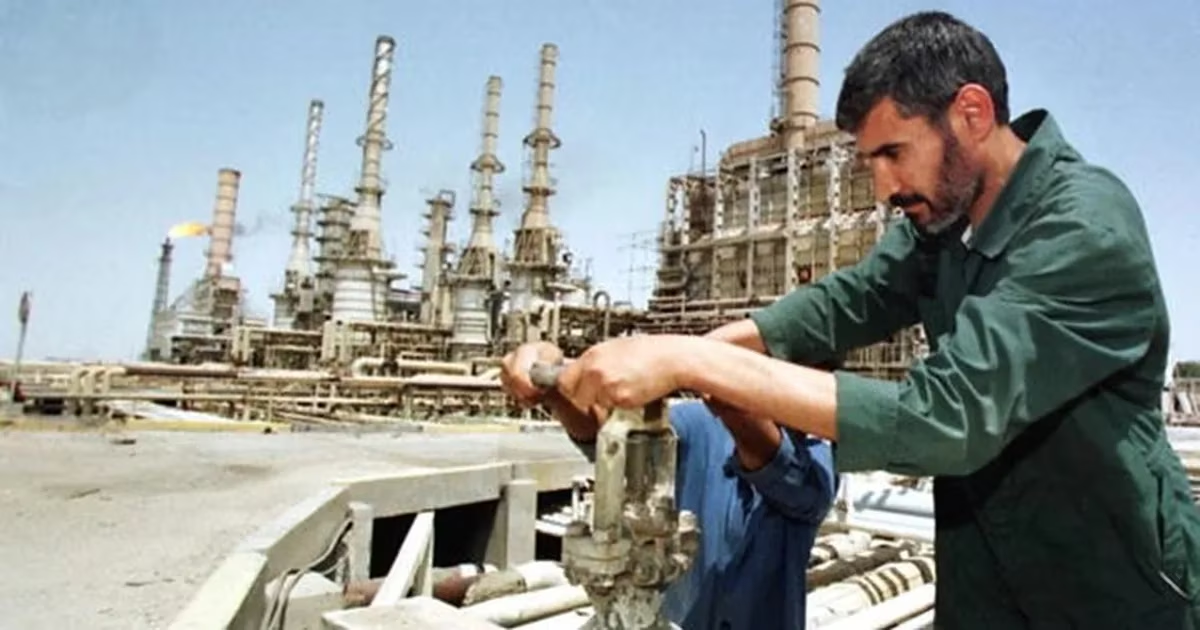
The Iraqi government approved a strategic plan aimed at creating a qualitative leap in crude oil export rates, as the Council of Ministers agreed to raise export quantities via pipelines to reach 770 thousand barrels per day instead of 220 thousand barrels. This plan is scheduled to be implemented in two phases, lasting about two and a half months, as part of Baghdad’s efforts to strengthen its financial resources and expand its logistical capabilities in the energy sector.
In parallel with pipeline transportation, the Iraqi authorities intend to increase the pace of exporting crude oil by trucks heading to neighboring countries, bringing the export capacity of this route to 420 thousand barrels per day. The government statement explained that this increase will take place in three successive stages, aiming in its entirety to diversify export outlets and reduce dependence on specific routes, ensuring greater flexibility in the face of global market fluctuations.
In a step that reflects the strengthening of regional cooperation, the Council approved a contract between the Ministry of Oil and the Syrian side to use the Syrian infrastructure in the operations of transporting, storing and handling Basra oil of various types. The agreement will include the export of light, medium and heavy crude through the ports of Baniyas and Tartous, located on the Mediterranean Sea, opening a new vital export window for Iraq towards Western markets.
Government decisions also included the start of procedures to open a representative office for the Iraqi Ministry of Oil within Syrian territory, to assume the duties of direct supervision and management of export operations through the new route. The Council of Ministers also granted broad financial and contractual powers to the Minister of Oil to accelerate the implementation of these plans, while directing the Oil Marketing Company (SOMO) to complete the necessary contracts to market additional quantities of crude.
The principle of competition must be adopted between private sector companies, without exceptions, to ensure the preservation of public money and the quality of projects.
At the level of administrative reform and oversight, Prime Minister Ali Faleh Al-Zaidi stressed during the session the need to adhere to standards of integrity and professionalism in the management of state institutions, directing a comprehensive re-evaluation of public managers. Al-Zaidi stressed that the government will not be complacent in preserving public money, pointing out that the criterion of efficiency is the decisive factor in evaluating government performance and investment opportunities, especially in the vital electricity sector.
Within the framework of international economic openness, the Council of Ministers approved the establishment of a joint business council between Iraq and Uzbekistan to enhance trade exchange and scientific and technical cooperation. The Council authorized the Minister of Commerce to negotiate and sign a comprehensive cooperation agreement covering the economic and cultural fields, in a way that serves the common interests of the two countries and opens new horizons for mutual investment in various sectors.
In conclusion, the decisions were not limited to the oil and commercial aspects, but rather included the legislative aspect through the approval of the draft first amendment to the law regulating the commercial agency. This project has been referred to the House of Representatives to complete the necessary legal procedures for its approval, in conjunction with directives to complete the operation of catalytic cracking units in national refineries in cooperation with specialized Japanese companies to raise the quality of local production.