First, a terminological confusion must be resolved. An Audi boss who has since resigned came up with the brilliant idea of renaming model series that had been well established for decades: the electric ones were given even numbers, the combustion engines were given odd numbers.
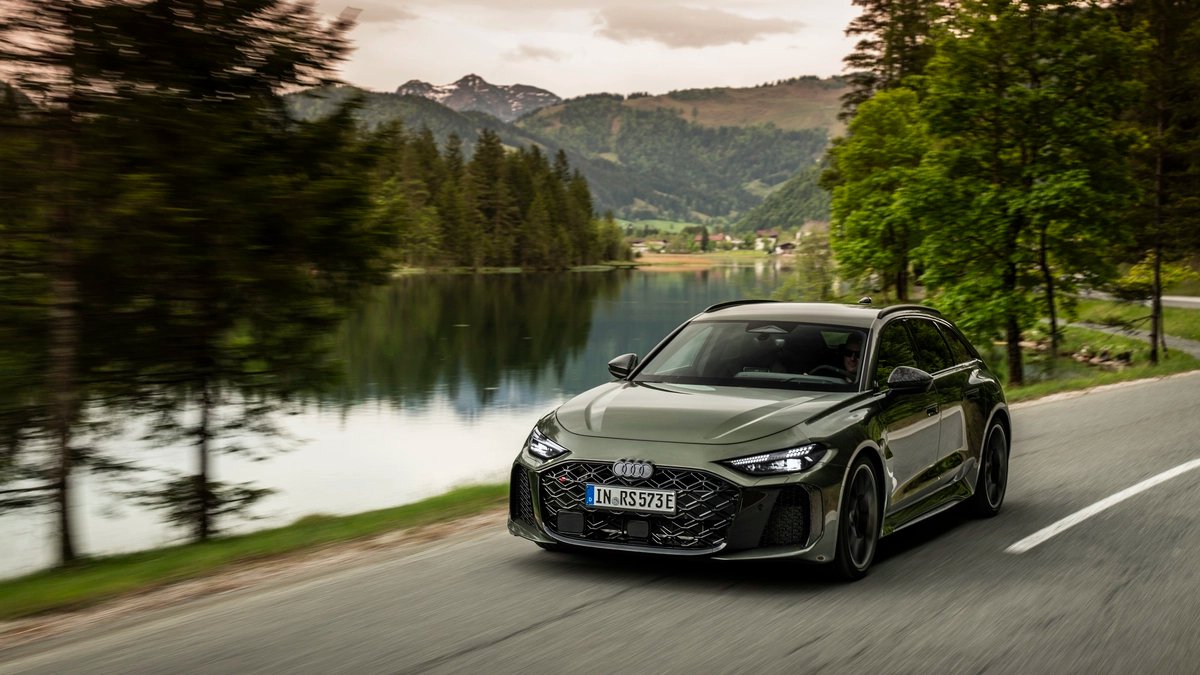
The maneuver has already been discontinued, but in the case of the A4/A5 it still has an effect, so that the new RS 5 is actually the successor to the RS 4, and is therefore available as a sedan and a station wagon. At Audi, the five was actually reserved for the (now discontinued) coupe.
You don’t have to understand it, and it’s not an issue for Audi connoisseurs anyway, because of course they know that. Word has certainly already gotten around that the new RS 5 generation is celebrating the series premiere of a plug-in hybrid.
For the Rabiat labels from Audi (RS), BMW (M) and Mercedes (AMG), PHEV has now become the standard solution for producing powerful horsepower, at least on paper, without CO2-To be able to represent excess. Where, like in Austria with the NoVA, violent CO2If penalties threaten, the tax-advantaged PHEV shows the way out.
The downside is the considerable additional weight that this entails, which is especially true in a very sporty car. weighs all the more heavily. So to get to the point, the curb weight of the RS 5, with a few extras, comes close to two and a half tons, which would otherwise be more in the range of large SUVs. Compared to the RS 4 as its predecessor, that’s an increase of 620 kilograms.
Not necessarily what the engineers dreamed of; after all, they did a lot for it perceived weight to lower. This also includes the huge 420 mm brake discs on the front wheels, as well as all sorts of chassis alchemy, but above all a newly developed quattro rear axle drive that converts torque electromechanically between the left and right wheels. Involved: a high-voltage actuator that produces eight kW and 40 Nm, a mechanical superposition gear and a classic differential.

Factory
Unlike a torque splitter, which is only effective under tension, i.e. when accelerating, the system also works without drive torque, for example when braking. With the effect that the rear axle is more agilely involved in the action and allows for more, better controllable lateral dynamics.
The best way to explore what the system really brings is on a wild drift handling course, for which a set of tires would of course also have to be taken into account. All that can be reported from the first test kilometers on public roads is that the car is literally hungry for curves, which it then clings to, but the weight takes its toll again when you brake sharply – you quickly find yourself in severe understeer because, in the deceptive confidence, you set the braking point too late, at least for clean turning.
We don’t even know whether customers are really that interested in lateral dynamic details. There won’t be any complaints straight away, as the powerfully boosting electric motor in the eight-speed gearbox helps.

No shortage of display space: home cinema atmosphere in the RS 5 cockpit. At the rear there are two stovepipes and a sporty cargo space due to the battery.
The 400-volt battery with a capacity of 22 kWh is located where there was still room: in the rear under the luggage compartment, which naturally reduces the space. You have to see it in a sporty way. The fact that there is no quick charging function and the AC charging power is limited to eleven kW points to the wallbox at home or in the office, rather than long distances, where it can’t be used. However, the extremely small tank, which only holds 48 liters, could be a calamity.
Real engine noise and artificial humming sound alternate; If the 2.9-liter V6 developed by Audi with an impressive 510 hp peak output is silent, the electric motor is in use in solo operation. Its range is around 80 kilometers, provided you don’t exceed the top speed of 140 km/h.
Audi RS 5 Avant
Mass: L/W/H 4896/2099/1446 mm. Wheelbase 2906 mm. Trunk 361-1302 liters. Curb weight (EU) 2445 kg.
Drive: Plug-in hybrid petrol/electric. V6 cylinder turbo, 2894 cc. Max. 375 kW (510 HP) at 6300 rpm. Max. 600 Nm. Li-Io battery 22 kWh net. System max. 470 kW. 0-100 in 3.6 seconds. Vmax 250 km/h.
Price: from 110,500 euros