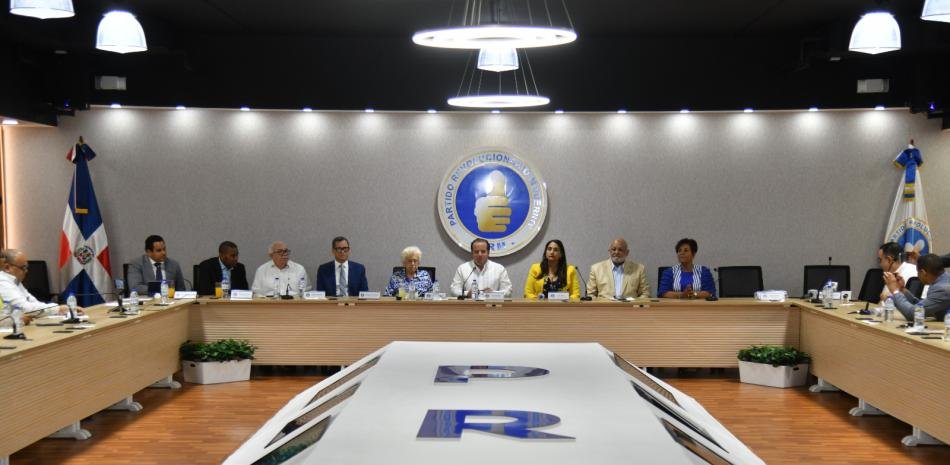
The Modern Revolutionary Party (PRM) called a meeting of its national committee where the method of electing the authorities of the political organization for the next four years will be decided.
The call to the national committee, scheduled for Sunday, June 21, arises in the midst of a process of renewal of the PRM guidelines that has generated widespread disagreement and rejection from its bases.
These first signs of rejection occurred during the first quarter of this year, when the leadership promoted the “consensus” method for the selection of the new municipal, local and provincial authorities, in search of preventing these contests from generating friction, which caused the opposite effect, after being rejected by multiple leaders of the party, from members of the base committee to deputies.
This broad rejection caused the PRM leadership to propose the extension of the national leadership of the ruling party until 2027 and 2028; proposal that was made official on May 15, indicating that the current economic situation of the country, produced by the crisis in the Middle East, pointing out that given by the political organization is that militancy must “remain focused” on the tasks of Government, on the institutional stability of the country and on “fulfillment of the commitments assumed with Dominican society, within the political and electoral context for 2028.”
Reform to the statutes
Through a statement, the ruling party indicated that during that meeting the date on which the so-called “Extraordinary National Convention” will be convened will also be decided to hear, approve and reject the proposal to modify its statutes.
The ruling party had indicated on May 27; through a statement where they indicated that the purpose of the initiative is “seeks to guarantee a participatory, orderly and representative reform”, without specifying which articles would be modified.
Although that was the official reason, the change proposal was made just 12 days later where the extension of the period of José Ignacio Paliza (party president), Carolina Mejía (general secretary) in charge of their respective positions, in addition to all other management positions at the national level, was proposed.
If that is the main purpose of the reform to its internal regulations, the changes would have to be executed both in article 152 of the same, which indicates that the duration of the PRM authorities at the national, local and foreign levels will be four years; as in 21, which states that only due to an extreme cause of force majeure, duly justified and recognized and approved by the Executive Directorate, the Ordinary National Convention may not be held on the corresponding date and that once the Ordinary National Convention is postponed, the National Internal Elections Commission will have a single period of up to 45 days to hold it.
Precisely one week before the meeting of the national committee, this Sunday, June 14, the commission appointed by the executive leadership of that political entity (composed of Guido Gómez Mazara, Roberto Fulcar, Darío Castillo, Sigmund Freund, Dionicio De Los Santos, Yadira Henríquez and Salvador Ramos) must present the report on what specific changes will be made to the statutes.
Another item on the agenda
The other task scheduled for the PRM national committee is to determine the date to convene the Ordinary National Convention, which in turn will be in charge of deciding when the conventional process will begin to elect management positions at all organic levels in the country and abroad and the day on which the Ordinary National Assembly of Delegates will be held, to proclaim the elected leaders at all organic levels in the country and abroad.
Who makes up the national committee?
The PRM national committee is made up of its president, vice presidents, general secretary, general undersecretaries, members of the executive management (including president Luis Abinader and vice president Raquel Peña), who are part of the Internal Elections, Ethics and Discipline, Statutory Reform Commission, and National Strategy commissions.
In the same way are the national secretaries, the national prosecutor, the directors of permanent departments, the presidents of the sectoral fronts, the president and general secretary of each of the provinces, the presidents of the municipal districts, constituencies and sections outside the country; in addition to the provincial liaisons of each of the national secretaries.
All party leaders who hold elective positions are also members of the committee, with the exception of councilors and members (senators, deputies, mayors and directors of municipal boards).