In the era in which, after the death of God, the attribute of omnipotence has been transferred to the human being (in particular to the male), the word tends to become a real weapon: of attack, preventive perhaps, even before defense.
We are no longer capable of dialogue. On the one hand because we cannot stand silence, which puts us before ourselves even before others, and is the necessary condition for listening. Contrary to what seems obvious, the first move of communication is listening, where silence sets up the space for meeting rather than confrontation.
Women are facilitated in this, because they are better trained to listen to the signals of their own body, or to perceive those of the creatures they have carried or are carrying in their womb. And this is not an “essentialist” discussion but simply a “situated” one, given that we exist in the body.
The second reason depends on radical individualism, this abstraction (in the literal sense, which “pulls us out” of the relationships that constitute us) which permeates the culture, or rather the dominant ideology. Where even science, from biology to quantum physics, tells us that everything is connected, we continue to think, even our freedom, in terms of separation: and, what is worse, in terms of the sovereignty of the self. Although even Hannah Arendt declared that the greatest mistake of political philosophy was to superimpose freedom and sovereignty, we continue to think in these doubly fallacious terms: the self, a separate individual, is sovereign. But the language of sovereignty is war, the clash between sovereignty. And this is both at the level of interpersonal relationships and at that of geopolitics. Within this framework, dialogue can only be polarized, warlike, aimed at destroying or delegitimizing the other rather than understanding him. Today, with digital, we think that artificial intelligence can resolve disputes, given that we are no longer capable of reaching an agreement. The dream of the philosopher and mathematician Leibniz comes true, who at the beginning of the 18th century declared «a day will come when we will no longer say “let’s discuss”, but “let’s calculate”!». And in fact Google invented the “Habermas machine”, named after the great philosopher who recently passed away who dedicated his work to the study of communicative rationality; and he would not be at all happy to see that what is most truly human about us is delegated to a device.
Should we resign ourselves? Absolutely not. Where to start again? Unarmed words can be a good start.
Disarmament is never a surrender but a subversion of the action/reaction scheme, destined for an escalation that always leaves dead and wounded on the field. It is the proposal, embodied in a gesture and not just in a program, that inaugurates a new relational framework. It takes courage to refuse weapons. But also a sense of limits, without which delusions of omnipotence spread with their harmful effects. Because the omnipotent sovereign self cannot help but be violent.
The most disarmed word of all is prayer. Which arises precisely, as the very root of the word reveals, from our sense of precariousness, from non-self-sufficiency, from the sense of our fragility, from the need not so much to ask but to trust. And maybe even simply to say thank you: let’s think about the song of Magnificat and to the power that arises not from strength but from “deposition”, from the acceptance of one’s own limitations which is however accompanied by an attitude of active availability and responsibility.
Because between the arrogance of power and the anguish of impotence there is a third way that rejects any dualism: that of deposition, precisely. A form taken from the Latin language, where some verbs (coincidentally the most existentially relevant ones: nascor, morior, experior, loquor…) have a passive form and an active meaning, indicating the essential mix of activity and passivity, choice and acceptance that characterizes our life as humans. The word disarmed is deponent.
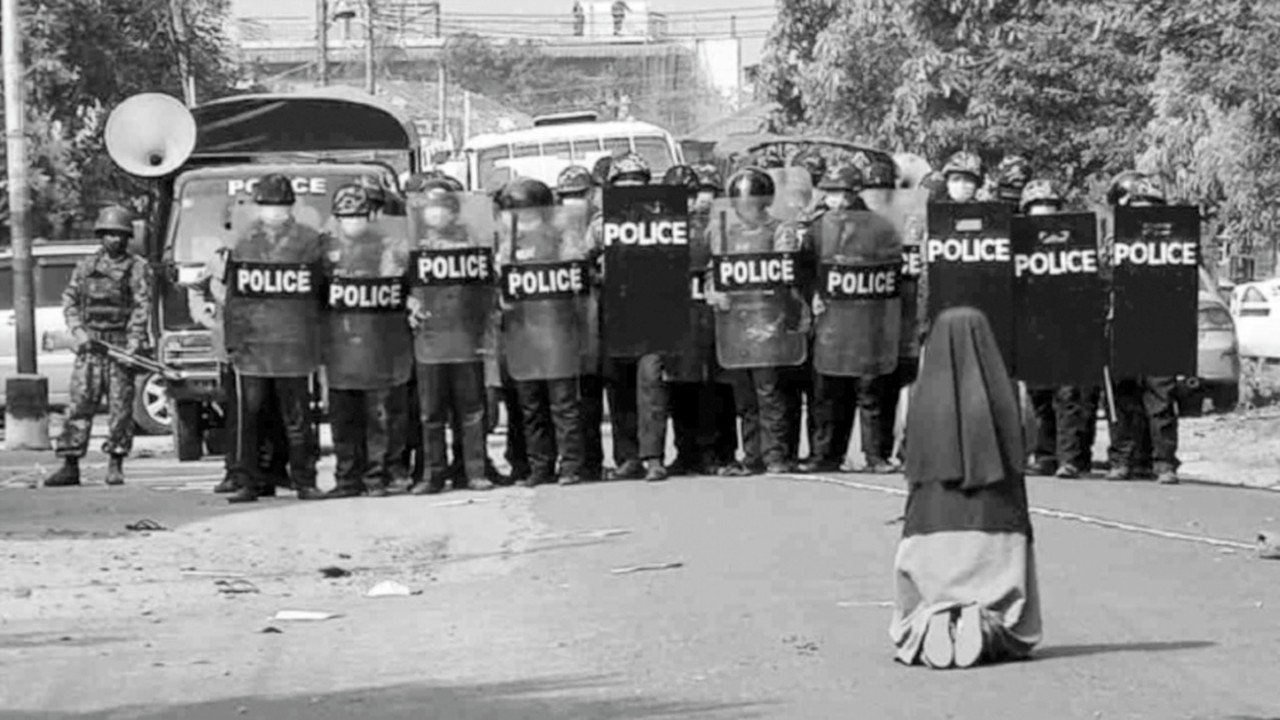
Disarmament is not docility, supine acceptance, but the ability to act differently, to break the pattern of abuse. Disarmament means kneeling before soldiers who are armed and ready to shoot. A gesture that is not a challenge, but an invitation to abandon violence, sacralizing the value of life, at the cost of losing it.
Disarmed is the poetic word which, as the poet Mahmud Darwish writes, tells the truth without proclaiming it. Without imposing it, without claiming to possess it.
Disarmed is the word that accepts a part of opacity and mystery, which prefers to allude rather than define, which recognizes that there is always more than what we can say. Today language, aping that of science, demands instead of. possess reality in transparency, in the dominion of what by definition always escapes. The ideal of language today is datafication, the translation (and reduction) of everything that exists into a language that allows us to control and manipulate reality (and people).
The disarmed word is that of hope, which does not say “everything will be fine”, but “it is worth committing”, to say yes, regardless of the result.
The disarmed word blossoms only on the terrain of brotherhood and sisterhood. From the awareness that we are all in relationship and that «Every word we give to the world / is written on someone’s flesh» (Francesca Mannocchi).
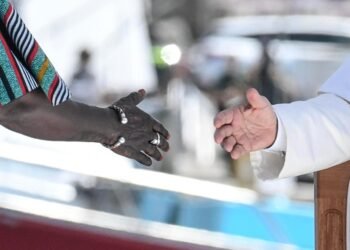
The word disarmed disarms, invites us to abandon the conflict to embrace the encounter, and it does so by setting an example, taking the risk, making the gesture and what motivates it sacred.
Those of Simone Weil, Madeleine Delbrel, Etty Hillesum but also Margherita Guidacci, Mariangela Gualtieri, Chandra Livia Candiani and many other women who have captured the essential and offered it in words that touch the heart are disarmed words.
The word disarmed exposes the violence of those who need weapons to assert themselves, but does so by rejecting the winners and losers scheme, to indicate the path of common humanity.
by Chiara Giaccardi