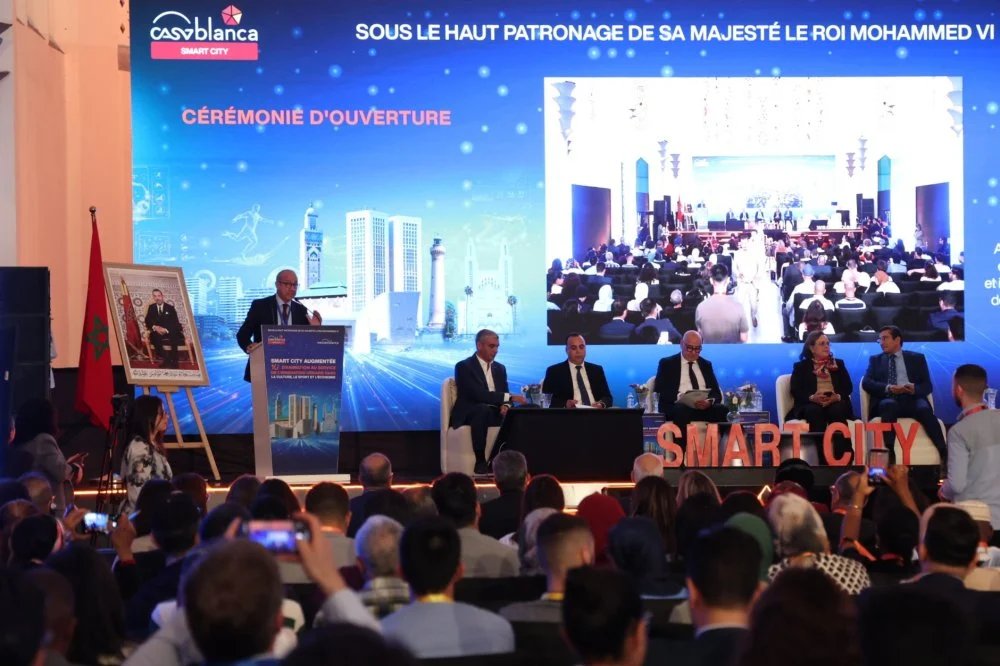
Ten years ago, when Casablanca launched its Smart City initiative, generative artificial intelligence did not yet exist in the public debate, urban digital twins were more prospective than reality, and the very notion of an “augmented city” remained marginal. Ten years later, the Moroccan metropolis claims a pioneering role in African reflection on the future of cities. Gathered in Casablanca on the occasion of the 10th edition of Casablanca Smart City, public officials, academics, researchers, entrepreneurs and international experts outlined the contours of a new stage: that of a city augmented by artificial intelligence, data, immersive technologies and digital platforms, without renouncing its identity or its human dimension.
Artificial intelligence as a new urban horizon
But behind the technological enthusiasm, several speakers called for caution. Hassan Redouane, speaking on behalf of the president of the Mohammed VI Polytechnic University, Hicham El Habti, delivered one of the most noted reflections of the morning. For him, the question is no longer just how to augment the city through technology, but what this transformation risks causing to disappear. “What do we risk losing when the city becomes augmented?” he asked himself. The university official warned against an exclusively algorithmic vision of the city. “A city is neither limited to its data nor its algorithms,” he insisted, pleading for a connection between technological innovation and the preservation of collective memory. According to him, the real challenge consists of “combining innovation and identity, performance and meaning, technology and community”.
This concern was echoed by several other speakers. The president of the Hassan II University of Casablanca, Houssine Azeddoug, also defended a humanist vision of the smart city. “The smart city is not just a city equipped with technology. It is above all a city that places people at the heart of its development,” he said. For the academic, the major urban challenges can only be met through “a mobilization of knowledge, action and collective intelligence”.
Singapore’s view: technology serving citizens
Guest of honor for this edition, the Singaporean Minister of Social and Family Development, Masagos Zulkifli, provided particularly awaited international insight. Singapore is often cited as one of the world’s models for urban digital transformation. However, the minister chose to move the debate. “The true measure of a smart city lies not in the sophistication of its technologies, but in the quality of life it offers its inhabitants,” he told the participants. The Singaporean official described his country’s progress in digital public services: dematerialized administrative procedures, predictive infrastructure management, automated border controls and even intelligent maintenance of urban equipment. But he insisted that the aim remained social. “A smart city must be felt in the daily life of every family,” he explained, referring to young people as well as the elderly and vulnerable populations. Masagos Zulkifli also paid tribute to Moroccan researcher Awatif Hayar, believing that certain reflections developed in Morocco on artificial intelligence had preceded debates that are now widely spread internationally. “Wisdom and vision do not belong to any country. We have a lot to learn from each other,” he said.
Casablanca wants to become an African laboratory
For Djilali Lahiani, deputy mayor of Toulouse, cities will have to simultaneously address climatic, technological and social challenges. Cooperation between metropolises therefore becomes an essential lever. This same conviction drives Moroccan university leaders, who see research, innovation and student entrepreneurship as drivers of urban transformation. Through its laboratories, incubators and support programs, Hassan II University claims to support several hundred students each year in their entrepreneurial projects. Thus, while Casablanca prepares for the major international events of the coming decade, its promoters now hope to make the metropolis a model capable of reconciling economic power, technological innovation and human development. A complex equation, but which undoubtedly sums up the real challenge of the “augmented city”.
It now remains to be seen whether the ambitions displayed during this 10th edition can be translated into the daily lives of Casablancans. Because if artificial intelligence, digital twins or intelligent platforms open up new perspectives, residents continue to face very real challenges: endless traffic jams, mobility difficulties, disparities between neighborhoods and pressure on public services. Ten years after the first promises of the Smart City, the real test will undoubtedly come neither in laboratories nor in international conferences, but in Casablanca’s capacity to make the city more fluid, more inclusive and more livable for those who live there on a daily basis.