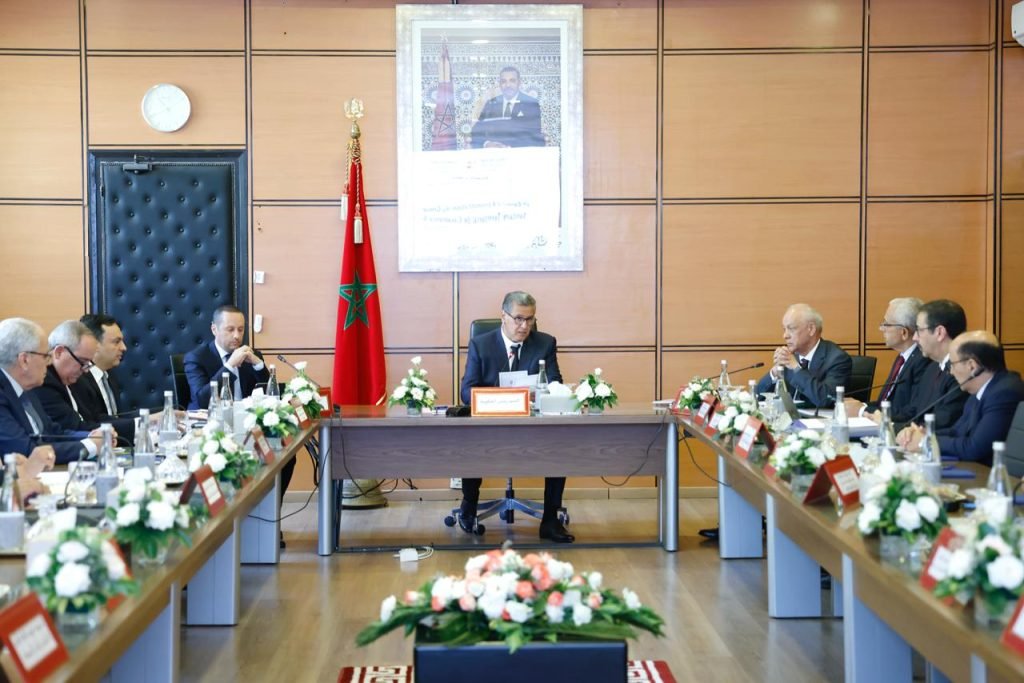
The Head of Government, Aziz Akhannouch, chaired, Wednesday June 10, 2026 in Casablanca, the work of the first Board of Directors of the Territorial Health Group of the Casablanca-Settat Region, the sixth of its kind at the national level, after the holding of the Boards of Directors of the GST of the Regions of Tangier-Tétouan-Al Hoceima, Rabat-Salé-Kénitra, Souss-Massa, Laayoune- Sakia Al Hamra and the Fez-Meknes Region, as part of the continued implementation of the reform of the national health system and the generalization of the model of Territorial Health Groups across all Regions of the Kingdom, in accordance with the High Royal Directives.
The Head of Government underlined during this meeting that the holding of this Council is part of the implementation of the High Royal Directives aimed at establishing a more local health system, offering better quality of services and guaranteeing greater equity. He affirmed that the strengthening of regional governance of the health sector constitutes a strategic choice for the government and an essential foundation of the reform of the national health system, so as to support the work of generalization of social protection and global medical coverage.
The head of government noted in this regard that this Board of Directors does not constitute just a formal station allowing the adoption of resolutions, but a moment of strategic orientation aimed at establishing the Casablanca-Settat Region as a model for the implementation on the ground of health reform, to make the University Hospital Center a vector of development and to establish the proximity of health provision as an effective right of the citizen and spatial equity as a fundamental criterion of success.
During this meeting, the action program of the Territorial Health Group, the draft budget for the 2026 financial year, as well as the draft resolutions necessary to launch the Group’s activities were presented and debated. All of these projects have been adopted, which lays the practical foundations for integrated regional management of health care provision, based on planning, coordination and improvement in the quality of care for citizens.
The group’s action program is based on establishing the foundations of efficient regional governance, supervising the transition period, continuing to upgrade health infrastructure, organizing care pathways, strengthening complementarity between primary health care establishments and provincial and regional hospitals and the University Hospital Center, in a way that allows the improvement of the patient’s care pathway and the rapprochement of health services for citizens.
The meeting was also an opportunity to emphasize the central role of the Ibn Rochd University Hospital Center in Casablanca, as a national reference institution in terms of specialized and high specialization care, as well as a major space for training, scientific research and medical innovation, and to underline the need to support this role by developing the university hospital offer at the regional level, in line with the needs and expectations of the population.
The Council noted the importance of initiating the project of the new Casablanca university hospital complex, in order to strengthen the public provision of care in the Casablanca-Settat region, improve access to health services and raise the quality of care for citizens.
He underlined the structuring nature of the future University Hospital Center of Casablanca, as a project likely to strengthen the public offer of standard care, to increase reception capacity and to respond in a sustainable manner to the evolving health pressure in the Casablanca-Settat Region.
The importance of human health resources was also underlined, as an essential foundation for the success of this transition, through the mobilization of medical, nursing and administrative skills, the improvement of working conditions and the strengthening of training, in the sense of effective support for the needs of health establishments within the Region.
Emphasis was also placed on the central role of primary health care establishments in the new model, as the first point of access to the health system, an essential lever for prevention, early diagnosis and monitoring of chronic diseases and the establishment of family medicine, which makes it possible to ease the pressure on hospitals and bring services closer to citizens.
The importance of supporting this project through the digital transition was also underlined, as a lever for simplifying procedures, improving coordination between health establishments and facilitating the care pathway for patients within the Region.
The Casablanca-Settat Region is of particular importance in this national project in view of its demographic and strategic dimension, with more than 7 million and 688 thousand inhabitants, or 21% of the population of the Kingdom, with a high rate of urbanization and increasing pressure on health services, particularly at the level of major and reference hospital establishments.
The Region has a significant public health offering, with 376 primary health establishments and a network of university, regional, provincial and local hospitals with a capacity of some 4,943 beds. The weight of demand and the diversification of health needs at the regional level, however, require a transition towards management of greater coordination and efficiency, guaranteeing complementarity in terms of services between the different levels of care.
This meeting was attended by the Minister of Health and Social Protection, the Minister of Economic Inclusion, Small Business, Employment and Skills, the Minister of Higher Education, Scientific Research and Innovation, the Minister Delegate in charge of the National Defense Administration, the Wali of the Casablanca-Settat Region, the President of the Council of the Casablanca-Settat Region, the General Director of the Territorial Health Group of the Casablanca-Settat Region, and the General Director of the National Social Security Fund.