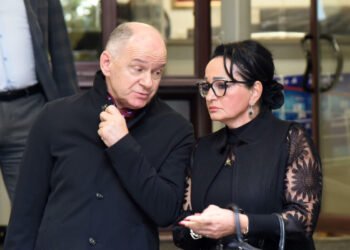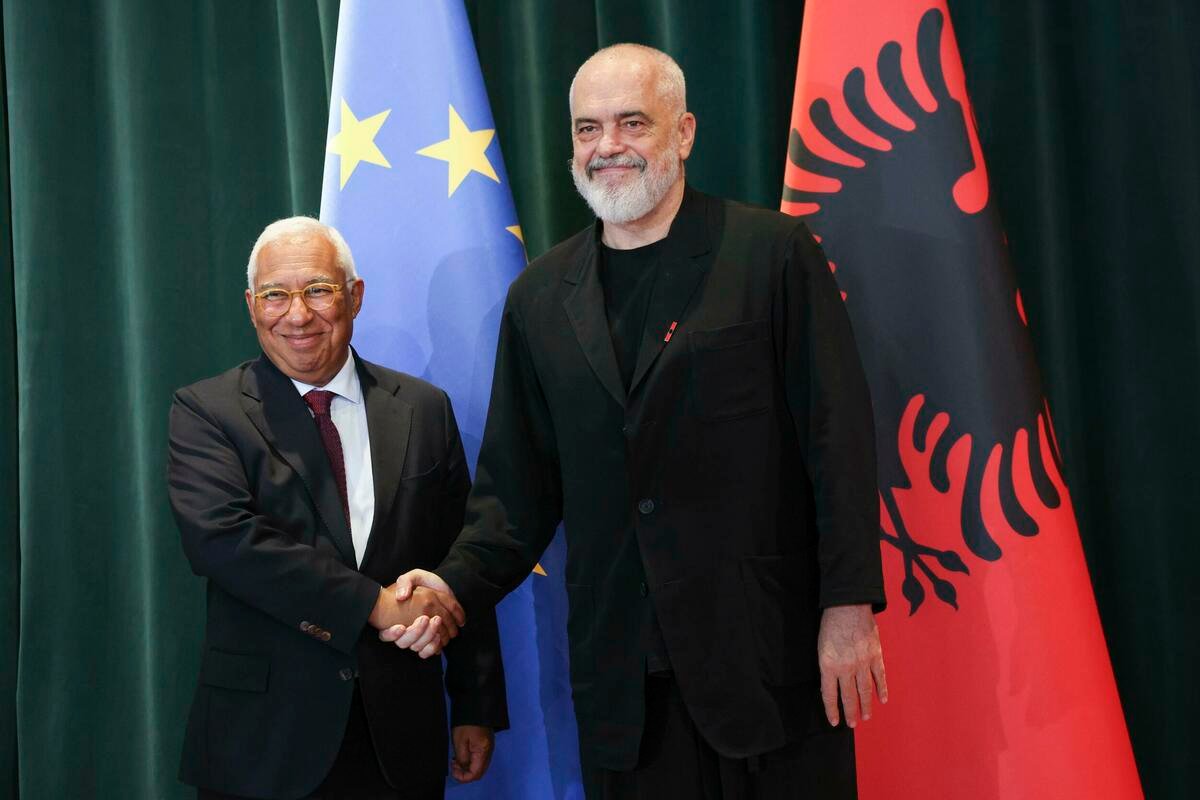

Košta and Rama in Tirana, Photo: BETAPHOTO
The President of the European Council, Antonio Košta, said today in Tirana that the European Union is the most reliable partner, the biggest investor and the main trade partner of the Western Balkans and Albania, and praised Albania’s determination and efforts to join the EU.
At the press conference with Albanian Prime Minister Edi Ram, Košta reminded that last week at the eighth conference on Albania’s accession to the EU, its progress was confirmed and that it met the temporary goals of negotiation cluster 1 – basics, Beta agency reported.
“Continuous, visible political commitment to the rule of law and ensuring an independent and accountable judiciary is a key foundation for EU membership. I encourage you to step up your efforts in the fight against corruption and organized crime,” Košta said.
The President of the European Council pointed out that EU membership is more than just entering the single market, it was announced on the website of the European Council.
“It means joining a political community built on common values, which shares a common strategic choice. Through resilient institutions and strong economic ties, the European Union has created lasting peace and stability for its members,” Košta said.
“Enlargement offers the same opportunities to our neighbors in Europe, such as Albania,” said Košta.
He added that in times of global geopolitical and economic uncertainty, “the expansion and geostrategic need of Europe” is because it is “an investment in the peace, stability and security of the continent”.
The EU-Western Balkans summit on Friday in Tivat “will be a clear demonstration of our determination to improve our cooperation and to take advantage of the acceleration in EU enlargement,” Košta said.
He started a multi-day tour of the Western Balkans yesterday in Bosnia and Herzegovina. Today he will travel from Tirana to Skopje, tomorrow to Pristina and on Thursday he will arrive in Belgrade. On Friday, he travels to Tivat for the EU-Western Balkans Summit.
Yesterday in Sarajevo, Košta said that his tour is a clear sign that the EU’s commitment to the Western Balkans is real. “As real as the opportunity to expand.”
Speaking about the election of a new international representative in BiH, he stated that BiH is no longer where it was in 1995 and that great progress has been made in that country.
“If the future of this country is in the EU, we will make it happen. It is important that the new high representative embodies the choice of BiH, that it strives for EU accession. We will continue to work together for the European future,” he said.
European ministers in Sarajevo ahead of the PIC session
The French and German ministers for Europe, Benjamin Adad and Gunter Krichbaum, arrived in Sarajevo, where they held a meeting with members of the Presidency of Bosnia and Herzegovina (BiH) today.
They arrived in the capital of BiH ahead of the session of the Council for the Implementation of Peace in BiH (PIC), whose Steering Committee should elect a new high representative in BiH at the session tomorrow and the day after tomorrow.
On the eve of his visit to Sarajevo, Adad announced on the X social network that Europe “cannot allow rival powers to interfere in our neighborhood in order to encourage instability.”
Stephen Doughty, British Minister for Europe, North America and Overseas Territories of Great Britain, also arrived in Sarajevo yesterday.
The Ministry of Foreign Affairs of Bosnia and Herzegovina announced after that meeting that Doughty reiterated Great Britain’s strong support for the full mandate and powers of the Office of the High Representative (OHR) in Bosnia and Herzegovina.
The Italian Antonio Zanardi Landi is mentioned as a possible new representative in BiH, who, as the media announced, has the support of the USA in addition to his home country.
The USA proposed its candidate William Ruger, while, according to the Sarajevo media, France nominated René Trokaz, who has the support of Great Britain and possibly Germany.
Germany, France and Great Britain, as previously announced, want to keep the existing model, which retains the “Bonn powers” of the high representative, i.e. the right to impose decisions, laws and replace elected officials in case of violations of the Dayton Agreement or blockades of institutions in Bosnia and Herzegovina.
The USA, on the other hand, advocates a gradual reduction of the interventionist role of the OHR and greater reliance on domestic leaders and institutions.
The previous high representative, Christian Schmidt, resigned from that position, and, according to the media, he did so under pressure from the US, because he did not resolve the issue of state property in Bosnia and Herzegovina, which even threatened to put him on the American “black list”.
Download the application and follow the news


FOLLOW US ON

News