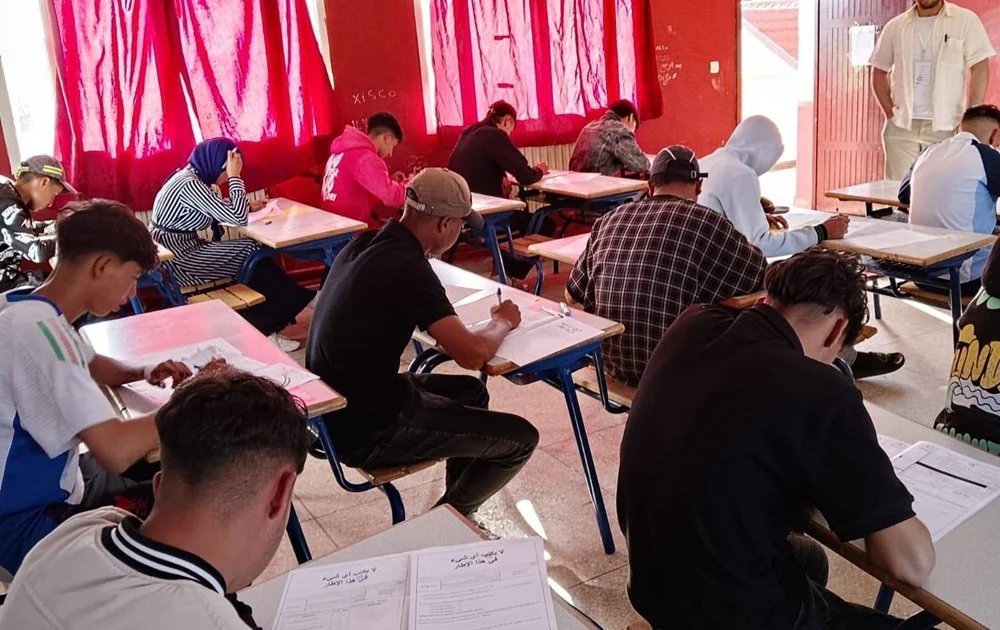
Nearly 520,000 candidates are registered for the session of baccalaureate 2026including around 420,000 school students and 100,000 independent candidates, according to data communicated by the Ministry of National Education. This number marks an increase of around 25,000 candidates compared to the previous year.
THE tests begin this Thursday, June 4 in a meteorological context marked by high temperatures in several regions of the country, a situation which raises concerns about the conditions of the examination and their effects on the performance of the candidates.
Dr Tayeb Hamdidoctor and researcher in health policies and systems, warns of what he describes as a “double health and educational penalty”, linked to the overlapping of examinations and heatwave episodes. He believes that these conditions can directly impair students’ cognitive abilities. According to him, “the brain is saturated with its thermoregulatory efforts to remove heat from the body, which reduces working memory, concentration and processing speed.” He adds that hot nights, when they exceed certain thresholds, lead to a “sleep debt” that can affect recovery between events.
The specialist also mentions medical risks including dehydration, headache, hypotension and, in extreme cases, heatstroke, considered a medical emergency.
On the organizational level, he insists on the question of fairnessestimating that territorial inequalities are accentuated by climatic conditions, depending on the exposure of establishments and the quality of infrastructure.
Recommended measures to deal with heat
Dr Tayeb Hamdi offers a set of recommendations aimed at reducing the health and cognitive effects linked to extreme heat during exam periods.
On the immediate level, he first insists on the importance of hydration and the care of students, with the provision of watermisting devices, as well as staff and first aid kits in the examination centers. It also recommends appropriate management of heat in rooms, based on blocking windows during the day, early ventilation in the morning and at the end of the night, as well as targeted use of fans. According to him, the latter would only be really effective when the temperature of the room remains below 35°C, beyond which their use could become counterproductive.
It also underlines the importance of home recovery conditionscalling for an organization of the living environment allowing candidates to sleep better and recover between tests, in order to limit the impact of thermal fatigue on performance.
In the longer term, its recommendations are part of an approach to public policy expanded, applicable not only to the baccalaureate but to all exams, competitions and teaching periods during heat episodes. He thus pleads for a modernization of school buildings oriented towards “summer comfort”, notably integrating the insulation of roofs, the installation of sunshades and the greening of spaces to promote evapotranspiration. He also mentions the need for a reform of the school calendar in order to adapt it to climatic constraintsregionalization of exam dates according to local specificities, as well as greater flexibility of schedules.