Doha – Nashat Amin:
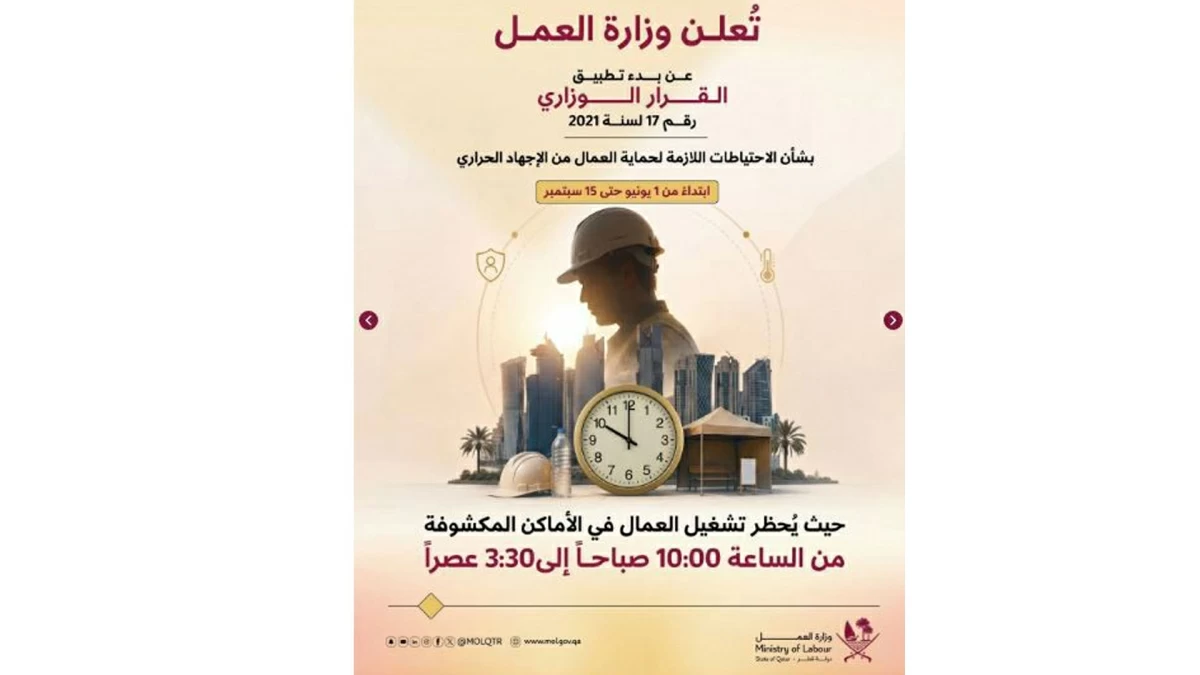
Experts, lawyers and businessmen have confirmed that the State of Qatar is one of the leading countries globally in the field of heat stress prevention through its launch of Ministerial Resolution No. (17) of 2021 regarding the necessary precautions to protect workers from heat stress, the provisions of which come into effect from June 1 to September 15 of each year, pointing out that the decision constituted a qualitative shift in the concept of worker protection from climate and occupational environmental risks.
They told Al-Raya that through this decision, Qatar placed human safety at the top of its priorities. By looking at the human being not merely as a “production tool,” but rather as an end worthy of protection and care. They pointed out that the ministerial decision was not limited to prohibiting work under direct sunlight, but rather adopted a broader concept of combating “heat stress” as an occupational hazard that may arise whether in shaded or closed places if temperatures and humidity rise to levels that threaten the worker’s health and safety.
They noted that the decision granted the worker the right to stop working and file a complaint if he found serious reason to believe that the working conditions constitute a danger to his health or safety, while prohibiting taking any disciplinary or discriminatory action against him for exercising this right, pointing out that violating the provisions of the decision exposes the facility to procedures that may amount to partial or complete closure of the work site, in addition to the possibility of civil or criminal liability if the violation results in injury to the worker or endangering his life.
Sheikh Ahmed bin Mohammed Al Thani: A qualitative shift in the concept of labor protection
Sheikh Ahmed bin Mohammed Al Thani, the lawyer, said that the State of Qatar has emerged as one of the pioneering countries in regulating this phenomenon legislatively, placing human safety at the top of its priorities. Man is not viewed as a mere “production tool,” but rather as an end worthy of protection and care.
He added: In this context, the State of Qatar issued Resolution No. (17) of 2021 regarding the necessary precautions to protect workers from heat stress, the seasonal provisions of which begin to apply from June 1 to September 15 of each year, as stated in Article 2, to constitute a qualitative shift in the concept of worker protection from climate and occupational environmental risks.
He continued: The evidence of the decision was not limited to prohibiting work under direct sunlight, but rather it adopted a broader concept of combating “heat stress” as an occupational hazard that may arise whether in shaded or closed places if temperatures and humidity rise to levels that threaten the worker’s health and safety.
He stated that one of the most prominent provisions of the decision is the ban on working in open, unshaded places during the period from ten in the morning (10:00) until three-thirty in the evening (3:30) for the duration of the decision’s validity. The decision also obligated employers to take a set of preventive measures, the most important of which is providing cold drinking water, shaded resting places, training workers to deal with heat stress, conducting periodic medical examinations, and monitoring temperature levels using the WBGT spherical wet bulb measurement system.
He noted that in addition, the decision granted the worker the right to stop working and file a complaint in accordance with Article 6 if he found serious reason to believe that the working conditions constitute a danger to his health or safety, while prohibiting any disciplinary or discriminatory action against him due to his exercise of this right.
He stressed that violating the provisions of the decision exposes the facility to procedures that may amount to partial or complete closure of the work site by decision of the competent minister, in addition to the possibility of civil or criminal liability if the violation results in injury to the worker or endangering his life.
D. Mohammed bin Saif Al Kuwari: Providing a safe and healthy work environment is consistent with Qatar Vision 2030
His Excellency Dr. Mohammed bin Saif Al Kuwari, Vice Chairman of the National Human Rights Committee, confirmed that the Committee continues to implement its annual awareness campaigns to prevent heat stress and protect workers’ rights, in cooperation and coordination with the Ministry of Labor, the Qatar Red Crescent, and a number of concerned authorities, with the aim of enhancing safe work environments and raising the level of awareness of the dangers of heat stress during the summer.
He pointed out that the National Human Rights Committee carried out many field visits to various work sites, and distributed awareness leaflets and booklets in multiple languages, including Urdu, Filipino and other languages, to ensure that awareness messages reach workers in their mother tongues and help them understand the laws, instructions and procedures related to occupational safety and health. Dr. pointed out: Al Kuwari pointed out that the Workers’ Support and Insurance Fund launched an initiative to appoint awareness ambassadors from the workers themselves, with the aim of contributing to disseminating the concepts of occupational health and safety among their colleagues in the workplace, in cooperation with the committee, the Ministry of Labor, the Qatar Red Crescent and various companies.
He explained that this initiative achieved tangible success in delivering awareness messages quickly and efficiently, due to the ability of these ambassadors to communicate directly with their colleagues in their different languages and in a manner appropriate to their cultures and work environments, which enhanced the level of awareness of the dangers of heat stress and ways to prevent it.
The Vice Chairman of the National Human Rights Committee stressed the importance of companies adhering to mandatory preventive measures to protect workers during the summer months, most notably providing free cold drinking water on an ongoing basis at work sites, in addition to providing drinks and liquids containing salts and minerals. He stated that the heat stress prevention campaign organized annually by the Ministry of Labor aims to reduce work-related injuries, ensure adherence to occupational safety and health standards approved locally and internationally, and provide a safe and healthy work environment for all workers in the country, in line with the Qatar National Vision 2030.
Jaber Al Marri: Strong commitment to the decision to ban working in open spaces
Businessman Jaber Al Marri confirmed that companies operating in various sectors are committed to implementing the decision to ban working in open spaces during the noon hours, noting that the decision represents one of the most prominent measures that reflects the interest of the State of Qatar in protecting workers and enhancing occupational health and safety standards. Al Marri said that companies adhere to the instructions issued by the Ministry of Labor regarding organizing work during the summer, pointing out that the prohibition rules are clear and known to everyone, especially with regard to prohibiting work under the sun during the specified hours of midday.
He explained that companies are keen to implement it to avoid violations and to preserve workers’ safety as well. He added that the competent authorities are continuously monitoring the implementation of the decision
He pointed out that the decision is not limited to contracting or construction companies only, but rather includes all work that requires the presence of the worker in open spaces and under direct sunlight, including some delivery activities using motorcycles.
D. Rashid Abudayyah: Legislative development in the philosophy of labor protection
saw d. Rashid Abudayyeh, the lawyer, said that Resolution No. (17) of 2021 is a legislative development in the philosophy of labor protection from “organizing effort” to “managing environmental risk” within the employment relationship. He explained that the legislator here did not deal with heat stress as an emergency health symptom, but rather as “expected structural risks” inherent to the nature of work in harsh climatic environments, which is clearly evident from the first article, which did not limit itself to the medical definition of heat stress, but rather expanded the concept to include the interaction of heat with humidity and physical effort, transforming the text from a linguistic definition into establishing a legal standard for determining liability.
He stated that in Article 2, the decision moves from the level of definition to the level of “preventive ban,” which is the most dangerous and strongest form of legal regulation, as it does not leave those addressed with the option of discretion or discretion, but rather stipulates a specific time frame in which it is prohibited to work in open environments.
As for Article Four, it represents the essence of the decision’s regulatory philosophy, as it did not limit itself to imposing general obligations, but rather established an integrated “preventive compliance system” based on four axes: planning, training, equipping, and medical monitoring. Most importantly, these obligations are not separate, but are legally interconnected, such that fulfilling one without the other is not sufficient to achieve true compliance. He said: The introduction of the WBGT standard into the same article clearly stands out here, which moves the regulation from the scope of administrative rules to the scope of “legally binding scientific standards.” The law is no longer satisfied with describing temperature, but rather measures it according to a complex scientific model, which makes the decision closer to an “operational risk management system” than to a mere regulatory regulation.