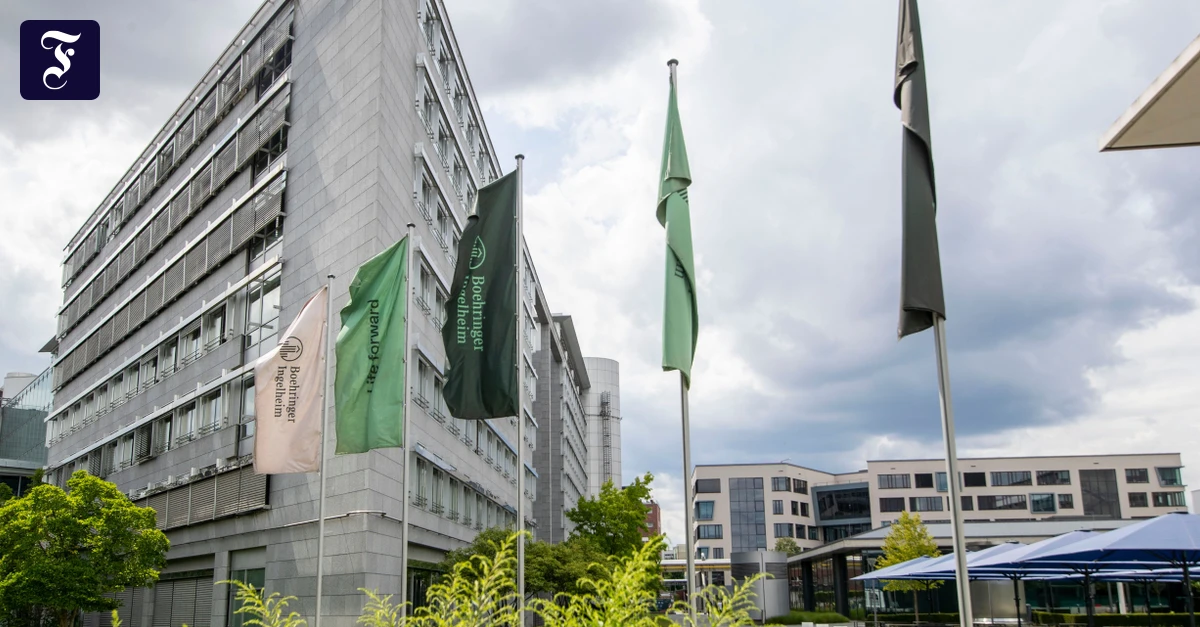
The family business Boehringer Ingelheim is drawing the first conclusions from the federal government’s planned austerity package to stabilize statutory health insurance companies. The pharmaceutical company from Rhineland-Palatinate is stopping planned investments amounting to 900 million euros in Germany. This became known on Wednesday, and a company spokesman confirmed it when asked by the FAZ. At the same time, he emphasized that no jobs were to be cut. The US pharmaceutical company Eli Lilly is even cutting half of its planned $2.3 billion investments in Germany.
At Boehringer, investments for the period 2027 to 2030 are affected, which should, among other things, flow into the expansion of laboratory buildings. “The money will now be invested in other locations,” said the spokesman. He didn’t want to say where exactly. Meanwhile, investments to maintain existing facilities in Germany continued. Boehringer informed the federal government of its decision.
US pricing policy puts pharmaceutical manufacturers under pressure
The GKV law, which sometimes provides for a dynamic manufacturer discount for pharmaceutical companies, i.e. a gradual increase in the discount that they have to grant health insurance companies on medicines, sends “completely wrong signals”. In addition, the pharmaceutical industry has already helped health insurance companies save around 29 billion euros last year. The measures also show that the government is not aware of the challenges facing pharmaceutical manufacturers.
A change in US policy is leading to drug prices rising USA wants to match the cheaper European prices, causing great uncertainty among manufacturers. They fear that the downward price pressure – as provided for by the GKV law – could simultaneously push down US prices. As a result, the launch of new drugs could shift entirely to the United States. A current study by the VFA shows that Germany is already missing out on one in three newly approved drugs in the USA.
“We find ourselves in a fundamentally changing global environment,” says Boehringer Ingelheim. “While markets such as the USA and China continue to expand their leading position in the research and development of innovative medicines, we see conditions in Europe deteriorating.” The head of Germany, Médard Schoenmaeckers, emphasizes: “As a company, we need political reliability and attractive local market conditions so that new investments in the future are worthwhile.” This is currently not the case in Germany.
Eli Lilly is also cutting investments
It is likely that other companies in the industry will follow suit and also cut investments in response to the austerity package. The US pharmaceutical company Eli Lilly also announced in the “Handelsblatt” on Wednesday afternoon that it would only invest half as much instead of the originally planned $2.3 billion that was supposed to flow into a high-tech factory for the production of slimming syringes in Alzey, Rhineland-Palatinate. This means that a significant proportion of the 1,000 positions initially planned are likely to be eliminated. The company writes in a press release that the site will still be commissioned with reduced capacity in 2027.
The German head of the French pharmaceutical company Sanofi, Heidrun Irschik-Hadjieff, recently made critical comments. It does not rule out the possibility of job cuts in the future. “You can assume that in the medium to long term,” she said in an interview with the FAZ. According to the manager, other locations would also be suitable for biotechnologically produced drugs (biologics).
Germany should still remain an important location for Boehringer. “We continue to see potential for the development of innovative medicines, also for the international market,” explains the spokesman. Last year, the company, which develops drugs for diabetes, heart and lung diseases, among other things, invested around 6.4 billion euros in research and development, of which around 2.7 billion euros were in Germany. In the past five years, a total of around 2.5 billion euros have flowed into research facilities in Germany.
It seeks dialogue with the federal government Family business further. The legislative package, which is controversial in the industry, will be introduced to the Bundestag for the first time on June 12th. Afterwards, on June 24th, the health committee will discuss it. It will probably take a few weeks until the final version is ready.