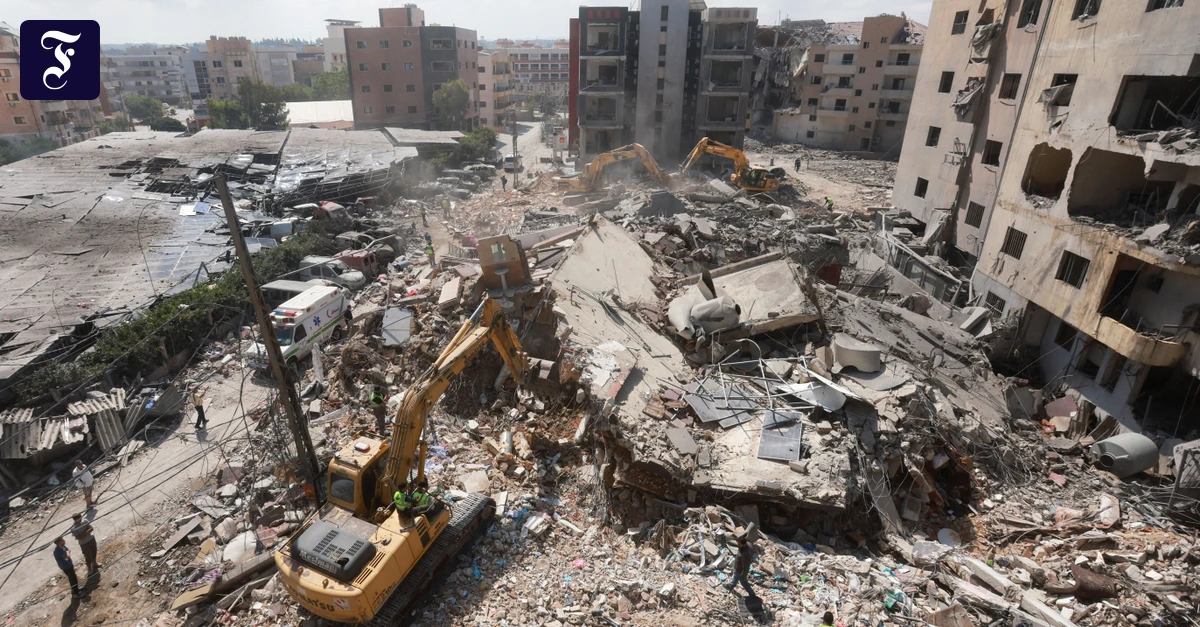
As close as they are in principle, there are reportedly tense moments between Donald Trump and Benjamin Netanyahu. This time the American president is said to have been exceptionally angry. In a telephone conversation on Monday, he attacked Israel’s prime minister, saying he was “crazy,” according to a report on the American news site Axios. The reason was that Netanyahu had ordered the south of Beirut to be bombed.
Trump made it loudly clear that he wanted to expand the war between Israel and rejects Hezbollah. One of the article’s sources claimed that the American president told Netanyahu: “You’re fucking crazy. Without me you’d be in prison. I’ll save your ass. Everyone hates you now. Everyone hates Israel because of this.”
Both Trump and Netanyahu are under considerable pressure. The Israeli is being increasingly criticized in his country for the army’s inability to… Hezbollah in the south of Lebanon. The American, in turn, wants to find a way out of the messy war against Iran. The regime in Tehran, however, has recognized the leverage it has at its disposal and is now making progress dependent on Israel stopping or at least not increasing its attacks in Lebanon. So, in order to reach an agreement with Iran, Trump will have to tie Netanyahu’s hands to some extent.
Trump: Israel won’t send troops to Beirut
That is said to have been the factual core of the allegedly emotional phone call. Trump wrote later on Monday on his Truth Social platform that he had a “productive” conversation with Netanyahu and announced: Israel would not send troops to Beirut – which was never discussed. Trump also explained that he had also spoken indirectly with Hezbollah: The Shiite militia had promised not to attack Israel any further.
The Lebanese government later confirmed that a new agreement had been reached. Accordingly, Israel refrains from air strikes in Beirut and Hezbollah refrains from attacks on Israel. However, the Shiite militia itself later said that, in accordance with the agreement, Israel had to stop its attacks throughout Lebanon.
Trump had already announced a ceasefire in mid-April. But it gradually collapsed. Hezbollah has recently been regularly firing rockets into northern Israel. Conversely, Israeli troops have continued to advance in southern Lebanon in recent days.
On Monday morning, Netanyahu took another level of escalation: He announced air strikes on the south of Beirut, a Hezbollah stronghold. Thousands of people then fled from there, and the plane carrying German Development Cooperation Minister Reem Alabali Radovan canceled its approach to Beirut.
Netanyahu: Army continues to act “as planned”.
After Trump publicly declared the announced Israeli attack on Beirut canceled, it took two hours for Netanyahu to respond: If Hezbollah continued to attack Israel, terrorist targets in Beirut would be attacked. He also made that clear to Trump. In addition, Netanyahu said, the Israeli army would continue to act in southern Lebanon “as planned.” Further attacks were reported by both sides in southern Lebanon overnight and on Tuesday; several Lebanese were killed.
Netanyahu’s defiant reaction raises the question of whether the scandal in the phone call between him and Trump might not have been staged to a certain extent. There was already a similar scene in the Iran war last June: Netanyahu only recalled the fighter jets at the last moment under pressure from Trump. Then, as now, he subsequently tried to portray himself to the domestic audience as someone who bowed to the USA – the most important ally – but only half.
It remains to be seen whether this calculation will work. Trump’s statement was met with criticism from opposition politicians and commentators. Some accused the prime minister of Israel being a “vassal state” of the USA and that he himself was a “puppet” of the American president.
Tehran wants to drive a wedge between Trump and Netanyahu
In Tehran, too, Trump’s rumored curses against Netanyahu are viewed more as theater. Basically, it is assumed that there is close coordination between the USA and Israel. At the same time, it is entirely in Tehran’s interest to give the impression that it could drive a wedge between Trump and Netanyahu. The combination of war events in Iran and Lebanon allows Tehran to feed international criticism of Israel’s actions.
It is probably no coincidence that Tehran played the Lebanon card shortly after Trump made new demands on Iran and sent a more strongly worded draft of a final declaration to Tehran. Iran wants to retain the upper hand in the negotiations and avoid the impression that it is bowing to pressure from Washington.
However, Iran did not stop at threatening to stop exchanging designs with Washington as long as Israel continued its attacks in Lebanon. The armed forces also threatened attacks on northern Israel. In doing so, Tehran underscores the strategic importance it continues to attach to Hezbollah as part of its deterrence strategy.
Hezbollah resumed attacks on Israel on the first day of the Iran War, allowing Tehran to focus its retaliatory strikes on US bases in the Gulf states – rather than on Israel. Iran obviously wants to hold on to its militia alliance, the “Axis of Resistance,” which some have already declared dead.