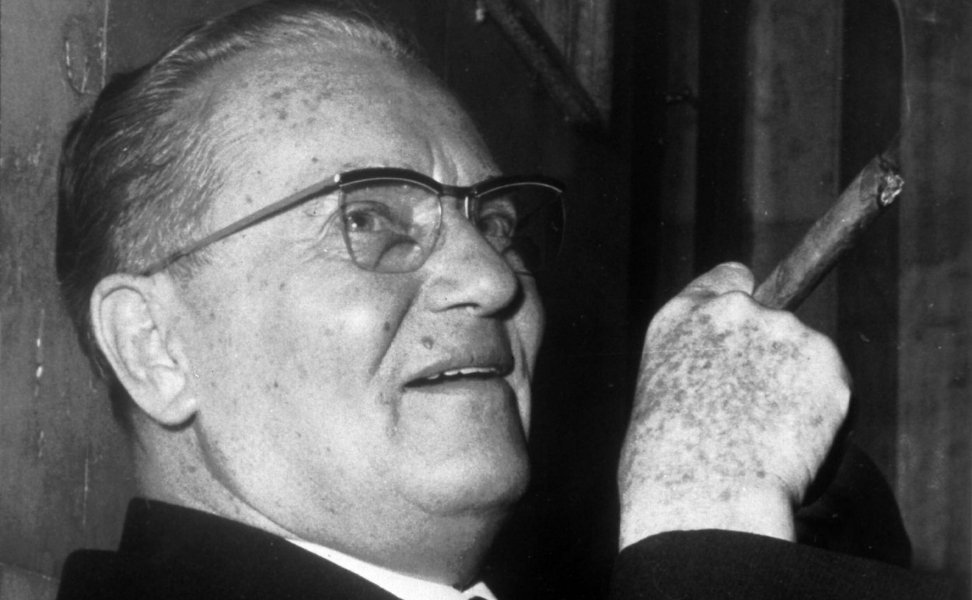
Josip Broz Tito remains one of the most complex and influential political figures of the last century, leaving behind a deeply polarized historical legacy. For a large part of the citizens, his era evokes nostalgia today and is remembered as a period of peace, relative economic stability and a huge international reputation through the Non-Aligned Movement.
Today marks 46 years since the death of the undisputed leader of socialist Yugoslavia – Josip Broz Tito.
The marshal was at the head of SFRY for 35 years, and he died in Ljubljana, on the eve of his 88th birthday. Even then, many saw his death as the beginning of the end of the Yugoslav state, it says “H1”.
The third world leader was admitted to the hospital in January due to circulation problems, and before his death his leg was amputated, which he did not want to agree to as long as he was conscious. Already from mid-February, he was in an artificial coma.
The news of Tito’s death was announced to the Yugoslavs by the speaker of Television Belgrade, Miodrag Zdravkovic.
– Comrade Tito died. This was announced tonight by the Central Committee of the Union of Communists of Yugoslavia and the Presidency of the Socialist Federal Republic of Yugoslavia to the working class, working people and citizens, peoples and nationalities of the Socialist Federal Republic of Yugoslavia – this was the news that echoed around the world.
Today, 46 years later, many remember his reign as a period of peace, relative stability and gradual progress for the majority.
Carter accompanied his mother to the funeral
The coffin with Tito’s remains arrived the next day with the “Blue Train” from Ljubljana, via Zagreb, to Belgrade.
Three days later, 700,000 people came to the funeral. 209 state delegations from 128 countries in the world were present. It is the most attended funeral of a statesman in the 20th century.
31 presidents of states, 22 prime ministers, four kings, six princes and 11 presidents of national parliaments paid their last respects to the founder of the Non-Aligned Movement. From the world divided by the Cold War, statesmen from both camps arrived in Belgrade.
The US Vice President Walter Mondale, Indira Gandhi, Hosni Mubarak, Saddam Hussein, Nicolae Ceausescu, Margaret Thatcher, Leonid Brezhnev, Helmut Schmidt, Yasser Arafat, Muammar el Gaddafi, Robert Mugabe and many other world leaders were at the funeral.
How important the gathering was is also shown by the fact that US President Jimmy Carter, who was absent due to illness, sent his mother as well, apart from the state delegation to Tito’s funeral.
Tito was buried in the House of Flowers in Dedinje on May 8, 1980. Besides Broz, his wife Jovanka has been resting since 2013.
The life of the first man of the resistance movement
It is considered that the resistance movement led by Josip Broz Tito was the strongest on the soil of Europe west of the Soviet Union and hence he emerged from the Second World War as a celebrated military commander.
Josip Broz was born in Kumrovec, in Zagorje, not far from the border with Styria, probably on May 7, 1892. His father was Croatian and his mother Slovenian.
After a messy primary education in his hometown, he learned a trade in Sisak. Allegedly, shortly after arriving in Zagreb in 1910, he became active in the labor movement, when he became a member of the local Social Democratic Party of Croatia and Slavonia.
In later years, he worked in Kamnik, Kranjska, Čenkov, Czech Republic, near Munich in Bavaria, Viennese New Town, but he did not stay anywhere longer.
He left for military service in 1913, where he excelled, both by acquiring the rank of non-commissioned officer and as the runner-up in the fencing competition in the Austro-Hungarian army.
After Vienna starts the First World War by attacking Serbia, Broz ends up at the front. Prvin fought on the Serbian front. In his later official biographies, that information is neglected, it is only noted that due to indiscipline, he was imprisoned in Petrovaradin. Then he was allegedly sent to the Russian front, in Galicia.
In May 1915, after being wounded, the Russians captured him. He spends the rest of the First World War in Russia.
Tito survives the Soviet purges
Later biographies state that Tito was a participant in the October Revolution, which was started by Vladimir Lenin and Leon Trotsky, which is not true.
During his stay in Western Siberia, he marries the minor daughter of the man on whose estate he worked.
In the fall of 1920, he and his wife left for the newly formed Kingdom of Serbs, Croats and Slovenes.
Until 1925, Tito lived in Veliko Trojstvo, not far from Bjelovar, where he worked in a mill. Four children were born here, of which only Zarko survives.
Then he stayed in Zagreb, Kraljevica, Belgrade, Smederevska Palanka, and in 1927 he returned to Zagreb. Tito is officially an industrial worker, but actually more dedicated to trade union-party work.
Broz was arrested in 1927 and 1928, after being sentenced to five years in prison. He was released in March 1934, after which he became a member of the Politburo of the Communist Party of Yugoslavia (KPJ) and a professional communist official.
As a well-paid Comintern official in the 1930s, Tito eliminated party rivals and survived Soviet purges.
In 1940, he formally became the head of the CPJ. After the occupation in 1941, at the behest of Moscow, he organized the Yugoslav uprising, winning a victory and gaining the crucial support of the Allies in London.
The Marshal at the head of Yugoslavia
As the undisputed leader of socialist Yugoslavia, Tito led the country from liberation in 1944-1945 until his death in May 1980. Formally, from 1943 to 1963, he was the President of the Government of Yugoslavia, and then the President of the State.
At the same time, he has been leading the CPJ all the time, that is, since November 1952. He holds the title of marshal from the Second Session of AVNOJ, towards the end of November 1943.
Tito Prvin is Moscow’s staunchest ally, but Stalin decides to get rid of him, which was revealed at the end of June 1948. With the Resolution of the Information Bureau, he begins to gradually rely on the West.
Washington then decides to help him to destroy the monolithic of the communist international. Tito then enjoys substantial military, financial and other assistance from the United States.
Leader of the Third World
In the conditions of the Cold War and the parallel process of decolonization, Tito managed to gradually, in the late 50s and early 60s, assert himself as one of the leaders of the so-called Third World, i.e. the Non-Aligned Movement, whose founder he was, together with the first prime minister of independent India, Jawaharlal Nehru, and the president of Egypt, Gamal Abdel Nasser.
In internal politics, a specific Yugoslav path was devised, called socialist self-management, which also implies the introduction of market mechanisms, with social ownership, which turned out to be successful.
At the same time, in addition to the formal federal arrangement, further decentralization is carried out over time, so from the Constitution in 1963, and completely with the Constitution from 1974, all real power has been transferred to the level of federal units, that is, to the republican parties.
Defense, foreign and fiscal policy remain common, and not entirely, whereby the so-called key is implemented everywhere to achieve the so-called equal representation with a mandatory consensus of the representatives of all republics and provinces. It turned out, as it turned out, to be a dysfunctional and destructive system, which made Yugoslavia’s survival impossible.
However, Josip Broz Tito remains one of the most complex and influential political figures of the last century, leaving behind a deeply polarized historical legacy. For a large part of the citizens, his era evokes nostalgia today and is remembered as a period of peace, relative economic stability and a huge international reputation through the Non-Aligned Movement. However, under the surface of the slogan of brotherhood and unity, the specific system of socialist self-government and complex decentralization proved to be completely unsustainable after his departure, and various external pressures “accelerated” the disintegration of Yugoslavia.