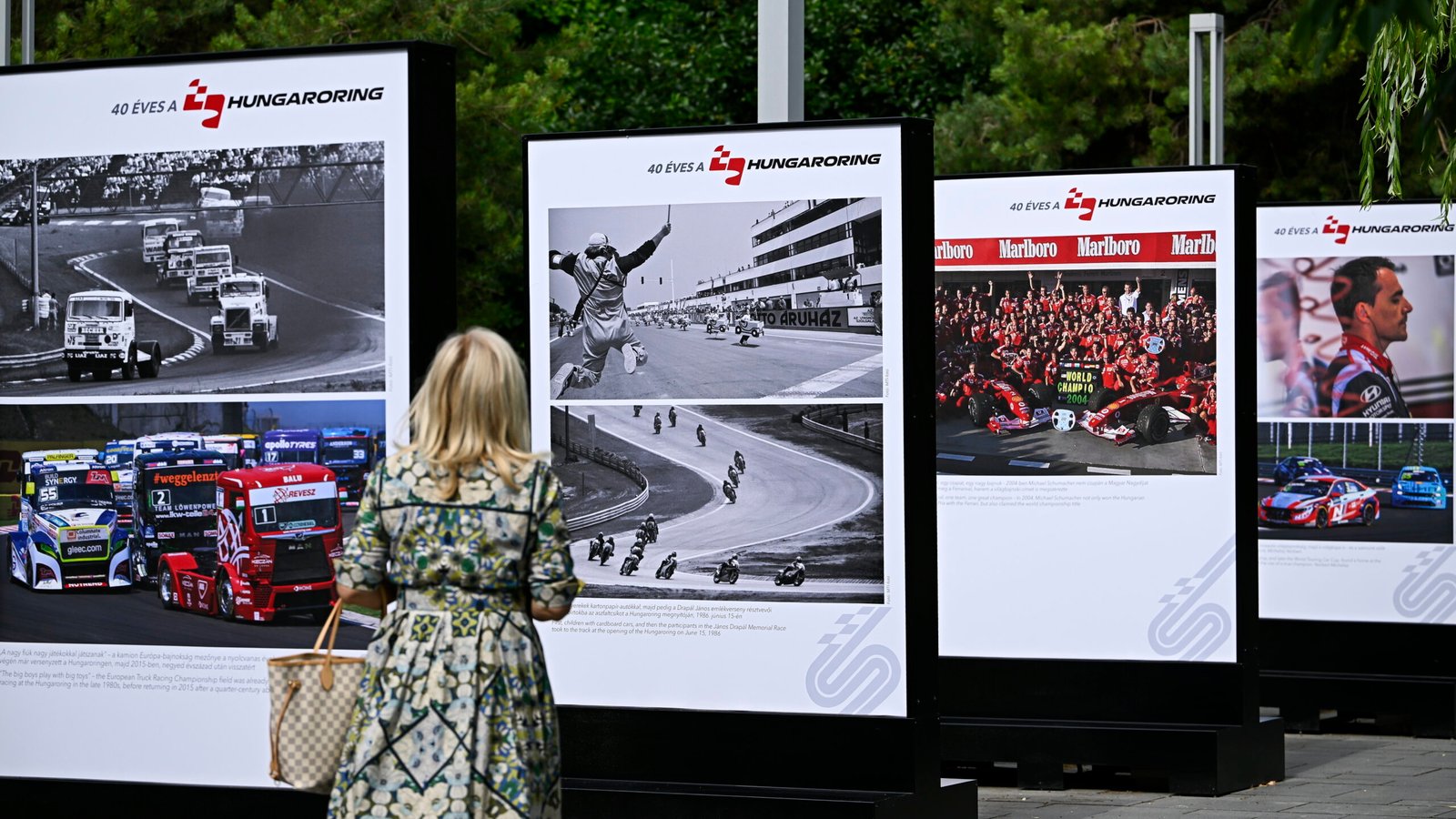

The celebrations marking the 40th anniversary of the Hungaroring kicked off with a photo exhibition at Millenáris Park in Budapest. Monday, June 15, marked the anniversary of the day four decades ago when the legendary Formula 1 racetrack was inaugurated with the Drapál János Memorial Race.
At the exhibition’s grand opening, Zsolt Gyulay, CEO of Hungaroring Sport Zrt., looked back on the track’s eventful history. In 1986, socialist construction companies built the circuit in Mogyoród at breakneck speed; the massive project was completed in just ten months. Following its debut with a motorcycle race, the first Formula 1 race took place shortly thereafter, drawing over 200,000 enthusiastic spectators to the track.

The original track layout of the Hungaroring (1986). Source: formula.hu/hungaroinfo.com/Nemzeti Archívum/MTI
As Gyulay said, the Hungaroring’s journey resembles a true Hollywood story. “It is fascinating how this globally popular racing series made its way to Hungary behind the Iron Curtain in the midst of the Cold War and has since been able to maintain its presence there—completely independent of all political and social system changes,” he explained.
Even amid an increasingly shrinking European racing calendar, the Hungarian Grand Prix is now considered a fixture and an indispensable event.
This is not only a sporting success but is also of great significance for tourism and the country’s image.

The first Formula 1 race at the Hungaroring in 1986. Photo: Fortepan / Glósz András
However, the Hungarian racetrack is not just looking back; it is moving with the times. Thanks to a recently completed, comprehensive modernization, the Hungaroring now boasts one of the world’s best pit lane and paddock facilities in the entire racing circuit.

A Red Bull Formula 1 race car in front of the renovated main building at the Hungaroring in June 2025. MTI/Máthé Zoltán
The track director was particularly proud of the circuit’s success with the public. Last year, the Hungaroring prevailed over traditional circuits like Silverstone and Melbourne and was awarded the Best Fan Experience Award. The future is also secure:
An existing contract through 2032 guarantees the circuit’s place on the Formula 1 calendar.
Race director Péter Faluvégi highlighted just how rapidly motorsports have changed since the early days. He was still working as a marshal during the first race in 1986. Back then, there were neither digital monitors nor radios as we know them today. The marshals followed the race action via portable Soviet Sokol pocket radios and the live commentary of reporter Attila Földy. Safety standards were different, too. Instead of today’s state-of-the-art tire and TecPro barriers, rectangular straw bales served as track barriers back then.

Photo: MTI/Hegedüs Róbert
The anniversary photo exhibition, titled “40 Years of the Hungaroring,” features 30 display panels with—fitting for the occasion—40 images. It will be on view at Millenáris Park until the end of this year’s Formula 1 race (July 26) and can also be visited in the evenings.

Via MTI, Featured image: MTI/Hegedüs Róbert