Of Guglielmo Gallone
If there is a word that helps us understand Siberia, that word is space. Even before the cold, before the mines, the gulags and even its history, in Siberia everything was born from geography. Sister Elena Isachenko, a Sister of Mercy of Saint Charles Borromeo, explained it to us: «We Siberians have a particular relationship with distances: 200 kilometers are considered normal. Our religious community also often goes to Achinsk to meet the nuns who adore the Blood of Christ. We leave in the morning and return in the evening. We don’t do it because we love the roads of Siberia. They are certainly not the best in the world. We do this because these trips allow us to maintain live relationships with other communities. This mutual support is crucial. We are few, we live very far from each other: spiritual and human closeness becomes an essential element of our mission.”
It is in this context that the largest Catholic diocese in the world by surface area arises, that of St. Joseph in Irkutsk. Extending over almost ten million square kilometers, it is divided into five deaneries: Irkutsk, Krasnoyarsk, Jakutsk, Vladivostok and Magadan. Of these, Yakutsk alone covers almost three million square kilometers: a surface area comparable to that of India. On the other hand, when we talk about Siberia we mean an immense territory: it extends for over 13 million square kilometers and, alone, occupies 77 percent of the Russian Federation, but hosts just a quarter of the country’s population. In these vast spaces, Sister Elena explains further, «representatives of around 140 peoples live. There are around fifty indigenous groups, including the Tuvans, Chakassi and Yakuts, but also very small groups that inhabit the far north. In Siberia, almost fifty different languages are spoken and some represent real linguistic enigmas.” Also because this remains a very cold territory. The deanery of Yakutsk actually also holds another record: it is probably the coldest Catholic deanery in the world since it includes Oymyakon, the village of 800 inhabitants known for being the coldest inhabited place on Earth. In winter, the temperature can drop to minus 71 degrees. What does it mean to bring the Gospel here?
«The first and most important mission of the Church is the transmission of the faith – Sister Jana Pavla Halcinova, of the company of the Daughters of Charity of Saint Vincent de Paul and originally from Slovakia, tells us -. Many people approach the Church precisely thanks to the concrete example of believers. There are also people who, now adults, rediscover their roots and remember that their ancestors were Catholic. An important part of the activity of the Catholic Church in Russia consists of bearing witness through works of charity, social assistance, education and attention to the poor, the elderly and the lonely. Another task is the development of ecumenical dialogue and collaboration with other Christian confessions. Another challenge remains the shortage of local priests and religious. Many priests and religious from abroad still work in Russian dioceses. For this reason it is essential to train local clergy and laity capable of assuming responsibility in the life of the Church.”
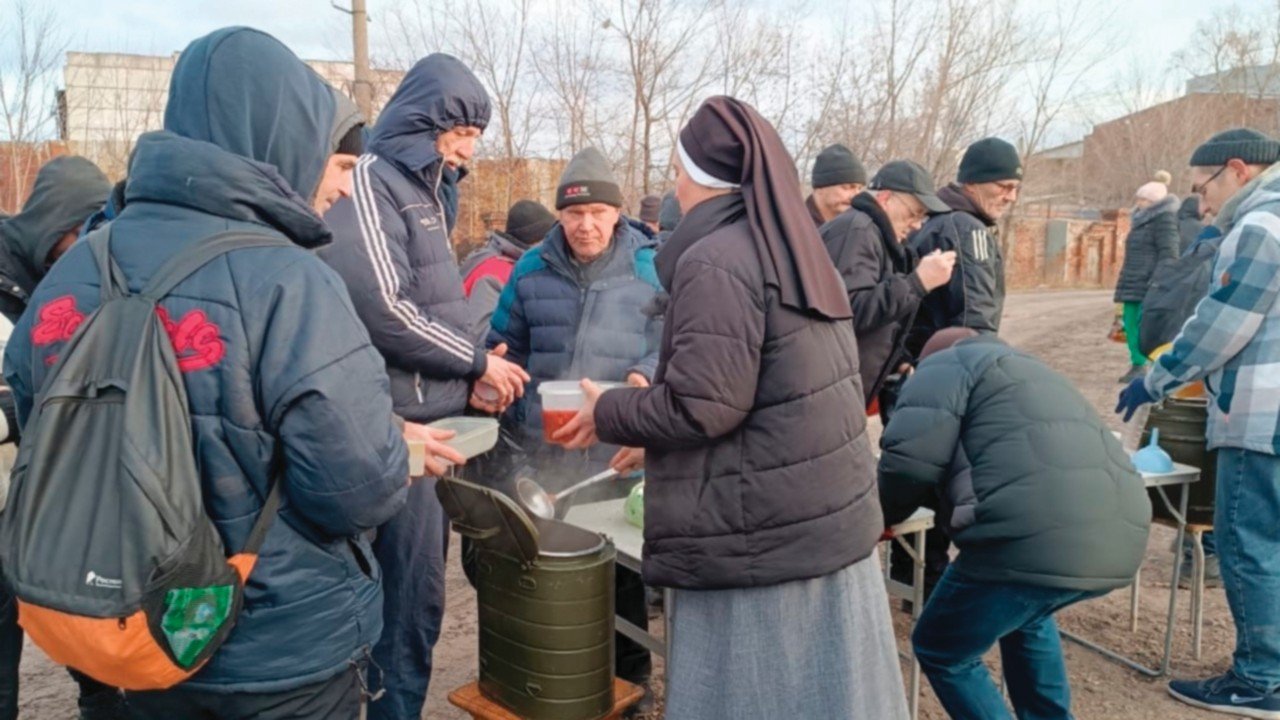
Sister Elena and Sister Jana Pavla both work in Krasnoyarsk, the third largest Siberian city, where one of the most important activities is aimed at assisting the poor. The most beautiful aspect, Jana Pavla tells us, is that «several Christian communities in the city have taken on the responsibility of distributing meals to the poor on different days of the week. The Catholics cover Mondays, the Orthodox cover Tuesdays and Thursdays, and the Protestant communities cover the other days. Meals are distributed to around fifty people every day. For many people this same unity between Christians is already a concrete testimony of evangelical values.” An important role is also played by Caritas: «Their activity in Russia – he continues – is closely linked to the rebirth of Catholic structures after the collapse of the Soviet Union. The organization was founded in Novosibirsk in 1991 by Bishop Joseph Werth. Thirty years ago Caritas began distributing humanitarian aid to people experiencing a profound social crisis. As time passed, increasingly complex problems emerged: abandoned children, parents marked by alcoholism, domestic violence, poverty and homelessness. To address these situations, several programs were initiated. Today Caritas is also involved in projects dedicated to prisoners, people suffering from tuberculosis or HIV, those suffering from alcohol or drug addictions, children with disabilities and their families, migrants and people affected by emergencies”.
It’s true, Catholics in Siberia today number just over 50,000 and do not exceed 1 percent of the population, yet their presence is well rooted in the history of these territories. «Starting from the 17th century, deported Catholics began to arrive in Siberia – Sister Elena explains – there were even entire villages populated by Catholic exiles. An example is the village of Tunka, in Buryatia, a symbol of the ability of faith to survive in total isolation, in the depths of the Siberian taiga. In the second half of the 19th century, around 150 Catholic priests were confined there, deported after the Polish uprising of January 1863. The first Catholic parishes were founded at the beginning of the 19th century. At the beginning of the twentieth century a new wave of Catholics arrived: no longer deported, but coming from Poland, Latvia and other regions of the Russian Empire. They developed agriculture, built churches, called priests and brought with them prayer books in their own languages. Some Russians also entered the Catholic Church. The revolution of 1917 radically changed the situation. Many churches were destroyed and numerous priests were killed or expelled. Faith, however, survived. The families kept the old prayer books and continued to pray clandestinely. For us in Krasnoyarsk an important part of the service consists precisely in safeguarding this historical memory.”
This is how the Church continues to maintain its multinational face. «Today among our faithful there are many representatives of indigenous peoples, such as the Chakassi or the Yakuts – says Sister Elena -. Even the first religious vocations from indigenous peoples were born. Naturally there are still many Russians in our communities, I believe that people still have that deep thirst for God that characterized the period following the fall of the Soviet Union.” The nun tells us about some projects such as “I am Catholic”, which she defines as the «most important mobile application for Catholics in Russia. It allows you to find information on any Catholic parish in the country, its activities and its geographical location. Another project, born from young Siberians, is called Faith and Reason: a Telegram channel through which young people can ask questions to priests and nuns and receive answers on the most important issues in life.” Of course, Sister Elena concludes, «our communities remain very small. On average the communities have between thirty and fifty faithful. According to European standards this may not seem like much. But we, here, like to think that the time dedicated to a person is worth as much as that dedicated to a community.” This is how the “logic of smallness” that Pope Leo XIV spoke about several times comes to life and develops. Disappear so that Christ remains. An even more fundamental mission in the largest Catholic diocese in the world, even more crucial in a territory so wounded by history, between the tsarist deportations and the communist gulags, and so cradled by geography, between the freezing cold and the immensity of the Siberian steppes.