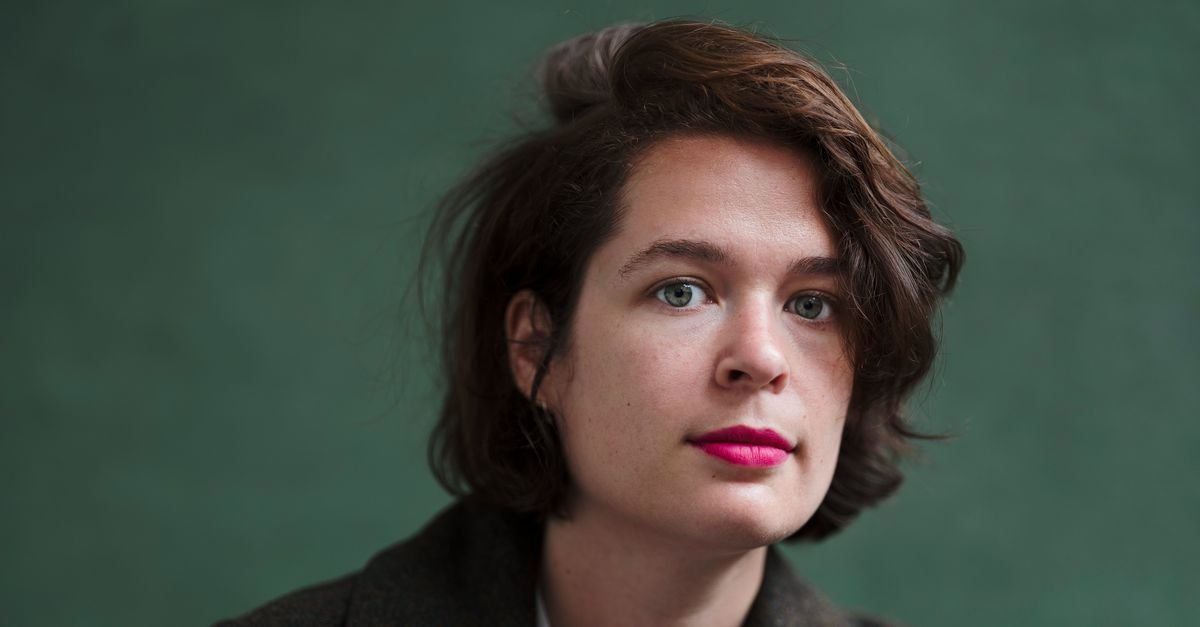
The last days of her life, poet and philosopher Lieke Marsman was in Paris; She visited the Roland Garros tennis tournament with her new wife – they got married last month – and spent two days watching top tennis. And then, on Wednesday morning, it suddenly stopped. Her illness, the rare cancer with which she had lived for about eight years and against which she continued to fight tirelessly, had finally destroyed her.
“I want to be a call to life,” she once said, as the centerpiece of the TV show Summer guests. Even knowing the inevitable end, she retained her zest for life in recent months; she also completed her new collection of poems.
Lieke Marsman, who died at the age of 35, was one of the most prominent literary authors of her generation. She was the youngest laureate of the Constantijn Huygens Prize, for her entire oeuvre, in 2025. She published poetry, essays and literary prose, genres that she managed to bring together more than once within one book, and made it feel self-evident – for example in the critically acclaimed climate novel The opposite of a human (2017). She also knew how to write in a unique, innovative way in such a way that her texts were both intimately personal and social.
“I know that I am able to turn something horrible/ into the bittersweet/ that gives a life its value, the crisis/ and chaos from which a life gets its dynamism. This is what I tell myself when I think about death,” she wrote in her poetry collection In my basket (2021). That collection was published on the day in early 2021 on which she, the youngest ever, became Poet Laureate. She was already ill at the time, terminally ill, and she therefore knew that she would not, like some of her predecessors in that position, travel around the country to climb all kinds of podiums. That was not an option anyway thanks to the corona pandemic, but also because as Poet Laureate she would have been able to get close, even if it was from a distance.
Voice of the ‘dry wood’
After all, she had acquired a unique position in the years before, when she participated in the public debate through poetry and essays, but also as an astute user of Twitter. When vulnerable people were called ‘dry wood’ during corona times, Marsman took it upon himself to be the voice of that ‘dry wood’. That commitment was also rooted in her illness, which appeared in 2018: cartilage cancer. She “needed” writing about politics, she wrote The next scan takes five minutes (2018), “not to be completely consumed by cancer” and to combat the loneliness that illness brings. “A loneliness that I experienced as unbearable, but which was fairly easy to shake off by practicing social criticism.”
The title Poet Laureate gave her new thoughts “about the role of literature in the public arena,” she wrote in the collection On the occasion of poetry (2023), which was published at the end of her period. What could literature achieve in a social sense? She was apprehensive about writing ‘commissioned poetry’, knowing “that writing on commission entails a certain pressure and as soon as that pressure is there, there is a lurking danger that I will imitate myself.” That was precisely what was wrong with our “imitation society”: we make things because we have to, not because they are “true,” “and I suspect the reader will eventually notice that.” Language is the victim of untruthfulness, she showed: ugly, empty jargon is created that conceals the fact that the language says nothing. If this slop creeps into the language, the users suffer, and with it society.
Also read
“I’m still going to die, I know that, but in my own way,” Lieke Marsman said in this interview in 2025
:format(webp)/s3/static.nrc.nl/wp-content/uploads/2025/02/05135512/data127662794-df6b83.jpg)
Her task as a poet was to sharply and carefully analyze and unmask that language, and to hold up a mirror to us, language users, in pursuit of something better. She could be sharp and critical of politicians, such as then Prime Minister Mark Rutte or D66 party leader Sigrid Kaag. “Words matter,” Marsman quoted her, with cheerful cynicism: that truth had now petrified into a cliché, but nevertheless true and worth living. Her poetry was always clear, fresh and accessible, without raising high barriers or thresholds – but also without sacrificing depth or complexity. The same applied to her essayistics: after all, she wanted to say something with it, to convey it.
Better to live armless than to die poor
That was strongly reflected in They can save me on another planet (2025), a book of essays in which she also merged genres because that way her story came across best; from poetry and reflection to diary text. It became a surprising bestseller. Marsman wrote in it about her illness, her fight against the healthcare system that saw her cancer as incurable and wanted to discontinue treatment, while she wanted to continue living at all costs. When the amputation of her arm was considered due to a metastasis, it was not a question for her: she would rather live armless than die armless. She tweeted about it with gallows humor: “This Woman Lost Five Kilos In One Day, Click Here To Find Out What Her Secret Is.” She accepted the risk of complications – she preferred to believe in a hopeful opportunity rather than resign herself to a sad possibility.
:format(webp)/s3/static.nrc.nl/wp-content/uploads/2026/06/04115731/040626BUI_2034224101_3.jpg)
:format(webp)/s3/static.nrc.nl/wp-content/uploads/2026/06/04115729/040626BUI_2034224101_2.jpg)
Photo Merlijn Doomernik
Following that thought I described They can save me on another planet also her turn to faith. She preferred to take into account that there was something divine, spiritual, supernatural (and also: extraterrestrial life), than to reject it because it was as yet unproven. Faith had returned to her life due to her illness after an upbringing that had been “somewhat anti-religious”, but in moments of despair she had “semi-mystical experiences”, in which she managed to find peace and tranquility again. But that was an earthly feeling rather than something vague, she explained in interviews. The title poem of the collection In my basket ended with: “Forget angels and psalms/ I want the vanilla of an old book/ I want a cold bottle of beer/ and I want you, one more time/ Forget birds singing/ I want to hear my dog drink.”
“Lieke Marsman’s work shows how literature can help us find a form to think about the unthinkable,” wrote the jury of the Constantijn Huygens Prize, praising both her abilities as a systems thinker and her sensitivity. Marsman was unusually young for an oeuvre prize, but her illness and the realization of finitude had brought her to mature wisdom, to an oeuvre that was no longer casual in any way. Still also funny: her poetry collection to be published next week The poet and the devil describes a journey into hell that is an absurdist satire – about meaningless politics, but also about AI.
Can poetry do anything to counteract this? Poems, Marsman writes, can be like “pebbles/ that bounce on water,” but: most thrown pebbles sink, and isn’t the poet “like a fisherman/ who, hunting for fish/ wastes his entire lunch/ on bait”? Lieke Marsman nevertheless managed to touch her audience with her fiery, sensitive, truthful poetry.
Also read
A poem by Lieke Marsman, from early 2026: A disorderly spelled but clear beautiful paradise
:format(webp)/s3/static.nrc.nl/wp-content/uploads/2026/03/27120629/030426OPI_2032495839_WEB_ILLU_Lucifer3_HP_Lars-Zuidweg.jpg)