***
If Home Affairs and DFAT applied the appropriate due diligence to Nauru Airlines, it’s unlikely they’d award it any contracts. Because even if we set aside concerns about related-party entities or subcontracting fees – and before we look at the reliability of its aircraft, or its safety record – Nauru Air Corporation’s finances are a mess.
According to its annual report, Nauru Air Corporation lost $12.5m in the 2025 financial year, up from $6.6m the previous year. Its losses had near-doubled because its operating expenses grew at roughly twice the rate of its revenue. Due to these structural cost problems, it was burning around $34,000 per day. Its working capital was negative (with current liabilities outstripping current assets), and its cash position was propped up by debt and related-party financing. In early 2025, the airline was borrowing from its own maintenance fund – a separate company – treating it as a loan facility to cover general operations.
If the airline had stopped flying at the end of the 2025 financial year, it could not have refunded its ticket holders – the classic airline insolvency signature.
On the financials provided in its 2025 annual report, Nauru Air Corporation would potentially fail both Australian solvency tests – the cash-flow test and the balance-sheet trajectory. This is despite the Australian government propping up the airline with contracts to the value of $40 to $50m per year, when the airline’s annual total revenue was just over $110m. In February, the company sold the engines of its fleet of planes; it now leases them back.
These figures raise serious questions about the capacity for Nauru Airlines to deliver the services paid for by the Australian government, which is entirely aware of the airline’s fiscal position. In other circumstances, such financial delinquency would be disqualifying. In Home Affairs, however, the contracts were waved through. (This was the department, after all, that gave a $432m offshore detention facilities contract to an unaudited little company that was registered to a beach shack on Kangaroo Island and had a PO Box in Singapore.)
The Australian government and its regulators are also turning a blind eye to other governance issues quite apart from Nauru Airlines’ financial problems. On October 28, 2025, the same day its troubling annual report was signed off by its directors, the Naoero government appointed four new directors to the Nauru Air Corporation board with immediate effect, including Damon Adeang, the President’s son. At the time of writing, these additions are not listed in ASIC company records. Either these board changes were reported and ASIC is being negligent, or, more likely, Nauru Air Corporation didn’t report them, despite it being a legal requirement to report such changes within 28 days. This would appear to breach the Corporations Act.
Government contractors are obliged to comply with all applicable laws and policies, and the government has the right to cancel contracts based on non-compliance. Despite all this, the Australian government continues to direct tens of millions of work annually to Nauru Airlines.
It gets weirder. A key reason Nauru Airlines didn’t fall into financial inoperability earlier this year was that Naoero’s finance department bailed out the national carrier with funds that had just been paid to it by … the Australian government. Without this cash injection, the airline – and Australia’s entire offshore detention arrangement – would have been crippled. Two months prior, Australia settled a payment of $388m into the Nauru Trust Fund No 2, tied to Naoero’s acceptance of the “third country resettlement arrangement” for asylum seekers. The Secretary of Finance, who approved the Nauru Air Corporation bailout using these funds, was none other than the new Nauru Air Corporation director – and the President’s son – Damon Adeang.
This is the price we pay for insisting that some asylum seekers don’t have basic human rights under our law, and for treating Naoero like a human dumping ground. Australia entered into a $2.5 billion, 30-year resettlement agreement that depends entirely on Nauru Airlines, regardless of the costs or consequences.
***
We can only speculate as to how Australian ministers and departments justify the position in which they’ve put themselves. But assume it runs along the lines of ends justifying means: the offshore immigration system is fundamental to border security; Naoero is critical to this system; and national security overrides any other concerns. The Nauru Airlines monopoly may breach regulatory standards, compromise procurement processes, and enable market manipulation and anti-competitive behaviour, but doing business with imperfect Pacific administrations (and airlines) is apparently the price we must pay for our security.
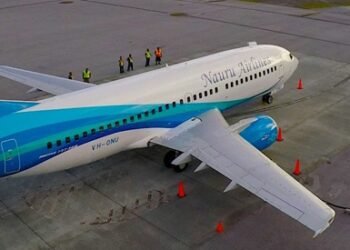
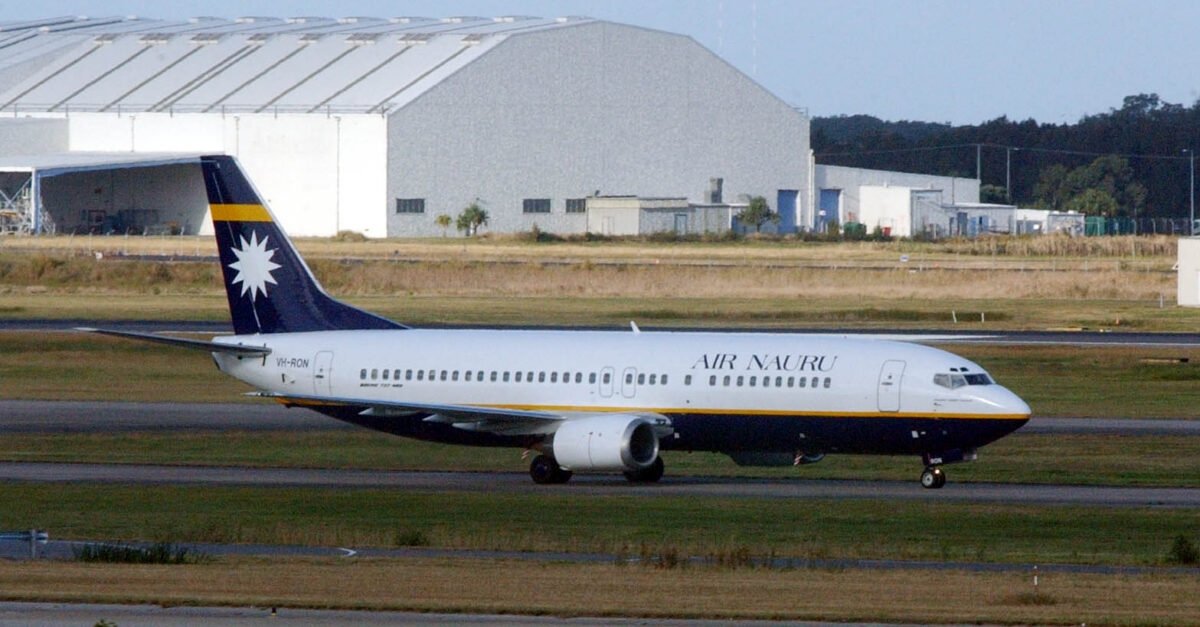
It’s worse than this, though. The risk has a physical safety aspect too. Our government is supporting an airline to fly Australian employees and asylum seekers in and out of an aerodrome that has safety and security deficiencies according to international standards; an airline that requires tens of millions of Australian taxpayer dollars annually to simply operate; and whose fleet consists of seven Boeing 737s that are on average over 25 years old and expensive to maintain, run by a company without competitors and on the verge of insolvency.
The Australian Transport Safety Bureau (ATSB), Australia’s national transport safety investigator, has reported no current or recent investigations into incidents involving Nauru Airlines aircraft. The most recent investigation in its records dates to 2015. In other circumstances, this might be reassuring. In this case, however, there are many reasons to be concerned.
On March 19, 2021, a Nauru Airlines Boeing 737-300 with 48 passengers was on approach to Brisbane Airport when passengers heard a loud bang from the right-hand engine – a compressor stall that caused it to choke. The engine started spitting out fire. Residents in the suburbs below told news reporters that “it sounded like it was going to explode, it was so loud … I thought it was missiles”, and “(we) saw flames coming out the back of the plane as it flew over”. The plane landed safely, and the incident, recounted with full drama on that evening’s 7NEWS bulletin, caused the brief suspension of all domestic and international flights as the tarmac was inspected for debris.
On November 15, 2023, a Nauru Airlines Boeing 737 cargo aircraft was approaching Brisbane Airport when the pilot experienced a loss in normal control: the horizontal stabilisers on the tail were not functioning as expected, meaning the pilot had retarded capacity to control the craft safely to ground. Disaster was averted; he regained control and landed safely, but subsequent inspection revealed serious corrosion issues – rust – affecting the movement of the tail flaps. The aircraft was taken out of service for 35 days. After various maintenance checks, it was back in the air, but another technical event a few weeks later forced another unscheduled landing, and the aircraft was then leased out to a different airline – and grounded for six months immediately after its delivery to them.
The latter incident is not recorded in the ATSB Aviation Occurrence database, therefore likely not reported, and was not investigated. The former incident was reported to the ATSB – but also not investigated.
Nauru Airlines, like many small Pacific airlines, has a high incidence of diversions from scheduled flight services – of air returns, cancellations and changes of destination. These can be caused by a variety of things: aerodromes being unprepared for an arrival; medical emergencies; weather conditions and other things. But they can also be caused by maintenance problems, fuel contamination or sundry other technical failures. Flight data and public records allow us to distinguish between the causes, by tracking every aircraft, every flight, and all of their flight data – altitude, flight path, velocity, timing and more. Data reveals when aircraft are grounded, and when they are sent into the air on an “engineering” flight following maintenance or repair work, to check that all systems are functional.
Since the start of 2026, there have been at least seven occasions in which a Nauru Airlines aircraft has set off on a scheduled flight, had an apparent technical failure, and returned to where it departed. (This doesn’t count other breakdowns on the ground or other unscheduled diversions, of which there were many more.) In most of these cases, the Nauru Airlines aircraft circled over the ocean for extended periods burning off fuel so as not to land with a full (and more combustible) tank. Some data indicate the possibility of de-pressurisation events. Each aircraft had been involved in similar previous return events, sometimes only a day or two before, and in several cases the aircraft was immediately grounded for repairs, with replacement aircraft taking over the service. Several flights carried tonnes of freight, while others carried passengers.
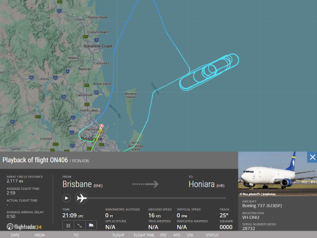
Photo: Nick Feik
By industry standards, this is a high incidence of air returns, let alone of turnbacks caused by aircraft technical issues. For example, Malaysia Airlines’ turnback rate in 2024, based on its own published figures, was 40-70 times lower than that of Nauru Airlines this year; yet even this rate was notable enough to attract parliamentary attention in Malaysia and a cautionary amendment to its air operator’s certificate. Other global aviation data comparisons also confirm that the Nauru Airlines’ turnback rate is tens of times higher than the industry average.
In Australia, any safety incident or serious technical failure is required by law to be reported to the ATSB. Failure to do so is a criminal offence. Yet only one of this year’s air returns is recorded in the ATSB Aviation Occurrence database, and none is being investigated. Combined with what we know of earlier incidents, this would suggest that either the airline is not reporting all such events, or the ATSB is receiving reports but not recording and investigating them. Or both.
CASA also treats in-flight technical diversions as a reliability indicator, and requires operators to monitor trends against established performance standards. The concentration of Nauru Airlines turnbacks surely warrants serious attention.
***
On July 20, Nauru Airlines apologised to its passengers for flight disruptions across that week, blaming “unserviceable fuel trucks” at Nauru International Airport. The following week, all flights in and out of Naoero were temporarily suspended without notice or explanation. A few days later, the Australian High Commission in Naoero announced the arrival of new “aircraft rescue and firefighting capability”, which the Australian government was funding, “to support the safe resumption of flights”. Nauru Airlines announced that regular services would soon resume, but didn’t clarify whether the “operational challenges” to which it referred related to the unserviceable fuel trucks, the fire-fighting equipment, scheduled works to the landing strip, aircraft maintenance, or some other issue.
In the middle of all this, on July 28, Nauru Airlines announced the appointment of its new CEO, Wendy Bowden, marking “an exciting new chapter” for the airline.
In the past 18 months, in addition to the board changes, Nauru Airlines has changed personnel in the following roles: CEO (twice); Deputy CEO; chief financial officer (three times); airworthiness managers (multiple); head of flying operations; head of maintenance; finance manager; and numerous other operational roles. Unsurprisingly, the human resources manager, the people & culture manager and the payroll manager also resigned earlier this year.
To say that Nauru Airlines’ staffing has been fluid throughout this period would be an understatement. This has also meant that its own organisational charts don’t easily match – and sometimes contradict – CASA records of its key personnel, or public listings of critical positions, hinting at a dangerous blurring of accountability lines. (CASA must approve key personnel changes.) In multiple cases over the past 18 months, several people have been simultaneously listed as filling the same safety or airworthiness role. This indicates a degree of dysfunction that would be concerning for any company; in an airline it’s alarming.
***
In recent months, there has been another strange twist in this tale. Nauru Airlines is at the heart of a geopolitical power struggle that threatens to reshape the entire region.
In June, Minister for the Nauru Air Corporation Asterio Appi led a delegation of Nauru Airlines officials to China, in a bid to unlock “new Pacific aviation opportunities”.
“China presents, for Nauru Airlines, very real pathways for us to elevate our services, our network and our presence in the Pacific,” said Appi. “We came with purpose, and we leave with a clear roadmap.”
As specialist aviation publication Aero South Pacific noted, “China has increasingly used aviation as a tool to expand its influence across the Southwest Pacific. It has been involved in airport infrastructure projects in countries including Papua New Guinea and the Solomon Islands … China has also explored extending one of its state-owned carriers’ services to Vanuatu from existing scheduled flights to Port Moresby”, and has “supported local airlines in launching services to China”.
The Australian government is evidently struggling to find a coherent response to the spectre of China’s direct access to the region, especially in regard to Nauru Airlines. It has the ongoing $104m Home Affairs contract and is funding new equipment at Nauru International Airport, which are both practical demonstrations of support and acknowledgements that Australia needs Naoero’s air services. On the other hand, our government is reconsidering its support for the Australian North Pacific Connector, the subsidised travel route through the region which has been operated by Nauru Airlines for several years. This pause represents either a cooling of the relationship or a coded threat: that Australia’s support for Nauru Airlines is conditional on Naoero’s good behaviour – not getting too close to China – or on improved standards. But without this subsidised service, Nauru Airlines becomes even less viable.
In the face of this, while happy to accept Australia’s largesse whenever available, Naoero is quietly demonstrating its autonomy and initiative by signing aviation agreements to link with various Pacific neighbours – presumably with the support of China, into whose orbit it has been slowly moving. Naoero’s foreign minister has also spoken openly about his government’s plans to run direct flights from Naoero to Guangdong.
Fresh from signing a major fishing-rights deal with China, Naoero announced in May that it had ordered all public servants and employees of state-owned enterprises to observe the One China Principle: staff were to “avoid using terminology, symbols, flags, emblems, or representations which are inconsistent with the One China Principle”. This meant all Nauru Airlines employees – including those in Australia – were forbidden from referring to Taiwan as anything other than a province of China; a bizarre state of affairs in an Australian-registered company receiving Australian government support, and probably unlawful.
Then in June, the nation formerly known as Nauru announced that it was changing its official name. It was shaking off the mangled relic of its colonial past and honouring its true heritage, according to President Adeang. The symbolism would not have been missed in Canberra: Naoero was looking to a post-colonial future, and this coincided with its burgeoning relationship with China.
These developments, concerning as they must be to Canberra, are about much more than aviation. China is flexing its muscles in various ways across the region, and not just in commercial deals. The Asia-Pacific is the critical forum in its great-power rivalry with the United States. In July, China launched a nuclear-capable intercontinental ballistic missile test thousands of kilometres across the Pacific. To the outrage of many Pacific islanders, the missile landed in the ocean between Solomon Islands, Naoero and Tuvalu. Naoero, however, refused to condemn it. In fact, it went so far as to block (with Kiribati) a joint statement by the Pacific Islands Forum which sought to condemn China’s test.
After years of financially supporting Naoero, propping up its airline and turning a blind eye to its failings, Australia now finds itself in a bind. The airline is critical to its offshore detention regime, but is also a slice of sovereignty for impoverished Naoero – one which Naoero is seemingly willing to use as a geostrategic pawn. Australian leaders and bureaucrats should be rightly concerned and embarrassed that their covert asset – and secret shame – is now being used to court China, but they only have themselves to blame.
***
To conclude with the strangest irony: in recent years, Nauru Airlines has reportedly been bringing employees and executives into Australia regularly on visitor (tourist) visas, even though the purpose of their visit is work. Under the Immigration Act, it is illegal to work on a tourist or visitor visa, or to enter Australia for purposes other than those allowed by your visa conditions.
If this proves true, it presents a serious problem: as a result of supporting this airline, to facilitate Australia’s offshore immigration apparatus, Home Affairs has been abetting illegal immigration.
***
We contacted Nauru Airlines with detailed questions, but they declined to reply. If you have any further information related to this story, please contact nickfeik@proton.me