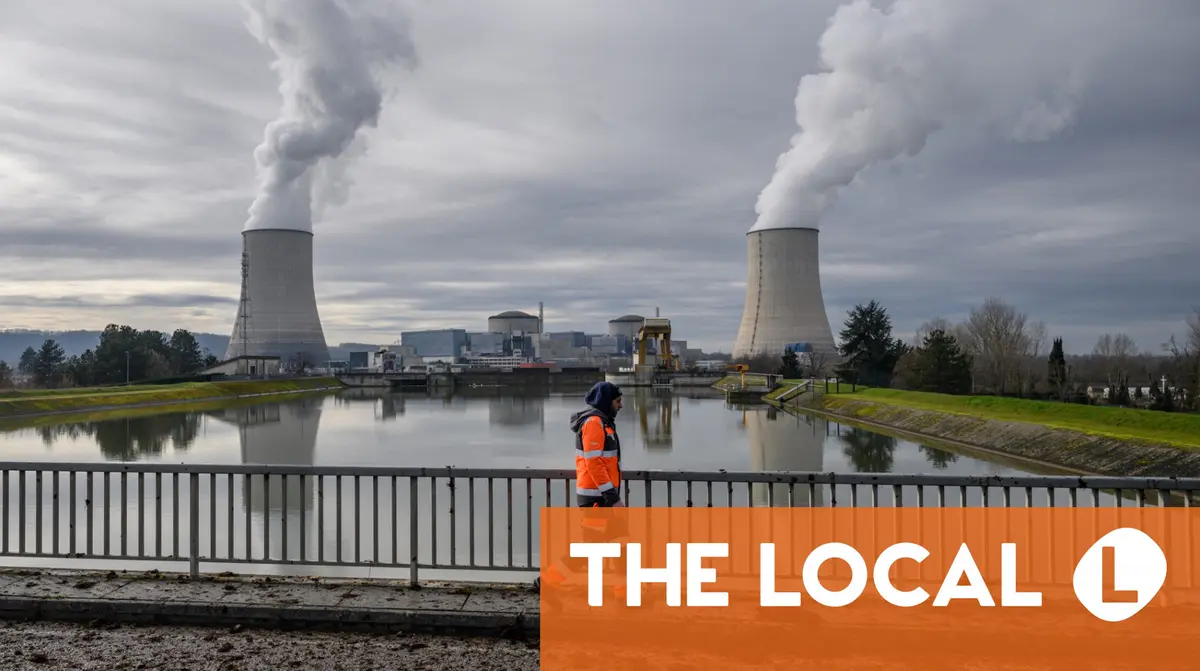
France relies heavily on nuclear power – but regularly shuts down reactors when temperatures soar. With summers getting longer and hotter, can the French nuclear sector cope with climate change?
As France sizzles under a severe and long-lasting June heatwave the Golfech nuclear reactor, in the south-western département of Tarn-et-Garonne has been shut down because the neighbouring River Garonne was too hot for its waters to be used to cool the reactor.
The same reactor was also shut down during the heatwave in 2025, while other reactors, such as the one at Bugey in Ain, along the Rhône, and the one at Blayais on the banks of the Gironde, had to reduce output.
These shutdowns are routine and were anticipated as soon as a heatwave was forecast – but what does this mean as French summers get hotter and heatwaves more frequent and more intense?
Safety protocols
France has 56 nuclear reactors, 30 of which are closed-loop and 26 open-loop. The former take in relatively little water, most of which is released into the atmosphere in the form of steam. The latter require much more water, all of which is released into waterways.
So open-loop nuclear power plants – which pump water from the rivers (or the sea) – are the first to be affected in the event of a heatwave.
The rules on heat shutdowns are not about nuclear safety – they are about environmental regulations that protect nearby flora, fauna and waterways.
Any used water which is discharged back into the rivers (or sea) is regulated and cannot exceed a certain temperature. These thresholds are specific to each plant and are designed to protect flora and fauna.
For example the Golfech power plant draws water from the River Garonne to cool production units before returning it “largely to the river at a slightly higher temperature (+0.2C on average),” the plant’s website explains.
Golfech stopped production because the forecast water temperature was so high coming in that it would have exceeded its regulatory temperature limit for its discharged water. At times like this it is not allowed to withdraw or discharge water from the river for cooling.
This is increasingly common. EDF has reduced or cut production at some power plants fairly regularly across recent summers. In 2018, the Saint-Alban power plant, in Isère, shut down both reactors because the water temperature in the Rhône was too high.
The other reason for a heat-related shutdown is if the local river flows are low due to drought.
In 2020, two reactors in Ardennes were shut down after weeks of drought made the cooling process too difficult to manage.
Energy levels
However, drops in production like this don’t mean there is an impending energy crisis.
“Summer is a period when consumption is low and the volumes involved are small,” Nicolas Goldberg, an expert consultant in electricity, told BFM Business.
“France currently has excess electricity production capacity” and therefore runs “no risk” of power cuts.
Most of the time, France is a net exporter of electricity and sells extra electricity produced to neighbouring countries.
According to EDF, since 2000, nuclear production losses due to environmental causes (high temperatures and low river flows) have represented an average of 0.3 percent of annual production from nuclear power plants. In total, around 80 percent of France’s electricity comes from nuclear.
Auditors the Cour des comptes, however, is concerned that the number of heat-related shutdowns will get progressively worse over the next 25 years, and has called on EDF to upgrade and improve its cooling systems.
This is particularly important given that demand for electricity is rising, even though it is – relatively – lower at this time of year – likely due to increased demand for air conditioning and cooling in order to cope with the heatwave.