Why are there quite a lot of Russian goods on the shelves of Moldovan stores and should they be banned? This topic has recently again taken a prominent place in public discourse in Moldova. NM analyzed statistics on trade relations between Moldova and Russia, and also talked with businessmen and experts about how and what the two countries are currently trading, and what a possible ban could lead to.
The topic of Russian goods periodically arises in public discussion: both in social networks and in the Moldovan media. Recently, this issue was again raised by the head of the National Party of Moldova, Dragos Galbur, who on social networks paid attention that soldiers of the National Army consume sweets produced in Russia. Russian sweets on retail shelves also outrage other Facebook users.
A possible revision of Moldova’s trade policy regarding Russian goods was recently announced by the Minister of Economic Development and Digitalization, Evgeniy Osmochescu, in an interview with several media outlets, including NM. However, he did not specify what goods he was talking about and when the ban could be introduced.
“My personal opinion is yes, we need to change this. But we must consider this issue from a legislative point of view, because we are a responsible state and approach all our obligations responsibly. But a decision must be made because we must participate in sanctions against aggressor states,” Osmokescu said.
He also said that, having arrived in Moldova from abroad, where he lived for some time, he was surprised to see Russian goods on the shelves of Moldovan stores: “But again, our legislation allows the import of goods from Russia that are not subject to international sanctions. Because we, as a state, also participate in packages of sanctions against Russia and Belarus. This is a fact. And we will continue to do so.”
How has the Moldovan-Russian trade turnover changed in recent years?
It should be noted that, despite the absence of direct prohibitions on the part of Moldova, trade turnover between the two countries decreased significantly after the outbreak of the war in Ukraine. If in 2021 exports from Moldova to Russia amounted to $276 million, then in 2022 – already $190 million, and in 2025 – $107 million, which was the lowest figure in the last 25 years.
Imports from Russia in 2021 amounted to $1.05 billion, in 2022 – $1.15 billion, in 2024 – $208.5 million, and in 2025 – $220 million. Imports from Russia to Moldova were lower than this figure only in 2001-2003.
At the same time, Russia periodically introduced trade restrictions on Moldovan products. Thus, in 2006, Moscow banned the import of Moldovan wine, as a result of which Moldova’s exports to Russia decreased from $353 million to $182 million. Moscow introduced another embargo in 2013 against the backdrop of the initialing of a free trade agreement between Moldova and the EU. Then Moldovan exports to Russia decreased from $632 million to $424 million. In 2022–2023, there were also restrictions on the supply of fruit and wine products from Moldova.
At the same time, Chisinau did not introduce trade restrictions against Russia. But after the start of the war in Ukraine and the reduction in supplies of Russian gas, Moldova gradually abandoned it, and since 2025, Transnistria has not received Russian gas either. In addition, the war changed logistics and supply chains between countries.
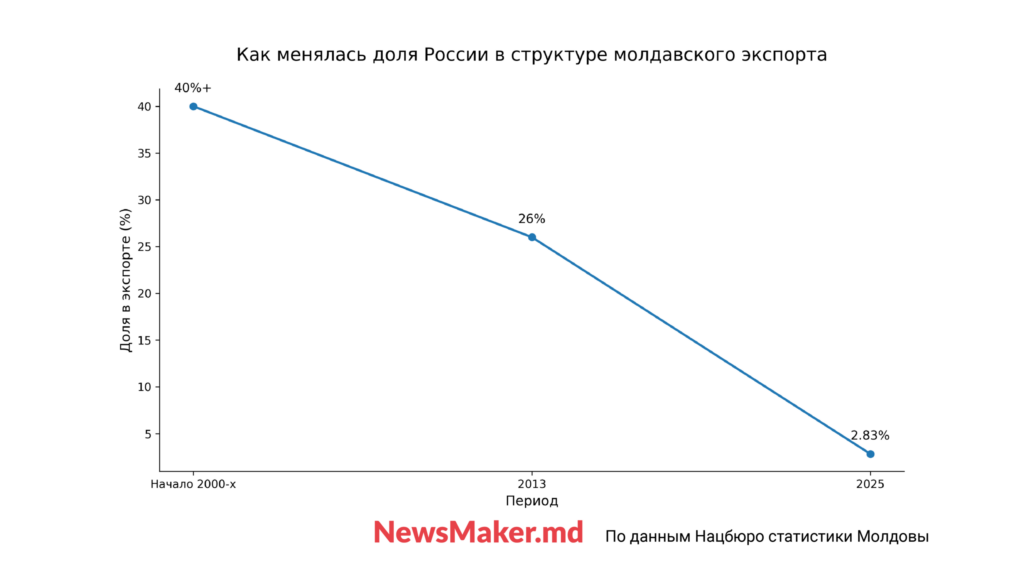
As a result, Russia’s share in the structure of exports of Moldovan products last year was only 2.83%, and in the structure of imports – 2.02%. For comparison: in 2013, Russia accounted for 26% of Moldovan exports, and in the early 2000s – more than 40%. The share of Russian goods in imports in 2013 was 14%.
NM asked the National Bureau of Statistics for detailed data on what categories of goods Moldova continues to import from Russia and export to Russia.
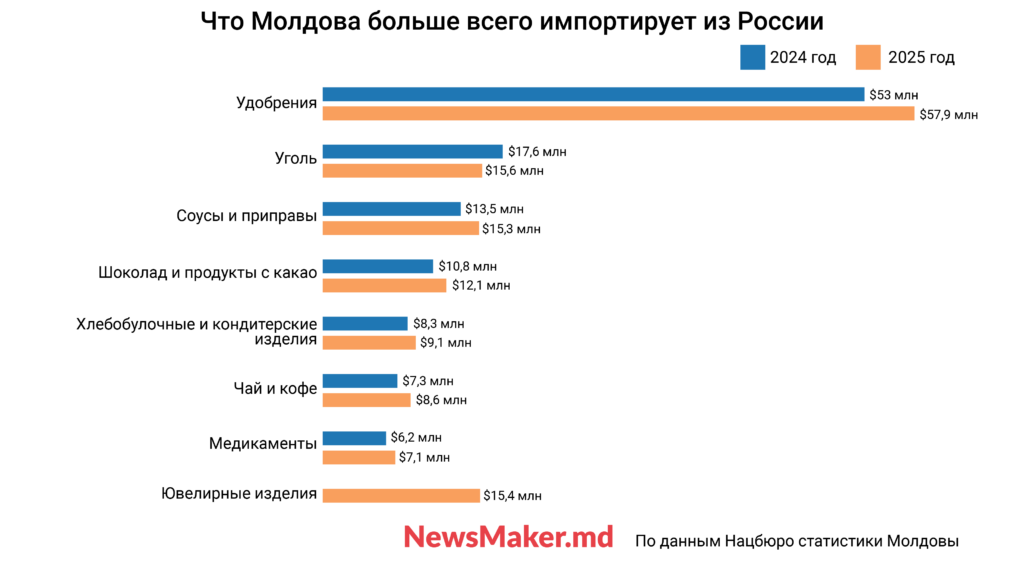
According to statistics, the largest category of Russian imports to Moldova remains not food, but fertilizers. Thus, in 2024, with total imports from Russia amounting to $208.5 million, almost $53 million came from fertilizers (in customs statistics, fertilizers are divided into nitrogen and complex mineral fertilizers, but for convenience we combined these categories). In second place is coal ($17.6 million).
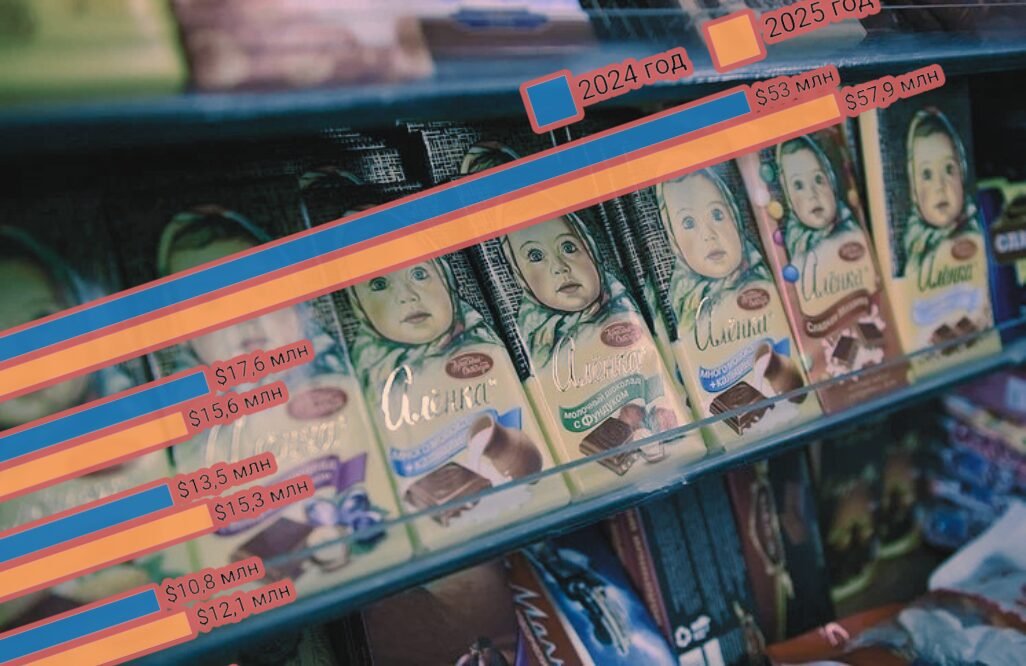
Moldova also continues to import Russian food products. In 2024, $13.5 million worth of sauces and seasonings, $10.8 million worth of chocolate and cocoa products, $8.3 million worth of bakery and confectionery products, $7.3 million worth of tea and coffee were imported from Russia. Also in 2024, $6.2 million worth of medicines were imported from Russia.
A similar structure remained in 2025. Of the total imports of $220 million, fertilizers amounted to $57.9 million, coal – $15.6 million. At the same time, jewelry ($15.4 million) appeared in the import structure. This is followed by sauces, chocolate, confectionery, tea and coffee.
In the first two months of 2026, the import structure remained similar: fertilizers, coal, jewelry and food. Over two months, imports amounted to $34.4 million, of which $15.7 million were fertilizers, $2.1 million were coal and $1.9 million were jewelry.
The structure of Moldovan exports to Russia is dominated by agricultural products and medicines. Thus, in 2024, out of $117.7 million in total exports, apples, pears and quinces accounted for $46 million, apricots, cherries, peaches and plums — $11 million, and medicines in third place with $9 million.
The main export categories also include equipment for the food industry ($8.9 million), grapes ($5.3 million), paper and cardboard packaging ($5 million), knitted T-shirts and T-shirts ($3.9 million).
In 2025, with a total export of $107.3 million, apples, pears and quinces amounted to $36.9 million, apricots, cherries, peaches and plums – $20 million, medicines – $9.1 million, grapes – $6.2 million, equipment for the food industry – $5.9 million, packaging – $4.3 million, dried fruits – $2.9 million, lamb and goat meat — $2.3 million.
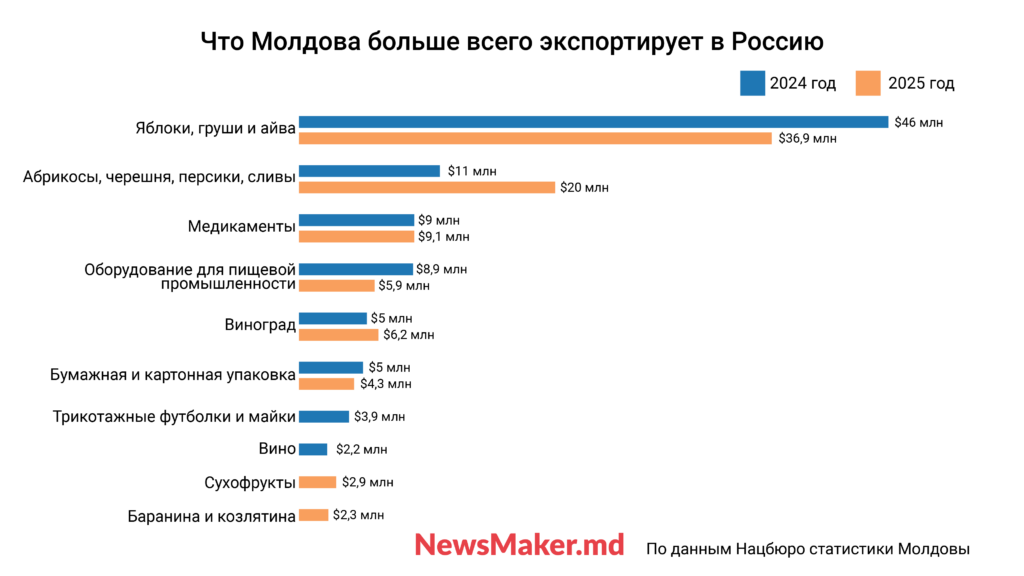
In the first two months of 2026, exports amounted to $15.6 million, while the structure remained the same: agricultural products, medicines and equipment for the food industry.
What do businessmen and experts say?
NM spoke with a representative of one of the retail chains, which also sells Russian goods. He noted that there is no “repackaging of goods” that is being talked about in the public space (Osmokeksku previously stated this – NM).
“You just pay, bring it, clear customs and bring it to Moldova,” the interlocutor said.
According to him, they continue to both import Russian goods to Moldova and export Moldovan goods to Russia. He added that books from Russia also continue to be imported to Moldova, although the procedure for importing them is more complicated than food products.
The businessman said that difficulties arise when paying for goods in US dollars, but this problem can be solved by switching to payments in Russian rubles, and Moldovan banks open ruble accounts for business.
He also noted that goods imported from Russia either have no direct analogues, or they are well-known brands in Moldova, or they are cheaper in price. “But what we import (from Russia) does not affect the interests of the Moldovan manufacturer. The same chocolate, for example. There is only one chocolate manufacturer in Moldova, and some of its products are produced in Belgium,” the interlocutor explained.
Speaking about a possible ban on Russian goods, he noted that such a decision would be political, but retailers would cope with it. “Economically, we will receive a mirror response (from Russia) to our exporters. Russian goods are both expensive and cheap. The store’s assortment is not based only on the principle “the cheaper, the better”: there may also be well-promoted and popular brands. Can they be replaced (if banned)? It’s probably possible, but we need to look at the consequences for our exporters (to Russia),” the businessman concluded.
The head of the Association of Agricultural Producers Forța Fermierilor, Alexander Slusari, in a conversation with NM, emphasized that it is now almost impossible to do without Russian fertilizers. “Unfortunately, due to expensive gas, Western fertilizers are twice as expensive as Russian ones. Fertilizers are produced in gas-powered chemical plants. If we talk about other Russian goods, we can replace cookies and other products with domestic ones. Their goods are on the most prominent shelves. And here I see a big problem: our cookies or waffles are no worse, there are also Ukrainian ones, which are not inferior in price to Russian ones. Even from an economic point of view, many Russian food products are very shameful,” says Slusar.
But, he emphasized, Moldova does not produce fertilizers. “If the difference in price was 10% and there were political aspects, this is one situation. When the price difference is 200%, we will simply ruin our agricultural producers. For Russia, our market is pennies, and we, (by refusing Russian fertilizers), will finish off our farmers,” Slusar explained, clarifying that the cost of fertilizers is about 10% of the cost of agricultural products.
IDIS Viitorul expert Veaceslav Ionita also considers a possible ban on Russian goods to be more of a political decision. “This topic needs to be divided into two parts. Economically, any ban is bad for consumers. Politically, there really are vulnerabilities here. We have already gotten rid of energy dependence, but it has cost us dearly. The second vulnerability is fertilizers,” Ionita noted.
According to him, there are “specific categories of goods” that are typical for trade turnover between Moldova and Russia. “We were dependent on Russia for many goods. Now we have almost pulled away from Russia in all goods, but there are some specific goods,” the expert said.
In the case of imports, he clarified, these are fertilizers. “And if we talk about exports, then, for example, we export quite a bit of meat, but a third of it goes to Russia. For fruits, we still supply about 22% to Russia. Pharmaceuticals used to go almost entirely to Russia, now it’s about 15%,” Ionita said.
And he added that relations between Moldova and Russia are already extremely tense, and trade volumes are the lowest in history. “I politically understand those who call for a ban, but economically it is difficult to understand the feasibility of such a decision,” says Ionita.
Economic expert Victor Ciobanu also noted the political nature of a possible revision of trade relations with Russia: “On the other hand, there are entrepreneurs who transport goods there and probably bring something back. Judging by what I see on supermarket shelves, these products are in the winning price segment. Same cookies and chocolate – cheaper.”
According to Cioban, “this is not the case when an embargo needs to be introduced.” “There is a part of society that is outraged by this. Some people ignore such goods for patriotic reasons. But I think that the state should not interfere here. We must leave everything in a state of natural decay,” the expert concluded.
Subscribe to our Telegram channel @newsmakerlive. Everything that is important to know right now about Moldova and the region quickly appears there.
Want to support what we do?
You can contribute to quality journalism by supporting us one-time through the E-commerce system from maib bank or by taking out a monthly subscription to Patreon! This way you will become part of changing Moldova for the better. Thanks to your support, we will be able to implement even more new and important projects and remain independent. No matter how you support us, you will receive a small gift. Follow the link to become our partner. It’s not difficult and even pleasant.