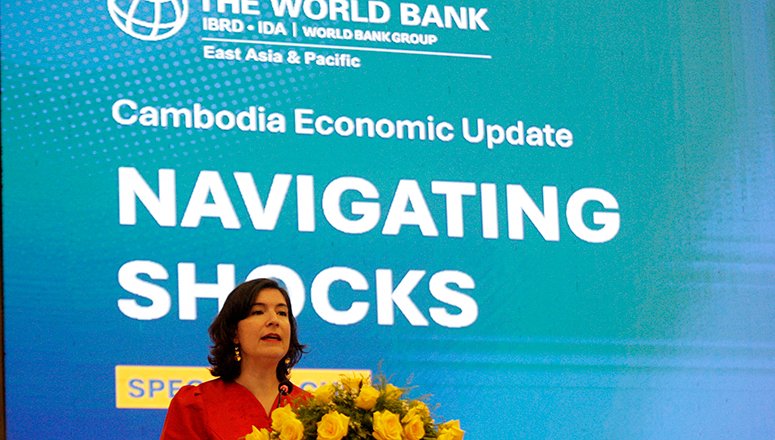
Synopsis: Meyer says the Kingdom’s economy is holding in the face of simultaneous shocks, demonstrating a resilience that can be sustained through targeted policy action to protect jobs and livelihoods.
The World Bank (WB) warned that higher fuel prices driven by the Middle East conflict, the return of nearly one million migrant workers from Thailand and strains in the domestic credit market are placing growing pressure on households, businesses and employment in Cambodia.
The WB’s augury came during the launch of the Cambodia Economic Update in Phnom Penh yesterday.
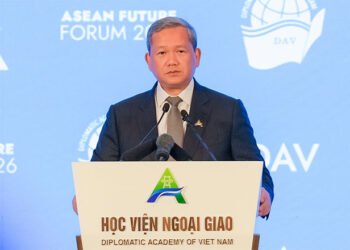
Presiding over the official launch of the Cambodia Economic Update for June 2026, themed ‘Navigating Shocks’, Tania Meyer, WB Country Director for Cambodia, said that fuel prices have surged due to conflict in the Middle East, while the return of nearly one million migrant workers from Thailand has reduced remittance inflows. At the same time, strains in the domestic credit market are affecting households and businesses across the country. “These three shocks are hitting Cambodia from every direction.”
The Cambodia Economic Update for June 2026 examined how external and domestic pressures are impacting the Kingdom’s economic outlook and development trajectory.
Vongsey Vissoth, Deputy Prime Minister and Minister in Charge of the Office of the Council of Ministers and Dr Sok Siphana, Senior Minister in charge of Special Missions and Chairman of the Trade Policy Advisory Board, among other dignitaries, were present on the occasion.
The WB Country Director highlighted Cambodia’s remarkable development journey over the past two decades, noting that the Kingdom has been one of the world’s fastest-growing economies and has laid important foundations for modern development. However, Meyer noted that Cambodia is currently facing extraordinary challenges.
To illustrate the human impact of these challenges, Meyer described the situation of a woman who returned from Thailand without a job while facing rising food prices and debt obligations. “That is not an abstract scenario. We know this is the reality for hundreds of thousands of Cambodian families and businesses right now,” she said.
According to Meyer, the combined impact of these pressures is expected to slow Cambodia’s economic growth to 3.9 percent this year. Despite the difficult environment, she stressed that the economy continues to demonstrate resilience.
“Cambodia’s economy is holding in the face of simultaneous shocks, demonstrating a resilience that can be sustained through targeted policy action to protect jobs and livelihoods,” she said.
Looking beyond the current challenges, the WB Country Director emphasised the importance of investing in human capital and creating new sources of growth to secure Cambodia’s long-term development.
“With the working-age population share projected to peak around 2043, the next 15-20 years are decisive for Cambodia’s future. Investing in people—in education, jobs, and new engines of growth—is what will turn Cambodia’s demographic window into its greatest competitive advantage,” she added.
The report noted that Cambodia’s economy is also grappling with a prolonged property sector downturn and a contraction in remittance inflows. These pressures contributed to headline inflation rising to 5.8 percent in April this year, disproportionately affecting low-income households.
The World Bank warned that a 10 percent increase in fuel prices is estimated to raise the poverty rate by 1.4 percentage points, highlighting the vulnerability of many households to external economic shocks.
Despite these challenges, foreign direct investment (FDI) reached $5.1 billion last year, helping create an estimated 400,000 formal jobs and providing critical employment opportunities for workers transitioning from agriculture and returning migrants.
According to the WB, the report recommends a multi-pronged policy response focused on protecting livelihoods, supporting job creation and advancing structural reforms to strengthen competitiveness and productivity.
In the short term, the report recommends targeted and time-bound cash transfers for vulnerable households rather than broad fuel-tax relief measures. It also emphasises mobilising domestic revenue to sustain and expand investments in health, education and social protection.
To ease pressure on rural employment, the WB recommends fast-tracking fertiliser imports and promoting fuel-efficient farming practices to help farmers maintain productivity and incomes.
The session also featured a panel discussion with four panellists: Dr Oum Chan Mono, Advisor to the Minister at the Ministry of Labour and Vocational Training (MLVT); Eng Netra, Executive Director of Cambodia Development Resource Institute (CDRI); Lao Poliveth, Under Secretary of State of OCM; and Sandra Bernklau, Representative of United Nations Population Fund in Cambodia (UNFPA).
The discussion explored policy options for strengthening resilience, protecting vulnerable groups and ensuring that Cambodia can sustain economic growth while navigating a challenging global environment.