
Listen to this article
Estimated 4 minutes
The audio version of this article is generated by AI-based technology. Mispronunciations can occur. We are working with our partners to continually review and improve the results.
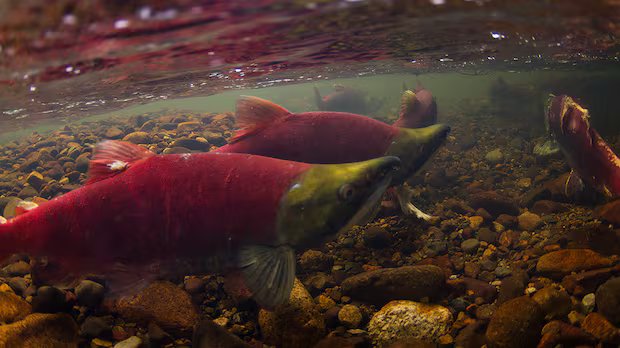
Warm rivers and streams are becoming a growing concern for salmon in B.C.’s Interior with another low sockeye return anticipated in Okanagan waters this fall.
According to the Syilx Okanagan Nation Alliance, the number of adult sockeye salmon returning to spawn is expected to be low for the second year in a row because of warm water and low stream levels.
It says current estimates suggest between 32,300 and 96,900 Okanagan sockeye will be counted at Bonneville Dam on the Columbia River — the largest river in the Pacific Northwest — which flows through B.C., Washington state and Oregon.
Of those, only about 4,800 to 14,500 are expected to reach spawning areas above Osoyoos Lake.
“For comparison, the spawning habitats have the capacity to support approximately 180,700 to 205,500 spawning sockeye,” the alliance said in a statement.
To reach Okanagan waters, the salmon travel more than 1,000 kilometres from the Pacific Ocean. They swim upstream against the current of the Columbia River, passing through nine hydroelectric dams before reaching Syilx territory.
Last year, the alliance said, the vast majority of the run stayed in the Columbia River seeking refuge in cooler water.
Given the low projected return this time around, there will be no economic or recreational sockeye fishing this year. Members may still harvest fish for personal needs but the alliance is asking people to take only what they need to help conserve future returns.
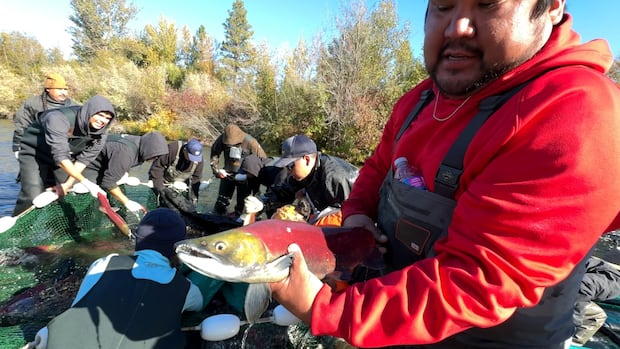
After nearly a century, sockeye salmon can again access a historical spawning habitat in B.C.’s Okanagan Lake. It’s a welcome return for the Syilx Nation people, who spent 20 years rebuilding the spawning habitat to make it possible.
The Syilx Okanagan Nation Alliance is made up of eight First Nations whose territory spans from north of Revelstoke into Washington state.
According to the ONA website, salmon — or ntytyix — are sacred to the Syilx people.
In May this year, the Nation declared a state of watershed emergency because of drought conditions, stating that there wasn’t enough water in the creeks that made it harder for fish to swim.
Young salmon at greater risk: research
New research from the University of British Columbia suggests increasingly warming rivers in the province’s Interior may be putting young salmon at greater risk than previously understood.
Two studies from UBC’s Pacific Salmon Ecology and Conservation Lab looked at juvenile Chinook salmon from the Nicola River and found that young fish had more trouble coping with heat when they were swimming, rather than resting in place.
Scott Hinch, a professor in UBC’s faculty of forestry and environmental stewardship, says most studies test fish at rest but young salmon in the wild are constantly moving to feed and avoid predators.
“In the Interior … the streams are really warm,” he said. “It’s not surprising that they’re more adapted to dealing with warm conditions than the population along the coast.”
But he says researchers found 20 C was an important threshold for the Interior Chinook they studied. Fish acclimatized to warm water could cope around that level but above it their ability declined. Some fish even died after being forced to swim in water at 24 C.
“We’re seeing streams in the interior right now that are getting up to 24 C quite, quite commonly and that’s going to become more of a reality moving forward,” the researcher said.
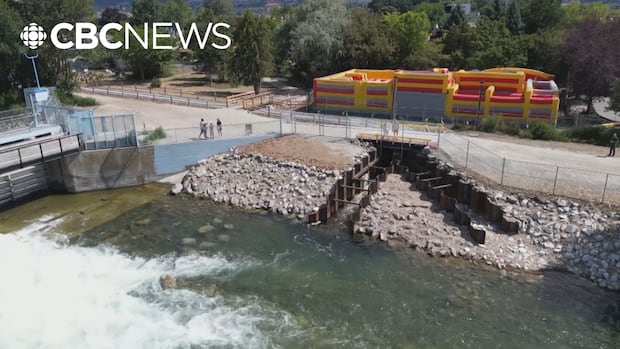
In B.C.’s Interior, an initiative supported by the Okanagan Nation Alliance has brought sockeye salmon to Okanagan Lake for the first time in nearly a century. As Brady Strachan reports, a new generation of young people are helping to restore salmon spawning grounds while reconnecting with their culture.
Warm water has already affected salmon migrations in B.C.
In July 2021, the B.C. Wildlife Federation reported that the Okanagan River reached more than 23 C, causing sockeye salmon to halt their migration.
In 2016, warm temperatures were blamed for the lowest number of returning sockeye in B.C.’s Fraser River on record, and two years later, officials warned that the river was so warm that migrating sockeye salmon might die on their journey.
“Salmon prefer to be in a particular temperature of water … that might be between 15-17 C,” Hinch said. “If fish can’t experience that … they’ll go looking for it.”
Hinch says protecting trees along streams can help keep waterways cooler, creating areas where salmon can find relief during heat.
According to a 2023 study, decades of logging activities near rivers in the Interior have driven up temperatures of salmon habitat.
Hinch says it’s absolutely necessary that riparian trees are protected.
“They make a huge difference,” he said. “Temperatures can rise really rapidly in those streams when they are not there.”