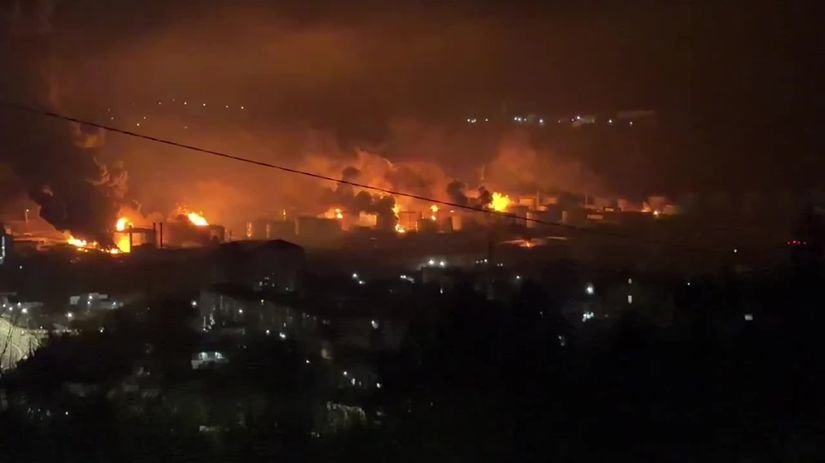
Russian emergency services are still trying to put out a fire that broke out at a Black Sea oil terminal after a Ukrainian attack earlier this week. This was stated on Thursday by local officials who called on residents living near the facility not to leave their homes due to possible health risks from harmful substances. The creator of the combat substance novichok warned on Facebook about the mass poisoning of the population with smoke from burning oil and petroleum substances.
23.04.2026 14:13 , updated: 14:54
“The fire at the Tuapse refinery is still burning. Four storage tanks are currently on fire,” an official from the Krasnodar region’s crisis staff confirmed to AFP on Thursday.
Ukraine hit an oil facility in a port city and known Tuapse Black Sea Airport on Monday, with four storage tanks still burning after the attack, according to the regional crisis management center.
On Wednesday, it also rained in the vicinity of the terminal, which combined with soot and ash in the air created the so-called black “oil” rain. According to the authorities, the concentration of toxic particles was “two to three times higher than the permitted limits”. In addition, the rain left a black coating on the surfaces.
The concentration of toxic particles released by the fire into the atmosphere is up to three times higher than the permitted level, according to official measurements on Monday.
“The situation will return to normal as soon as the firefighting is over,” the authorities say.
Unverified footage posted by local residents on social media shows huge black clouds over the city, oil slicks on the sea and beaches, and dead fish and birds lying on the shore. Stray dogs and cats, on the other hand, have fur covered with black deposits, and cars are littered with small black dots.
What is “oil” rain?
Oil rain is an unofficial name for the phenomenon when particles of oil or oil products enter the atmosphere and then fall to the ground together with precipitation.
- It can occur, for example, in oil well fires, tanker crashes or refinery bombings
- In the air, oil breaks down into tiny particles that bind to water or soot
- They then fall to the ground as dark, oily “rain”
- It is not classic oil rain, but polluted precipitation containing oil substances
- A similar phenomenon was observed, for example, during the war in the Persian Gulf, when oil wells were burning
“This criminal war must end immediately,” declared chemist Vil Mirzayanov, whom the Russian media describes as one of the creators of the Novichok combat agent, and who warned of mass poisoning of the population by smoke from burning oil and oil products. “As a chemist, I say that this smoke is not innocent, but brings death in the form of polyaromatic compounds formed during combustion, including strong carcinogens. Once they enter the body, it is impossible to get rid of them,” he wrote on Facebook.
City officials on Wednesday urged residents to close their windows, limit their time outside and, if they need to go out, to wear a mask.
According to AFP, Tuapse is repeatedly the target of Ukrainian attacks. In the past period, Kiev has intensified its attacks on Russian oil ports in an attempt to weaken the country’s income from energy exports, which are a key source of funding for the military.
 Read more Ukraine scares allies. The partners ask Kyiv to slow down and warn of the consequences