Manuel Iribarren, 28-year-old Venezuelan entrepreneur residing in Silicon Valleyco-founded the company Primavera Infinita, which signed a Productive Participation Contract (CPP) with PDVSA on September 2 to develop the Budare-Elotes block.
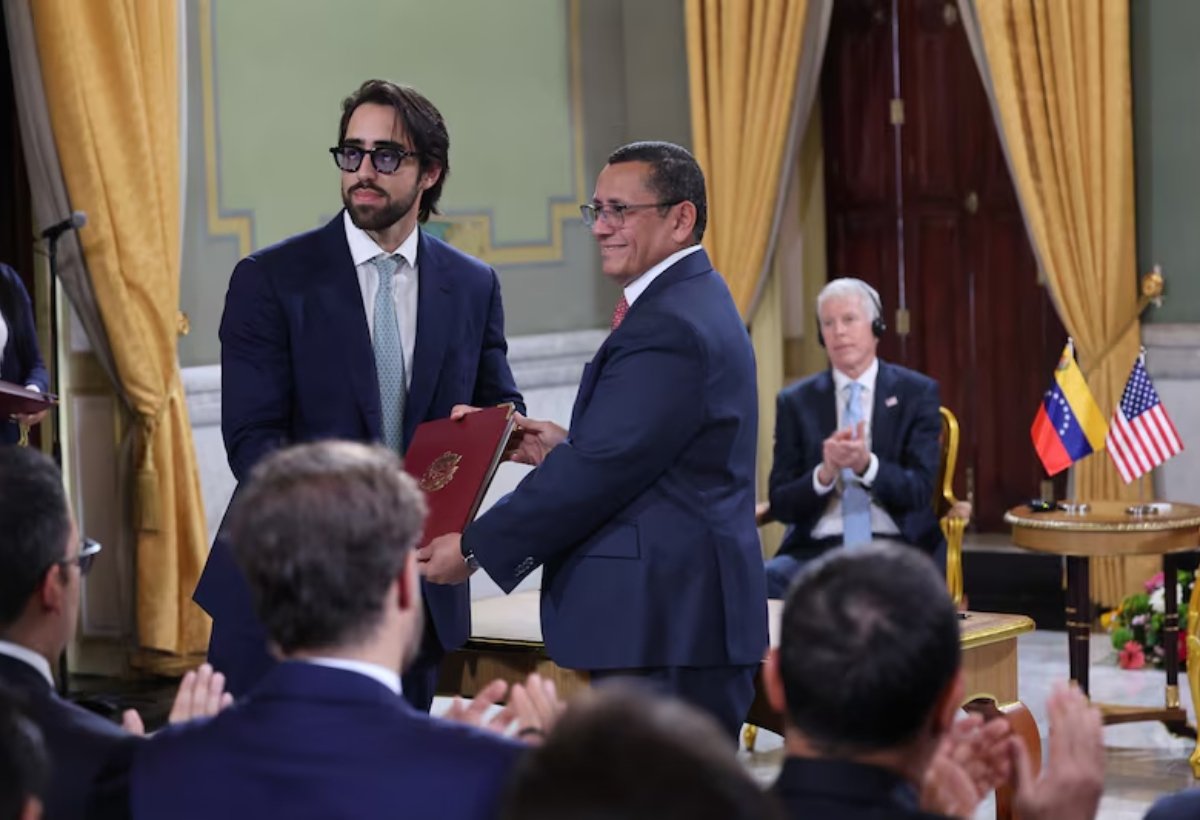
The agreement was signed in an event at the Miraflores Palace, with the president in charge, Delcy Rodríguez, and the United States Secretary of Energy, Chris Wright.
According to Bloomberg, Primavera Infinita was established in 2026 and is linked, in addition to Iribarren, raised in the United Kingdom, to Fred Ehrsam, co-founder of Coinbase and Paradigm. The third partner identified is Dheeraj Verma, former chairman of Quantum Energy Partners.
Iribarren avoided talking about the company. At the end of a discussion about risky investments at the Startup Venezuela Summit in Caracas, he was asked how an entrepreneur in the technological ecosystem intends to develop oil assets.
“No, I’m not giving interviews, I’m not interested, I came to work”he responded.
During the meeting he did express an ambitious vision. According to his intervention, Venezuela, which produces about 1.2 million barrels per day, could reach 10 million. That figure is not a known contractual goal of Infinite Spring nor did it come with a development plan that allows us to evaluate how it would be achieved.
A bet on a country with large reserves
Ehrsam maintains that Venezuela has enormous hydrocarbon reserves and production much lower than its historical maximums. In an interview with Bloomberg, he described the opportunity as exceptional and compared it to entrepreneurial bets that arise only a few times in a generation.
He considered that the country’s economic recovery can open space for businesses capable of boosting activity and improving living conditions.
Iribarren also defended the bet. In statements reported by the same media, he assured that the company committed to investing a substantial amount of capital to recover deposits and incorporate technology and operational efficiency.
He avoided, however, revealing how the operations will be financed and giving details about all the assets he intends to acquire.
🇺🇸🇻🇪 The executive director of the Primavera Infinita company, Oscar Quintero, called on Venezuelan talent abroad to join the energy development of Venezuela.🎥 VTV https://t.co/mPCOuxdg79
— 𝙋𝙤𝙡𝙞𝙖𝙣𝙖𝙡𝙞𝙩𝙞𝙘𝙖 (@polianalitica) September 2, 2026
Primavera seeks to produce 100,000 barrels per day in the short term. It is a business objective, not an achieved production. The company also showed interest in the Boca, Guico and Guara blocks, in the Orinoco Oil Belt, operated by the Brazilian Alvorada Heavy Industries.
The challenge of recovering mature fields
Budare-Elotes is not a new asset. YesOur fields were discovered decades ago and were under contract with LNGEG Growth I Corp, a subsidiary linked to the Canadian LNG Energy Group, until Venezuelan authorities terminated the agreement in February 2026.
Oil & Gas Journal attributed a production potential of more than 70,000 barrels per day to the project. Public information does not allow us to know how this figure is related to the goal of 100,000 barrels of Primavera, what assets each calculation includes or in what terms they would be reached.
The difference between the potential of a deposit and its effective production is decisive. Mature fields may require well workover, pressure recovery, interventions to reduce water entry, facility maintenance, and improvements to transportation and processing systems. Added to this are the needs for electricity, equipment and services to sustain the operation.
A contract with undisclosed terms
PDVSA confirmed the signing of the CPP for Budare-Elotes, but the public announcements consulted do not include the full text of the agreement or the breakdown of its economic conditions.
The amount of investment committed is not known, the duration of the contract, the distribution of income, the required production goals or the conditions to recover the invested capital, the media clarified.
An analysis by Antonio Pérez, oil contract advisor, suggests that the recovery of the block could be supported by improved recovery techniques, well rehabilitation and use of the associated gas.
The text also explores possible applications of financial tokenization and lithium extraction from produced water. They are technological avenues that can be studied in mature fields, but there is not enough public information to attribute to Primavera a barrel tokenization program, lithium recovery or gas monetization.
Technology can help optimize the operation and improve crude oil recovery, but it does not eliminate physical constraints or the need for capital. The result will depend on the real conditions of the assets, the resources that the company commits and its ability to execute a development program.
The company incorporated professionals with experience in the industry. They include Óscar Quintero, former head of enhanced oil recovery at Occidental Petroleum, who was confused with Iribarren at the signing of agreements in Miraflores, and three former Chevron Venezuela executives: Mario Gandara, Jorge Castro and Ivette López, in commercial, financial and legal functions.
That experience provides relevant capabilities, but it does not alone answer questions about available capital, investment schedule, and operational goals.