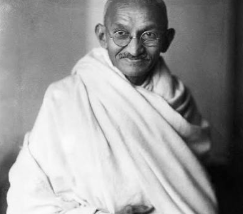
Context: On Gandhi Jayanti, an article revisited the “Gandhian Question”, examining the relevance of Mahatma Gandhi’s ideas amid digital polarisation, hyper-nationalism, economic inequality and technological disruption.

About The Gandhian Question: Reimagining Gandhi for 21st-Century India
What it is?
- Gandhian philosophy is an ethical and socio-political framework centred on Satya (truth), Ahimsa (non-violence), Satyagraha and Swaraj (self-rule). It advocates peaceful resistance, moral politics, decentralisation, self-reliance and dignity of labour, placing human welfare above materialism.
Core Pillars of Gandhian Philosophy in Contemporary Governance:
- Satyagraha & Moral Politics (Opposition Without Dehumanisation):
- Gandhi maintained that politics could not be detached from morality, framing truth not as an abstract ideal but as a code of public life.
- In an era dominated by algorithmic echo chambers, cancel culture, and aggressive partisan hostility, Satyagraha offers an alternative framework: contesting injustice and challenging political opponents without stripping them of human dignity or appealing to hatred.
- Ahimsa (Expanding Non-Violence Beyond Physical Force):
- Non-violence was not viewed as weakness; it demanded rigorous moral courage, organization, and discipline (as demonstrated by suspending the Non-Cooperation Movement after the 1922 Chauri Chaura incident).
- Today, violence extends into the digital and discursive domains through hate speech, targeted disinformation, online abuse, and sectarian polarization, making Gandhi’s call for emotional restraint and fraternity relevant to preserving social cohesion.
- Swaraj (Substantive Democracy vs. Procedural Majoritarianism):
- Gandhi distinguished between formal independence (political transfer of power) and genuine Swaraj (self-rule through internal moral restraint, institutional respect, and collective civic responsibility).
- True democracy cannot be reduced to voting every five years; it requires active civic participation, tolerance of dissent, institutional fidelity, and the recognition that democratic rights are inseparable from civic duties.
- The Talisman & Trusteeship (Ethical Economics & Public Policy):
- The Gandhian Talisman: Evaluating policy interventions—including digital public infrastructure, artificial intelligence, and macroeconomic reforms—by their measurable impact on the poorest and most vulnerable (Antyodaya).
- Trusteeship: While recognizing private enterprise, it establishes that capital ownership carries social responsibility, framing corporations and high-net-worth individuals as moral trustees of societal wealth.
- Swadeshi & Environmental Moderation:
- Framed not as autarkic isolationism, but as local self-reliance and the preservation of the dignity of manual labor.
- His famous observation that “Earth provides enough to satisfy every man’s need, but not every man’s greed” serves as an ethical critique of consumerism amid climate change and resource depletion.
Debates and Historical Context:
- Caste and the Ambedkarite Critique: While Gandhi campaigned against untouchability, his paternalistic approach toward caste structures contrasts with Dr. B.R. Ambedkar’s structural critique aimed at the total annihilation of caste. Modern public discourse emphasizes evaluating Gandhi’s social reform work alongside Ambedkar’s constitutional vision without uncritical veneration.
- Technology & Modern Industrialization: Gandhi’s early skepticism of large-scale machinery cannot directly replace modern industrial planning or macroeconomic policy. However, his framework remains useful for evaluating modern automation, algorithms, and artificial intelligence by assessing their impact on human labor, worker dignity, and economic equity.
- Communal Harmony & Secular Citizenship: During the communal violence of Partition, Gandhi insisted that national identity could not be founded on religious uniformity. His vision supports equal, rights-based constitutional citizenship in a multi-religious democracy.
Key Dimensions for Indian Public Policy:
| Gandhian Concept | Traditional Dimension | Modern Governance & Policy Application |
| Satyagraha | Civil disobedience against colonial rule | Civil, issue-based dissent; constructive public discourse over digital toxicity. |
| Ahimsa | Non-violent direct action | Curbing cyber-bullying, hate speech, and administrative or communal intimidation. |
| The Talisman | Individual ethical test for social action | Policy auditing of AI adoption, welfare delivery, and infrastructure projects to benefit the marginalized. |
| Swadeshi | Hand-spun khadi and village industries | Domestic manufacturing value addition, rural supply-chain decentralization, and MSME resilience. |
| Trusteeship | Moral stewardship of personal wealth | Corporate Social Responsibility (CSR), environmental disclosures, and progressive corporate governance. |
| Nai Talim (Basic Education) | Craft-centered experiential learning | Skill integration, vocational education, and civic-ethics modules under the National Education Policy (NEP). |
Way Ahead:
- Bridging the Institutional Distance: Reinvigorate participatory democracy by decentralizing power to Panchayati Raj Institutions and Urban Local Bodies, moving citizen engagement beyond periodic voting.
- Integrating the Talisman into Digital & AI Policy: Institutionalize socio-economic impact assessments for public-facing digital platforms and automation initiatives, ensuring that vulnerable communities are not excluded by digital divides.
- Decarbonization & Sustainable Consumption: Incorporate Gandhian principles of resource moderation into environmental policies by expanding the circular bio-economy, promoting localized renewable energy, and curbing single-use consumer waste.
- Moving Beyond Hagiography: Avoid reducing Gandhi to symbolic imagery or dogmatic literalism; engage critically with his legacy alongside contemporary constitutional thinkers like Ambedkar, applying his ethical principles to the challenges of modern governance.
Conclusion:
In a contemporary landscape shaped by digital polarization, widening inequalities, and environmental challenges, his emphasis on Ahimsa, the democratic duty of Swaraj, and the primacy of the marginalized provides an ethical benchmark for public administration. Preserving constitutional democracy in twenty-first-century India requires grounding state power in truth, civic responsibility, and human dignity.