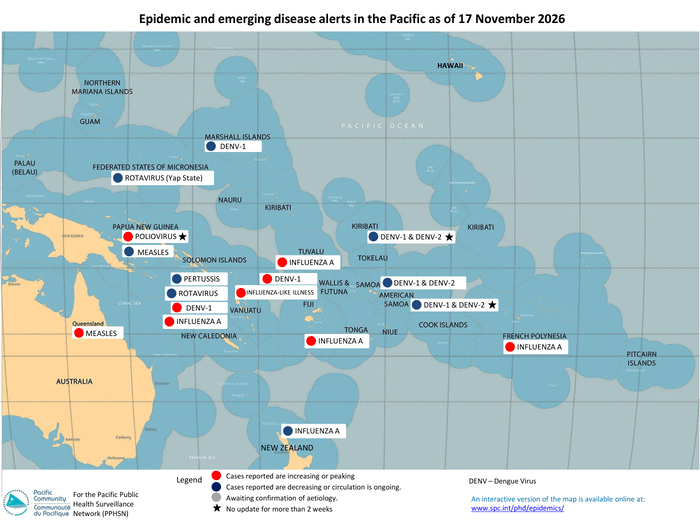
Highlights/updates since the last map was sent on PacNet on 10 November 2026:
Dengue
• Marshall Islands: The 20th Outbreak Situation Report, covering 15 August to 12 November 2026, records 173 positive cases (confirmed and probable) among 615 specimens tested: Majuro 128 and Ebeye 45, against 171 in the 18th report covering 15 August to 02 November 2026. All new positive cases since 29 October came from Ebeye, the most recent with onset on 09 November, while in Majuro the last confirmed case had onset on 18 October. There have been 18 hospitalisations since the beginning of the outbreak (Majuro 13, Ebeye 5), all children and no deaths. Positivity rates are 26% in Majuro and 35% in Ebeye, and attack rates 5.5 and 4.6 per 1,000 population, respectively. 71% of positive cases are under 20 years of age. Only DENV-1 has been identified. The red alert for dengue (DENV-1) is changed to a blue alert for Marshall Islands. – Source: Republic of the Marshall Islands Ministry of Health and Human Services, Communicable Disease Weekly Report for EpiWeek 45, including the 20th Outbreak Situation Report on dengue fever in Majuro and Ebeye shared with the PPHSN Coordinating Body Focal point on 16 November 2026.
• Samoa: Dengue Fever Outbreak Situation Report Issue No. 81 covering EpiWeek 44 (26 October to 1st November 2026) reports 37 new cases, up 3% on the previous week, with one laboratory-confirmed case (in comparaison to two in EpiWeek 43), two new admissions and no death. Since 1st January 2025, 20,553 clinically diagnosed cases, 5,550 laboratory-confirmed cases and nine dengue-related deaths have been recorded. DENV-1 accounts for 52% and DENV-2 for 48% of serotyped cases, and children under 15 years for 73% of cases. The blue alert for dengue (DENV-1 & DENV-2) remains in effect. – Source: Ministry of Health Samoa, Dengue Fever Outbreak Situation Report Issue No. 81 shared with the PPHSN Coordinating Body Focal point on 16 November 2026.
• Vanuatu: Situation Report #16 on the dengue outbreak reports 259 new laboratory-confirmed cases from EpiWeek 41 to 45 (05 October to 08 November 2026), mostly on Tanna (152) and Santo (76), with 20 on Efate and 17 on Malekula. The cumulative total reaches 476 confirmed cases on four islands: Efate 178, Tanna 167, Santo 100 and Malekula 18. Weekly cases peaked at 109 in EpiWeek 42, driven by Tanna (73 cases), then fell to 41 in EpiWeek 43 and 22 in each of EpiWeeks 44 and 45. Transmission, first concentrated in Shefa Province, increased sharply in Tafea between EpiWeeks 40 and 42. Seventeen dengue-associated hospitalisations have been reported, all discharged, with no severe dengue and no deaths. DENV-1 has been confirmed in 16 samples from Efate and Santo, and serotyping of Tanna samples is pending. The Ministry of Health keeps the outbreak under close observation until a sustained decrease is seen on all affected islands. The red alert for dengue (DENV-1) remains in effect for Vanuatu. – Source: Vanuatu Ministry of Health, Dengue Outbreak on Efate, Santo, Tanna and Malekula Island, Situation Report #16 shared with the PPHSN Coordinating Body Focal point on 17 November 2026.
Diarrhoea
• Federated States of Micronesia – Yap State: The Yap weekly bulletin for EpiWeek 45 (02 to 08 November 2026) shows diarrhoea below the alert threshold for a second consecutive week, with 3 cases against 5 in EpiWeek 44 (alert threshold 7), after ten consecutive weeks on alert. One of four stool specimens tested was positive for adenovirus. The blue alert for diarrhoea remains in effect for the Federated States of Micronesia (Yap State). – Source: Yap State Department of Health Services, Communicable Disease Weekly Bulletin shared with the PPHSN Coordinating Body Focal point on 13 November 2026.
Measles
• Australia: On 12 November 2026, NSW Health reported a confirmed measles case in a traveller recently returned from South Asia, where outbreaks are ongoing. While infectious, the person visited several places in Sydney, including Sydney Kingsford Smith International Airport and a healthcare facility. New South Wales has confirmed 58 measles cases since 1st January 2026. In Queensland, one measles notification was recorded in the week starting 02 November 2026, after none in the three previous weeks. Queensland has recorded 18 measles cases in 2026, 13 acquired overseas and 5 locally. Nationally, the National Notifiable Disease Surveillance System recorded 125 measles notifications in 2026 as of 17 November 2026, against 181 in 2025. The red alert for measles remains in effect for Australia. – Sources: NSW Health, Measles alert for Sydney, Queensland Health, Notifiable conditions weekly totals and summary information and the National Communicable Disease Surveillance Dashboard (NNDSS) accessed on 17 November 2026.
Pertussis/Whooping cough
• Vanuatu: Situation Report 7 on the pertussis outbreak in Penama Province reports no new cases on Ambae Island from EpiWeek 43 to 46 (26 October to 15 November 2026). The cumulative total remains 634 cases, of which 7 are laboratory confirmed. The last cases were reported in EpiWeek 41 (7 cases), after the peak of EpiWeeks 36 and 37 (266 and 307 cases). As of EpiWeek 46, five consecutive weeks have passed without a new case, which suggests that transmission may have been interrupted. The outbreak has not yet been declared over. The Ministry of Health may consider doing so once 42 days (two maximum incubation periods) have passed since the onset of the last case. Two cases have been hospitalised since the start of the outbreak, both discharged, and no death has been reported. The red alert for pertussis is changed to a blue alert for Vanuatu. – Source: Vanuatu Ministry of Health, Pertussis Outbreak in Penama Province, Situation Report 07 shared with the PPHSN Coordinating Body Focal point on 17 November 2026.
Respiratory diseases
• French Polynesia: In EpiWeek 45 (02 to 08 November 2026), French Polynesia remained in an influenza epidemic phase, with an increase to 111 laboratory-confirmed cases, 79 of them influenza A, and 38 hospitalisations, including four admissions to intensive care. No new death was reported. Since 05 October 2026 (EpiWeek 41), 283 confirmed cases (233 influenza A), 93 hospitalisations, seven intensive care admissions and three deaths have been recorded. These figures are still to be consolidated. Consultations for acute respiratory infection in the sentinel network also increased, while their proportion remained stable and more physicians reported than in the two previous weeks. Adenovirus, metapneumovirus, rhino/enterovirus and parainfluenza 4 were also detected. The influenza vaccination campaign is ongoing. The red alert for influenza A remains in effect for French Polynesia. – Source: Agence de régulation de l’action sanitaire et sociale (ARASS), Bulletin de Surveillance Sanitaire de Polynésie française n°40 shared with the PPHSN Coordinating Body Focal point on 17 November 2026.
• New Caledonia: On 09 November 2026, the Department of Health and Social Affairs (DASS) declared the end of the influenza epidemic, all clinical and virological indicators having returned to their usual level, with residual low-level circulation. The A(H1N1) epidemic had been declared on 25 September 2026 (EpiWeek 39). After a peak of 151 confirmed cases in EpiWeek 40, cases fell to 2 in EpiWeek 45, and test positivity from 20% in EpiWeek 44 to 5%. Over EpiWeeks 37 to 45, 599 cases were laboratory-confirmed, and A(H1N1) made up 99.3% of the 420 subtyped samples. People aged 65 and over accounted for 36% of cases. Acute respiratory infections represented 1.8% of emergency department presentations in EpiWeek 45, against a peak of 13% in EpiWeek 41, and 29% of presentations for acute respiratory infection during the epidemic led to hospitalisation. The red alert for influenza A is removed for New Caledonia. – Source: Department of Health and Social Affairs (DASS) of New Caledonia, Vigilance DASS bulletin 2026-#12 shared with the PPHSN Coordinating Body Focal point on 10 November 2026.
• New Zealand: The laboratory-based virology weekly report for week 45 (ending 08 November 2026) records 5,960 influenza-positive specimens since 1st January 2026: 5,514 influenza A (963 A(H1N1)pdm09, 877 A(H3N2) and 3,674 not subtyped) and 446 influenza B. This is 138 more than in the week 43 report, indicating that detections are slowing. The acute respiratory illness dashboard published its last weekly update of the season for the week ending 25 October 2026, and the next update is expected on 26 November 2026. The blue alert for influenza A remains in effect for New Zealand. – Source: PHF Science, New Zealand laboratory-based virology weekly report and Respiratory illness dashboard accessed on 17 November 2026.
• Tonga: The weekly syndromic surveillance report for EpiWeek 45 (02 to 08 November 2026) shows influenza-like illness falling for a fourth week, from 54 to 49 cases, while severe acute respiratory infections rose from 3 to 9. From 03 August to 08 November 2026, 623 of 835 ILI cases (74.6%) were tested: 270 (43.3%) were positive for influenza A, 6 for influenza B and 31 for RSV. A total of 101 SARI patients have been hospitalised and a fifth death has occurred among SARI cases, up from four reported in EpiWeek 43. The red alert for influenza A remains in effect for Tonga. – Source: Tonga Ministry of Health, Weekly Communicable Diseases Syndromic Surveillance shared with the PPHSN Coordinating Body Focal point on 12 November 2026.
• Vanuatu: The first situation report on the influenza A outbreak in Shefa and Tafea provinces, covering EpiWeeks 30 to 45 (20 July to 08 November 2026), reports 114 laboratory-confirmed influenza A cases out of 232 samples tested. Confirmed cases rose from 2 in EpiWeek 41 to a peak of 40 in EpiWeek 43, then fell to 32 in EpiWeek 44 and 12 in EpiWeek 45. Efate accounts for 98 cases (86%) and Tanna for 16 (14%), where the first cases were detected in EpiWeek 44. Subtyping identified influenza A(H1N1)pdm09 as the circulating strain. Thirty-three confirmed cases have been hospitalised and no death has been reported. Influenza-like illness reached 7,315 cases over the period, 5,943 in Shefa and 1,372 in Tafea, with a peak of 981 in EpiWeek 43 followed by 754 and 533 cases, still above the alert threshold. The outbreak, declared in Shefa in EpiWeek 42 and in Tafea in EpiWeek 44, remains ongoing. The red alert for influenza A remains in effect for Vanuatu. – Source: Vanuatu Ministry of Health, Influenza A Outbreak, Shefa and Tafea Province, Situation Report 01 shared with the PPHSN Coordinating Body Focal point on 17 November 2026.
Rotavirus
• Vanuatu: The first joint situation report on the rotavirus outbreak in Tafea and Sanma provinces, covering EpiWeeks 30 to 45 (20 July to 08 November 2026), reports 1,202 cases, of which 12 are laboratory confirmed (3 in Tafea and 9 in Sanma). Tanna accounts for 929 clinically diagnosed cases (78%), Santo for 259 (22%) and Malo for 2. Cases peaked at 251 in EpiWeek 37 and have declined steadily since, to 8 in EpiWeek 45, although sporadic transmission continues. Children under five account for 82% of cases. Tafea has reported 46 hospitalisations and one death since the start of the outbreak, and no patient remains in hospital. The blue alert for rotavirus remains in effect for Vanuatu. – Source: Vanuatu Ministry of Health, Rotavirus Outbreak, Tafea and Sanma Province, Situation Report 01 shared with the PPHSN Coordinating Body Focal point on 17 November 2026.
Other Information:
Dengue
• American Samoa: On 12 November 2026, the US CDC published in its Morbidity and Mortality Weekly Report a review of the dengue outbreak in American Samoa. From June 2025 to August 2026, 1,048 confirmed dengue cases were identified (211 per 10,000 population), 95% locally acquired and 49 travel-associated. A total of 371 patients (35%) were hospitalised and none died. Of the confirmed cases, 78% of cases were under 20 years of age, and incidence was highest among children aged 10 to 14 years (652 per 10,000). Of 146 serotyped cases, 93% were DENV-1 and 7% DENV-2. No travel-associated case was identified after 15 February 2026, and case counts declined from February to August 2026. – Source: US CDC, Morbidity and Mortality Weekly Report, Notes from the Field: Dengue Outbreak, American Samoa, 2025–2026 accessed on 17 November 2026.
Hantavirus
• Global: On 12 November 2026, the Institut Pasteur published the results of coordinated genomic sequencing of the Andes hantavirus cluster on the MV Hondius expedition cruise (April to May 2026, 13 cases and three deaths), carried out by laboratories in seven countries. The viruses showed low genetic diversity, consistent with a single zoonotic spillover event followed by human-to-human transmission through close and prolonged contact. Eight of ten apparent mutations were sequencing artefacts, and there was no evidence of airborne spread. – Source: Institut Pasteur, Andes hantavirus: characterization of a rare disease cluster by coordinated genomic sequencing, accessed on 17 November 2026.
Respiratory diseases
• Northern Mariana Islands: The weekly syndromic surveillance report for EpiWeek 44 (1st to 07 November 2026) records 24 laboratory-confirmed influenza cases (22 influenza A, 2 A(H1N1)pdm09), up from 11 in EpiWeek 43, for 427 in 2026. Influenza-like illness rose to 41 cases, 64% above the average of the three previous weeks. Subtyping by the Guam Public Health Laboratory, released on 22 October 2026, identified three A(H1N1)pdm09 viruses. – Source: Commonwealth of the Northern Mariana Islands, Weekly Syndromic Surveillance Report shared with the PPHSN Coordinating Body Focal point on 16 November 2026.