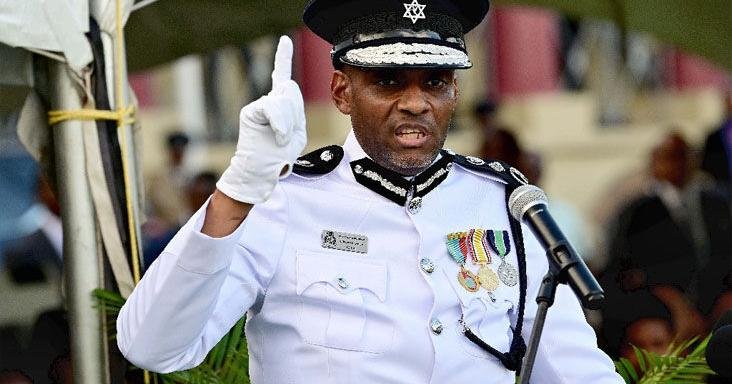
It has been a very long and trying year for the Trinidad and Tobago Police Service (TTPS), Commissioner Allister Guevarro said as he marked his first 12 months in charge of the organisation yesterday.
This as the TTPS implemented initiatives like the state of emergency (SoE) and responded to a number of significant events, he said.
In an interview at the Police Administration Building, Port of Spain, Guevarro said he appreciated the reception he received from the public and members of the TTPS when he assumed office.
He noted that shortly after taking office, national discussion focused on the SoE, including questions about whether the Police Service had become reliant on emergency powers to combat crime.
Guevarro maintained that the TTPS had long operated under strategic crime-fighting plans and said the SoE had simply provided additional tools to support existing efforts.
“I want to assure the public that the TTPS has a strategic plan. We’ve always had strategic plans from since the early 2000s coming forward that treat with crime, and we have one to deal with crime moving forward,” he said.
According to the Commissioner, two aspects of the SoE proved particularly useful—preventive detention orders and warrantless entry powers.
“What the SoE did was add a different layer to what we had available to us as our tools,” he said, adding that the measures helped the TTPS maintain control over criminal activity.
Guevarro pointed to what he described as measurable successes following the introduction of the emergency measures.
He said September 2025 recorded the lowest monthly homicide figure in approximately 15 years, with 20 murders reported during that month.
The Commissioner also said the country ended 2025 with 369 homicides, compared to 629 in 2024, representing a 42% reduction.
He described the decline as a significant achievement and credited police officers across the country for the results.
“By the end of the year, we finished with 42% less homicides than 2024,” he said. “From a historic high to a record low…and that is not Guevarro only. I would like to recognise the hard work of the TTPS.”
He noted that serious reported crimes had also declined—by about 30%—and said the Police Service remained on a downward crime trajectory during 2026.
He acknowledged, however, that public perception had not necessarily kept pace with the statistics.
“I know the public will say that they are not feeling safe and there is a public perception that crime is still high. But the statistics do speak for themselves,” he said.
$500m TTPS debt
Guevarro said an internal review of the organisation’s finances revealed approximately $500 million in outstanding debt owed to suppliers and service providers.
He said the liabilities covered a wide range of vendors, including those providing information technology services, equipment, and other operational support.
“At this point in time, we have submitted a report to the Minister of Homeland Security (Roger Alexander) where we have about $500 million in debt,” Guevarro said.
He said the financial position would require the TTPS to carefully prioritise spending, particularly as Government resources remain limited.
This included overtime and the procurement of body-worn cameras—which he said remained a priority for the TTPS.
One of his primary concerns upon taking office was ensuring officers had access to appropriate facilities, vehicles, equipment and technology, he said.
Guevarro said modernisation remained a major objective and identified digitisation of the TTPS as one of his key priorities.
The initiative would rely heavily on existing expertise within the organisation to reduce costs and avoid unnecessary outsourcing.
“One of my first priorities is to digitise the Police Service, but in so doing, utilise the skill sets we have in the TTPS already to save money,” he said.
The Commissioner said he also wanted to reintroduce technical capabilities that previously existed within the service, including vehicle repair (in-house mechanics) and body shop operations.
He said such initiatives could create opportunities for graduates of trade schools while helping the TTPS maintain and repair its own fleet.
Guevarro said he wanted to attract university graduates into specialised areas such as information technology and crime scene investigation, and expressed a longer-term ambition of establishing T&T as a regional centre for law enforcement training.
“I envisage Trinidad and Tobago could become a hub for law enforcement training in this part of the world,” he said.
The Commissioner also addressed criticism he faced during the past year, including controversy surrounding his decision not to suspend police officers connected to the Joshua Samaroo and Kaia Sealy police-involved incident.
He said he stood by that decision, arguing that the circumstances required investigators to complete their work independently before any action could be considered.
“I still maintain that being seized of the information that I had, I could not in good conscience adopt that particular approach and had to allow the investigation to be completed,” he said.
Guevarro noted that the matter was now before the courts—and pointed out to the public information that the State would be relying on 30 witnesses and exhibits.
The Commissioner said the TTPS could not satisfy every public expectation but remained committed to enforcing the law fairly and professionally.
‘I work for you’
Addressing concerns about public interactions with police officers, Guevarro acknowledged ongoing complaints about customer service and officer conduct.
“That’s something I would admit that we have reports about,” he said.
He said customer service training programmes were continuing throughout the organisation as the TTPS sought to improve interactions between officers and members of the public.
Asked to assess his own performance, Guevarro declined to give himself a rating.
“I am a public servant. I work for you,” he said. “Despite whatever else, you are the ones who have to say how you rate me. It is not up to me to say how I would have functioned during the year.”
On June 17, 2025, Guevarro was appointed Police Commissioner, with his role taking effect from June 18.
He is subject to a one-year probationary period, after which the Police Service Commission is expected to determine whether he will be confirmed in the post until retirement.
Up to yesterday afternoon, there was no official update from the Commission.