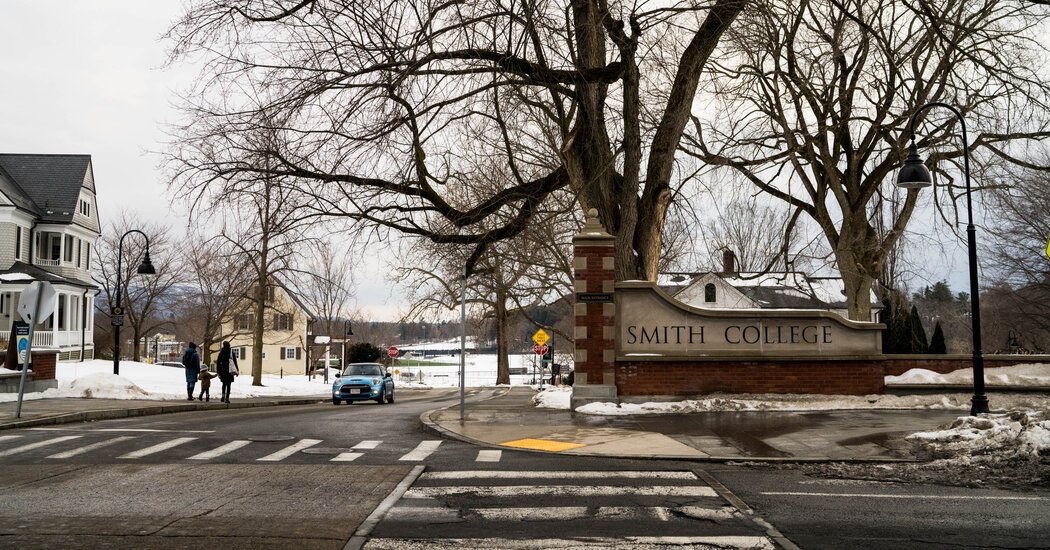
The Education Department has opened a civil rights investigation into whether Smith College, the women’s school in Northampton, Mass., violated anti-discrimination laws by allowing transgender students to enroll.
The inquiry broadens the Trump administration’s bid to limit rights for the nation’s transgender students by targeting school admissions for the first time. Until now, the administration had mostly focused on policies that allowed transgender women to participate in women’s sports and use women’s bathrooms.
By investigating Smith, the administration is raising the question of whether allowing transgender women to enroll at a women’s college — and providing access to “women-only” spaces such as bathrooms, housing and locker rooms — violates civil rights protections for women.
Kimberly Richey, the assistant secretary for civil rights at the Education Department, said in a statement that “an all-women’s college loses all meaning if it is admitting biological males.”
“Allowing biological males into spaces designed for women raises serious concerns about privacy, fairness and compliance under federal law,” Ms. Richey said. “The Trump administration will continue to uphold the law and fight to restore common sense.”
The college issued a statement acknowledging the investigation and stating that it remained “fully committed to its institutional values, including compliance with civil rights laws.”
The investigation raises the possibility that the administration could target additional women’s colleges, which in recent years have largely opened their doors to applicants who identify as women or nonbinary.
Lynn Pasquerella, a former president of Mount Holyoke College who helped rewrite its admissions policies a decade ago to welcome transgender students, said the Education Department’s investigation might have a chilling effect on those applications.
She pointed to executive orders signed by President Trump last year that barred school programs focused on diversity, equity and inclusion. Rather than battle the administration, many schools shuttered campus offices or created new rules on how to talk about gender and race in the classroom, and she said she feared a similar result from the admissions investigation.
“This is an issue that affects a small number of individuals very deeply,” Dr. Pasquerella said. “But it will create uncertainty for transgender students and discourage them from applying, and that will be the real loss.”
Once the primary option for American women seeking higher education, women’s colleges grew rapidly in the late 19th century, even when many Americans viewed college studies as harmful to women’s reproductive capacity, according to “Women in Academe: Progress and Prospects,” a comprehensive study edited by Mariam K. Chamberlain.
After reaching a peak of 281 schools in the mid-1960s, women’s colleges faced decades of steep enrollment declines and financial pressure as most universities opened their doors to female applicants. These schools now hold themselves up as incubators of female leadership and academic success. Today, Smith College — which counts among its alumnae Julia Child, Sylvia Plath and Gloria Steinem — is one of about 30 women’s colleges remaining.
But just as women’s colleges were created, in part, as a response to cultural norms of a certain era, these schools have also adapted to modern changes in society. That includes the question posed a decade ago over whether to admit transgender students, a battle that the Trump administration’s investigation threatens to reopen.
The issue of enrollment of transgender students sparked intense debate at the time among feminists, whose political movement had, in many ways, been nurtured on women’s college campuses. Some argued that admitting transgender students aligned with their view that women’s colleges should serve and empower marginalized genders. Others feared the change would chip away at a protected space for biological women.
“There are probably still some die-hard, radical feminists who don’t accept trans women, but most feminists and women’s college alums are very supportive,” said Genny Beemyn, director of the University of Massachusetts at Amherst’s Stonewall Center. “That means there would be a tremendous amount of support for Smith if they decide to fight this.”
Today, about 4.7 percent of college students identify as transgender, according to the Society for Evidence-Based Gender Medicine, a group of doctors and scientists that has called for more government regulation of pediatric gender medicine.
Women’s colleges are routinely identified as some of the most supportive campuses for transgender students. Mills College in California, which in 2014 became the first women’s college to adopt a formal admissions policy for transgender women, reported in 2017 that transgender women accounted for 8 percent of its student body. A more recent percentage was not available, a school official said.
Smith, one of the nation’s largest women’s schools with about 2,500 students, has been admitting transgender students since 2015, along with several other top women’s colleges. The issue became a lightning rod after a transgender applicant was denied acceptance to Smith in 2013 because her gender identity did not match her financial aid forms.
One notable exception has been Sweet Briar College in central Virginia, which does not admit transgender students and helps students in transition transfer to another college.
The federal investigation of Smith was in response to a civil-rights complaint filed by Defending Education, a nonprofit group founded in 2021 that has become one of the leading voices in the growing parents’ rights movement. Several of the group’s complaints have sparked federal civil rights investigations during the past year, and its research is often cited during congressional hearings by conservative lawmakers.
The Trump administration has made rolling back transgender protections a key priority, launching more than 40 investigations into schools and other educational institutions that they say may have extended rights to transgender students in violation of anti-discrimination laws or protections for women.
The Education Department has taken the unusual step of backing out of civil rights agreements that previous administrations negotiated to protect transgender students. The government has also sued state education departments and high school athletic associations in California and Minnesota over policies that permit transgender athletes to participate in school sports.