Nesting turtles, fish-filled coral reefs, and mysterious deep-sea creatures: this is what scientists found in one of the world’s last largely untouched ecosystems.

ADVERTISEMENT
ADVERTISEMENT
Two remote coral atolls in the Pacific Ocean are being studied to support local and global conservation efforts.
Bikar and Bokak became the Marshall Islands’ first national marine sanctuaries in 2025. Since then, scientists have been working to establish a comprehensive ecological baseline for the 48,000-square-kilometre site, from sky to land and sea.
Their findings matter far beyond the remote atolls, which lie around 116 and 385 kilometres from the nearest inhabited atoll, respectively.
“They are among the best ecological reference systems we have to better understand what we have lost elsewhere and to provide fundamental insights needed for effective conservation and restoration efforts,” says marine ecologist Dr Alan Friedlander of the University of Hawai’i.
He served as chief scientist aboard a joint expedition in Bikar and Bokak with Pristine Seas, a global conservation and exploration project founded by National Geographic Explorer Enric Sala to help protect vital ocean areas.
What they found were “some of the most intact ecosystems remaining in the region” – and perhaps the world.
‘Treasures for the entire planet’: What the world can learn from remote ecosystems
Extensive monitoring of Bikar and Bokak in 2023 informed the creation of the protected area.
Researchers were guided by the Marshall Islands’ national framework for community-led conservation, which seeks to protect natural resources “while ensuring island life thrives for generations to come”, explains Friedlander, who led a recent study on the atolls’ ecosystems.
“Bikar and Bokak are not just treasures for the Marshall Islands but for the entire planet, a gift from the community of Utirik Atoll, which has traditionally and vigilantly safeguarded these fragile ecosystems for decades,” he says.
While the atolls have recently gained national protection, they have long been cared for through community-led stewardship, with high chiefs establishing ‘mo’ or ‘taboo’ areas. In these zones, human activity is restricted, allowing nature to rest and replenish – an approach that has been incorporated into the national framework.
It has resulted in an ecosystem that offers an unparalleled glimpse into how life functions with only minimal human influence.
“The Marshall Island government should be applauded for their foresight in protecting these global biodiversity hotspots, where human activity is distant and habitats teem with life,” says Friedlander. “As human activities increasingly threaten biodiversity, areas devoid of intense human impacts serve as vital refugia.”
Large marine protected areas like these are globally important benchmarks for understanding how tropical ocean ecosystems are structured and how they may change in an era shaped by human activity, the researchers say.
Remote atolls teem with life while wildlife is in decline elsewhere
Bikar and Bokak offer a rare contrast to most of the world. Monitored wildlife populations have fallen by an average of 73 per cent globally since 1970, according to WWF’s 2026 Living Planet Report, with marine populations down 59 per cent.
Bleaching-level heat stress hit 84 per cent of the world’s coral reefs between January 2023 and May 2025, and only around 3.5 per cent of the ocean is considered fully or highly protected.
Using scuba, underwater video, deep-sea cameras, and a submarine, Pristine Seas scientists explored Pacific ecosystems that, by contrast, remain relatively intact.
Across both atolls, they found 15 breeding or likely breeding seabird species and more than 260 kinds of reef fish, as well as open-water predators including sharks, jacks and wahoo. Cameras and a submarine also revealed “surprisingly diverse and poorly known deep-sea communities”, and two of the fish recorded might be new to science, the researchers say.
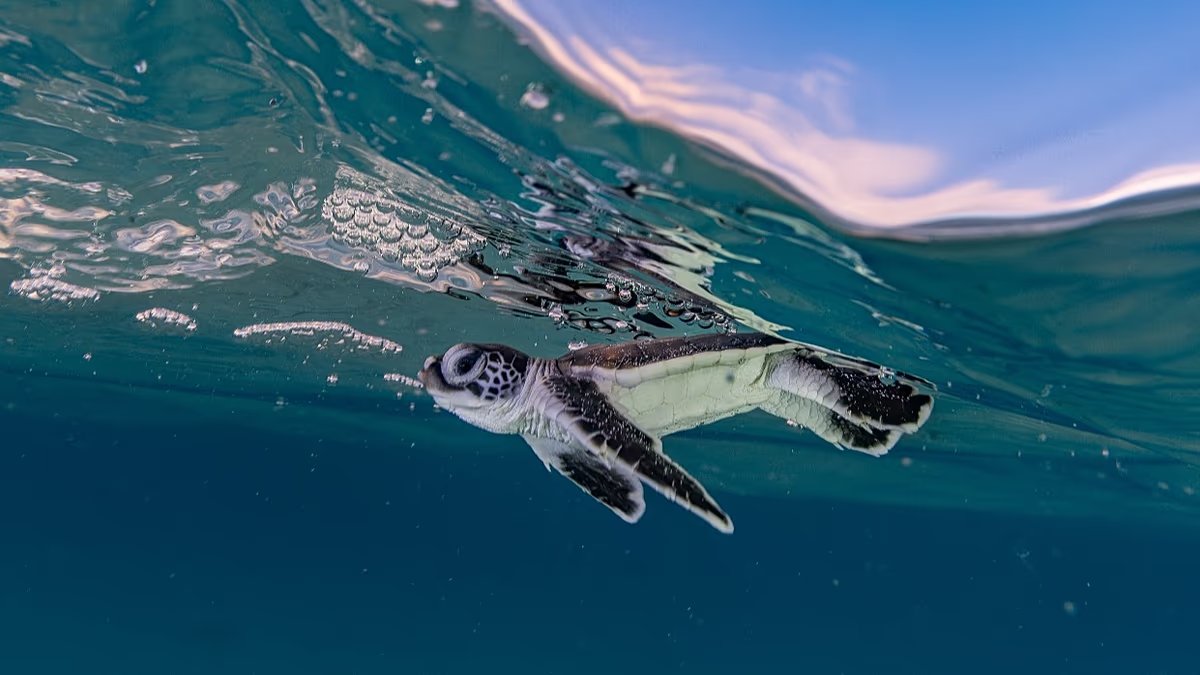
Nesting green sea turtles were also observed at Bikar.
Ecological differences between the two reefs were noted, although the researchers say the reasons are not yet clear. Bokak’s reefs are dominated by coral, with around twice the fish biomass of Bikar, where seaweed covers more than half of some deeper slopes.
The project also highlights the importance of assessing ecosystems in their entirety in order to conserve their integrity and track future climate-driven change, the researchers say, adding that future studies should examine nutrient transfer and ecological connectivity between habitats.
Even with responsible local governance, the most isolated tropical reef systems aren’t immune to the global impacts of human-caused climate change. They are increasingly affected by coral bleaching, ocean warming, sea-level rise, and changes in how much food the open ocean produces, the study warns.