It was a four-hour flight and, curiously, the time it took a group of 83 journalists of different nationalities to get to know each other. They had shared six days of coverage, travel, airports, masses and meetings in Uruguay and Argentina. However, it was on the plane that took Pope Leo XIV to Lima where they finally began to feel like a small community. There were journalists from Peru, Argentina, Uruguay and other countries. They all had something in common: They were about to accompany the Pope on his return to a land he knows deeply.
The Commerce was there. It was not just any flight nor just another transfer on the apostolic agenda. There was expectation, conversations and even curiosity among foreign journalists about something that inevitably appeared in the talks: how much the Pope was going to eat during his stay in Peru. Peruvian gastronomy was also beginning to enter the international conversation.
Before arriving in Lima, Leo XIV had had to say goodbye to Argentina. And it was not a discreet farewell. The last mass, celebrated in front of the Basilica of Our Lady of Luján, brought together more than two million people, according to local authorities. The Virgin of Luján, patron saint of Argentina, was the scene of a goodbye full of emotion. “Thank you Argentina for welcoming me with open arms!” said the pontiff.
But if Argentina had been a massive farewell, Lima was preparing a welcome of its own dimensions.
The plane landed at Air Group No. 8 of Callao, the Peruvian Air Force base located on Faucett Avenue. Civil, military and religious authorities were waiting for him there, as well as a delegation of children who did not hide their excitement. Two children gave him flowers and others shouted from the security barriers. Even among the military personnel who participated in the reception, the desire to record that moment with their phones was evident. There were uniforms, protocol and honors, but also a spontaneity that was difficult to contain.

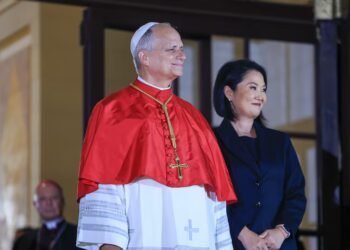
President Keiko Fujimori received the pontiff and both held a brief private meeting at the base facilities. Then the movement towards the center of Lima began.
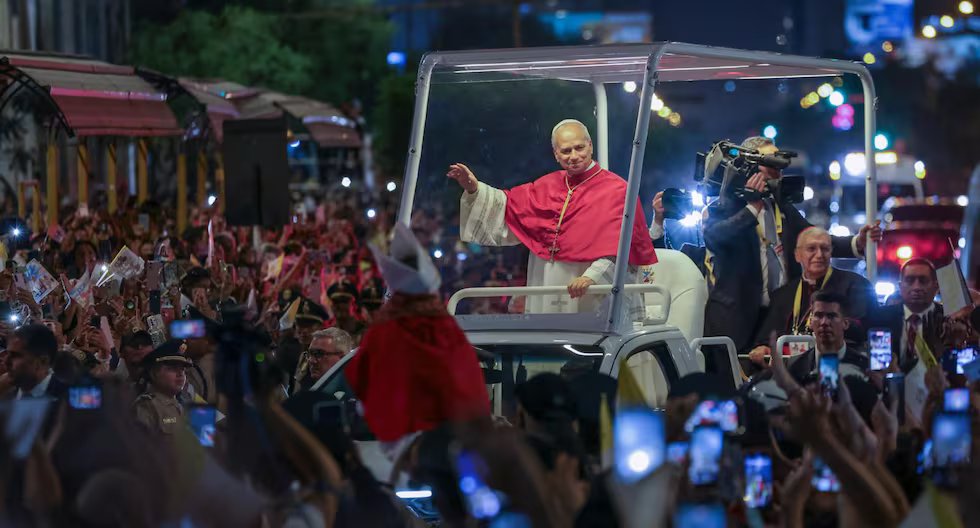
What awaited on the streets was difficult to measure from a vehicle. El Comercio counted approximately eleven kilometers of uninterrupted queue of faithful, with police presence along the route. The measurement reached the area of Salaverry Avenue with Pershing and Juan de Aliaga, on the border of Jesús María and San Isidro. Eleven kilometers of people. They were not just groups stationed in front of a church or a square: they were families, young people, older adults and children who had found a space to wait for the Pope to pass by.
Faucett Avenue, La Marina and Brazil became welcoming corridors. There were Peruvian flags, balloons, banners and raised telephones. At some points, people organized to see it from the Metropolitano stations and from the elevated spaces on the tracks. Public transportation, which normally measures the city in stations and passengers, this time also offered a window to contemplate the passage of a supreme pontiff.
The change of vehicle in front of the Basilica of María Auxiliadora, in Breña, marked another important moment. There Leo XIV passed the Popemobile to continue towards the Historic Center. The route included Avenida Brasil, Plaza Bolognesi, Alfonso Ugarte, Bolivia, Garcilaso de la Vega and Nicolás de Piérola avenues, to the Conde de Superunda street and the Plaza Mayor.
But there was a detail that turned that trip into a particularly Peruvian postcard. Instead of limiting itself to the usual image of motorcycles escorting the pontifical vehicle, part of the route featured Peruvian paso horses. The chalans accompanied the Popemobile in a gesture that incorporated one of the most recognizable expressions of our equestrian tradition to the official welcome.

Pope Leo XIV waves to the faithful from the popemobile on his way to the Peru’s Government Palace in Lima on November 11, 2026. Pope Leo (Photo by Alfredo ESTRELLA / AFP)
/ ALFREDO STAR
The Peruvian Paso horse, recognized for its lateral gait and its particular elegance, is not only a symbol of the countryside and Creole tradition. It is also an expression of national identity. Seeing him accompanying the Pope, in the heart of Lima, was another way of telling him that he had returned to a country that wanted to show him what was his.
And one of the most emotional moments was still missing.
In the Patio of Honor of the Government Palace, during the official welcome ceremony, Leo XIV first heard a musical presentation by the National Children’s Choir of Peru and the band of the National Council for the Integration of Persons with Disabilities (Conadis). The group performed pieces prepared especially for the occasion. The Pope was visibly moved, approached the little ones and greeted them affectionately. He also paid attention to the members of the band, made up of young people and adults with intellectual disabilities.
Then came the National Anthem. And something happened that many Peruvians expected, but that never ceases to surprise: Leo XIV sang it. He did it following the verses with the band and the chorus, with a familiarity that showed that he was not listening to a foreign song. He looked moved. His eyes seemed to moisten as he accompanied the performance.
It was not just a protocol ceremony. It was Robert Prevost, the man who lived for more than twenty years in Peru, singing the anthem of a country that is also his. He had arrived as Leo XIV, but a good part of those who were waiting for him continued to recognize in him the priest and bishop they knew before his election as pontiff.
After the military honors, the musical performance and the greeting to the authorities, the Pope entered the Palace with President Fujimori. There he held a private meeting with the head of state and continued with the official agenda.. Later he moved to the Gran Teatro Nacional, in San Borja, to meet with authorities, representatives of civil society and the diplomatic corps, where he gave his first speech on Peruvian soil.
The day would end at the Apostolic Nunciature, in Jesús María, where thousands of people also gathered outside to await their arrival. It was the end of a first day that had begun with a farewell in Argentina and ended with a welcome that overflowed the streets of Lima.
The Pope thanked the Peruvian welcome and spoke of the meaning of returning to a country that is part of his own history. In his arrival message, the greeting he had received from the control tower had already summed up the feeling of the day: “Welcome home.”
Now begins a six-day visit, until November 16, which will include Lima, Chiclayo, Pimentel, Cajamarca, Cusco and Pucallpa. This Thursday he will have meetings with the bishops, representatives of the Church and Peruvian society, in addition to a prayer vigil with young people and university students at the National Stadium.
Thus began the return of Leo XIV. The man who left Peru as Robert Prevost and returned as Pedro’s successor.