Despite the fact that successive governments over the past fifteen to twenty years had announced transparency in their policies, not much seems to have come of it. This government is not doing much better either. I have not yet received the official report of the massive fish kill in the Upper Saramacca River area, which I requested from the National Environmental Authority. You can judge for yourself how transparent the current government is.
Text and image Richenel Ellecom
As stated in part three of this series, cyanide is very toxic to the human body. The disruption of oxygen intake in the body causes a lack of oxygen that can ultimately lead to serious disruption of the body’s metabolism, which in some cases can lead to death.
“The biggest problem that Suriname is experiencing is that those who have to make the laws and ensure their enforcement are directly or indirectly involved in the activities where the toxic metals are used“
The government has a protective task towards the population. This means that legislation and enforcement are in the hands of government bodies. The biggest problem that Suriname is experiencing is that those who have to make the laws and ensure their enforcement are directly or indirectly involved in the activities where the toxic metals are used. It is not the intention to mention specific names. There is a proverb that says: ‘If the shoe fits, wear it’.
Concern
The concern that we all need to raise is that since the beginning of the recent gold rush, the effect of these toxic metals is already unknowingly manifesting itself in a cohort of young adults because 25 years ago they were among the group of unborn children during their mother’s pregnancy.
This is a deductive reasoning, without statistical data to support it, because the government does not make money available for longitudinal or prospective research. This makes it difficult to identify abnormal cognitive-emotional symptoms in child development that are due to the effect of these toxic and heavy metals.
I have no statistical data on the consequences of cyanide exposure in Suriname. This picture is based on general scientific effects of cyanide on the neurophysiological development of humans.
I will explain in general terms what the government could do for children and young adults who have symptoms. The government is ultimately responsible for the import and use of these toxic substances, albeit passively through a policy of tolerance.
Intervention and strategies
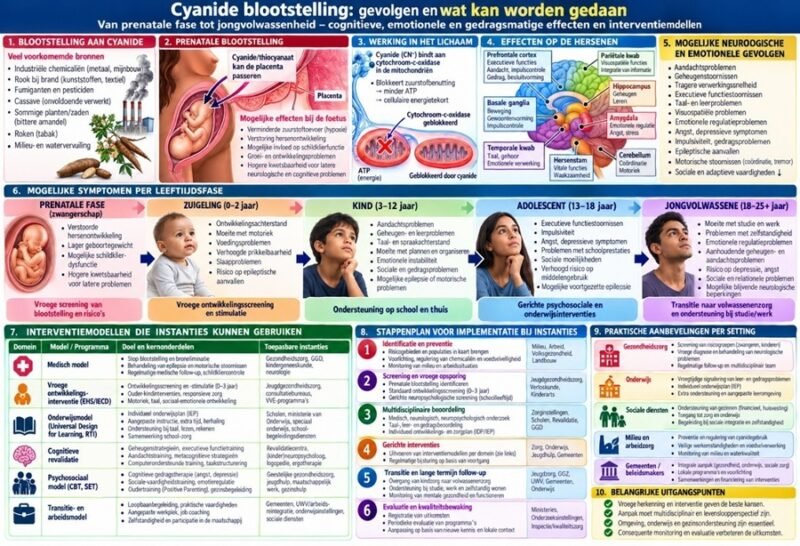
The picture lists the development phases, the possible symptoms of exposure and the corrective interventions.
1. Prenatal (voor birth). See disruptions in the picture. Intervention, screening pregnant women from risk areas.
2. Infant (0-2 years). See disruptions in the picture. The intervention, early developmental screening and stimulation.
3. Child (3-12 years). See disruptions in the picture. Intervention, support at school and at home.
4. Adolescent (13-18 years). See disruptions in the picture. Intervention, targeted psychosocial and educational interventions.
5. Young adults (19-25 years). See disruptions in the picture. Intervention, Transition to adult care and support with study and work.
Because cyanide has a diffuse (widespread) effect on the human body, it is necessary that this matter is addressed systematically and targeted. All conflicts of interest must be set aside so that the common interests of developing children can be served without hindrance.
The development of Suriname does not only depend on processing the raw materials, developing a healthy economy and combating corruption, making study opportunities available and financial resources linked to this. It is also important that the quality of human capital (the young generation) is protected. Without a healthy young generation, the potential of all the country’s available resources cannot be utilized.
*If you have any further questions, please contact the author of the article
Richenel Ellecom (899-6441/(email protected)), Psy.D., Dr.PH, HSPP, is a preventive medicine and medical nutritional specialist, as well as a clinical and forensic neuropsychologist.