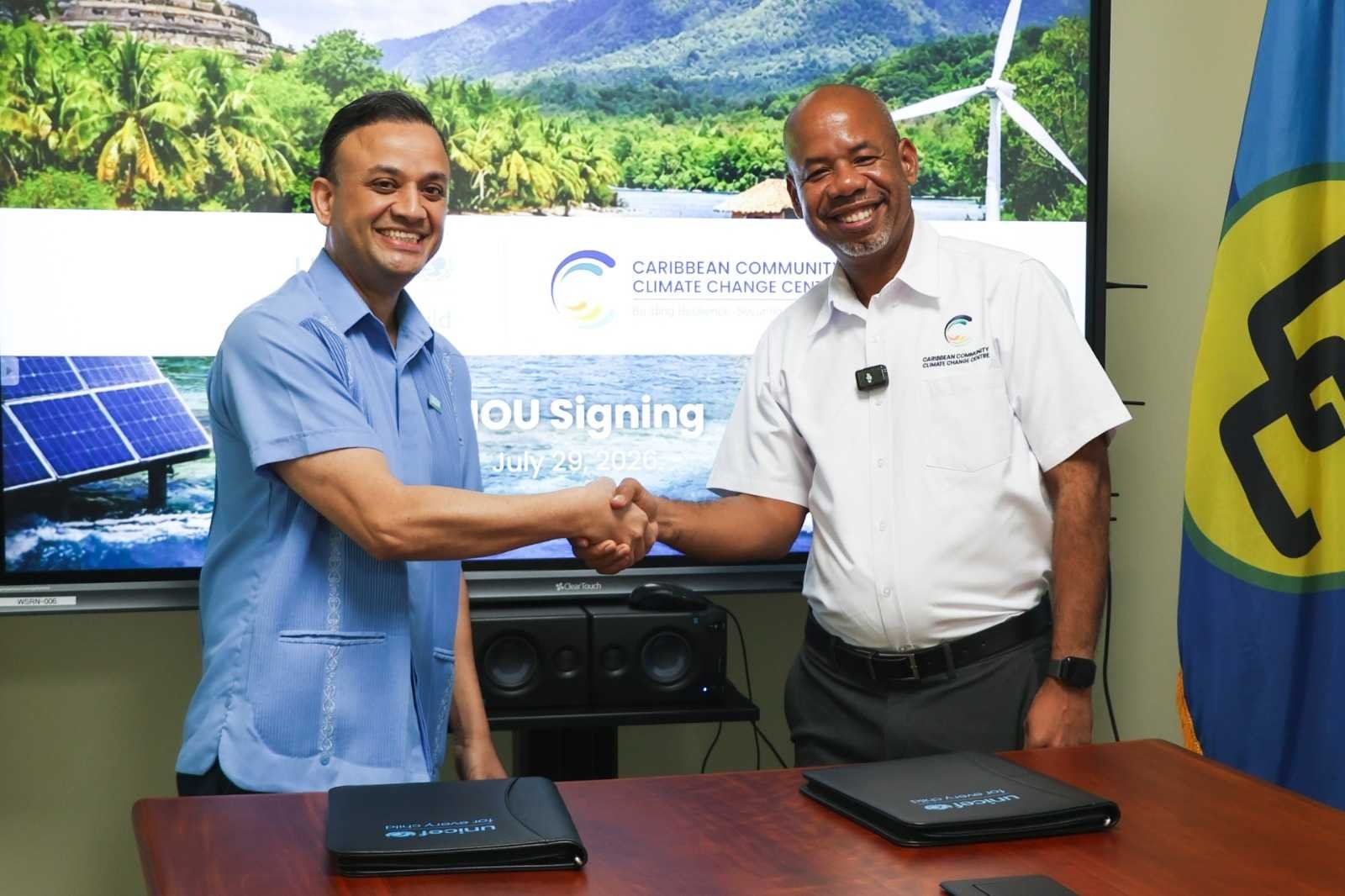
The United Nations Children’s Fund (UNICEF) and the Caribbean Community Climate Change Centre (CCCCC) have signed a five-year Memorandum of Understanding (MoU) aimed at strengthening climate action that prioritises the rights and well-being of children across the Caribbean.
The agreement, signed in Belmopan, Belize, establishes a framework for collaboration on child-sensitive climate policies, climate adaptation, disaster risk reduction and resilient social services, while also increasing opportunities for young people to participate in climate decision-making.
The partnership comes as Caribbean countries continue to face increasingly severe hurricanes, flooding, droughts, extreme heat and environmental degradation, all of which threaten children’s access to education, healthcare, safe water, sanitation, nutrition and protection services.
UNICEF Representative Sajid Ali said climate change is not only an environmental issue but also a child rights issue.
“Children are among those least responsible for the climate crisis yet they bear some of its greatest consequences,” Ali said. “This partnership with the Caribbean Community Climate Change Centre will help ensure that climate policies, investments and programmes across the region put children at the centre and strengthen the services and systems they rely on every day.”
Under the agreement, the organisations will work together to strengthen child-sensitive climate governance and support climate-resilient education, health, nutrition, water, sanitation and hygiene (WASH) systems. The partnership will also promote child-responsive social protection measures, disaster preparedness, research, resource mobilisation and knowledge sharing on climate resilience.
Executive Director of the Caribbean Community Climate Change Centre, Dr Colin Young, said the agreement addresses an area that has often been overlooked in climate resilience planning.
“It is a well-known fact that children and youth have not been a central focus of climate resilience programming, either regionally or globally,” Young said. He added that UNICEF’s experience in advocating for children’s rights complements the Centre’s climate resilience strategy and will strengthen regional efforts.
A major component of the partnership will focus on improving climate-resilient sanitation services across the Caribbean through evidence-based advocacy, capacity building, knowledge sharing and climate financing initiatives.
The organisations will also promote youth leadership by supporting children, adolescents and marginalised groups to develop the knowledge and skills needed to contribute to climate solutions and regional policy discussions.