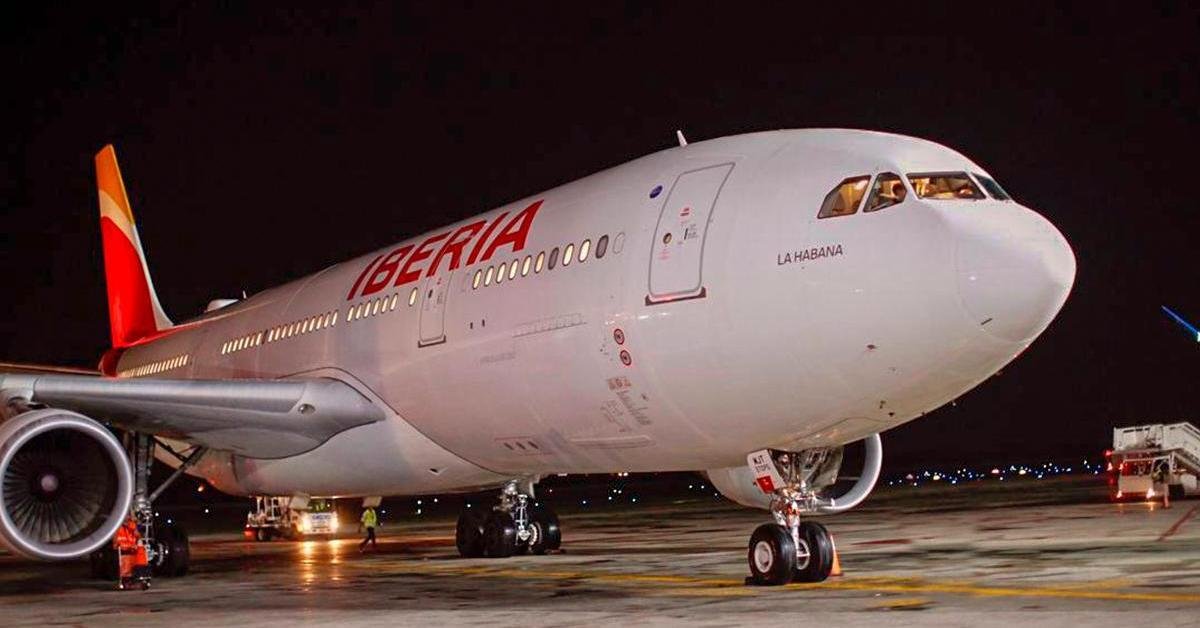

Madrid/The Iberia airline announced this Monday the suspension of its flights to Cuba due to a drop in tourism. The operation does not have immediate effect and is reduced to the low season, between June and November, with the intention of resuming the routes on that date. However, the fact that it is one of the main airlines that connect Europe with the Island and that until now seemed committed to continuing to guarantee the journey, is another coup de grace against the deplorable state of the sector.
The Spanish company currently maintains three weekly frequencies from Madrid to Cuba and the first step is to reduce them to two in May. When June arrives, the only alternative will be to go to Panama and, from there, come to the Island with Copa Airlines, which has a codeshare agreement with Iberia. The company has warned that its offices in Havana keep their doors open to serve customers who need help.
“This temporary suspension exclusively affects Cuba, due to its exceptional situation. Iberia maintains the rest of its operations normally and, for this summer, it will offer a record number of 21.4 million seats,” the airline said in the announcement statement. The declaration is another painful sentence for Havana. The Spanish company had only suspended operations twice previously and neither was attributable to the conditions on the Island.
“This temporary suspension exclusively affects Cuba, due to its exceptional situation. Iberia maintains the rest of its operations normally and, for this summer, it will offer a record number of 21.4 million seats”
In 2013, Iberia went through a serious economic crisis that forced the airline – which only two years earlier had merged with British Airways into the IAG alliance, one of the largest in the world – to carry out an employment restructuring. In those negotiations, which involved the departure of more than 4,500 workers, three long-distance routes were canceled: Cuba, the Dominican Republic and Puerto Rico. It was the first time in more than 60 years that the Spanish company did not fly to the Island.
The measure lasted two years and in 2015 flights were resumed in a big way, with five weekly connections, precisely in a promising year for the Cuban economy, when in the midst of the thaw with the United States, companies from all over the world bet on positioning themselves on the Island before an opening that ended in fiasco.
Iberia again suspended flights to Cuba during the pandemic, when air routes around the world were affected by border and airspace closures.
This is, therefore, the first time that the Spanish woman leaves the Island for reasons attributable exclusively to Cuba. On February 9, the company announced that, despite the lack of kerosene, it would maintain its flights to Havana, refueling in the Dominican Republic. It was also one of the few airlines that did not back down from its decision, as occurred with those of Canada and Russia, countries that currently have greater flows of tourism to the Island and that, despite this, evacuated nationals and stopped traveling until the situation is resolved.
Spain, despite being a priority economic and cultural partner of Cuba, is no longer a major tourist market as it had been until now. The bet of the hotel entrepreneurs It remains, for the moment, unscathed, but the travelers flee. Last year, only 46,489 Spaniards visited the Island, compared to 65,054 in 2024, although the worst part of the figure comes if we remember that in 2017 168,949 did so.
In both first months In 2026, only 4,422 Spaniards flew to Cuba, 32% less than in the same period of the previous year.