I would like to begin today with a field that is quite far removed from the main subject of my lecture: social psychology. Psychologists — much later than writers — have identified a tendency in people whereby, despite the warning signs around them, they continue to believe that circumstances or their environment will never really change. Psychologists have given this phenomenon a name: the normalcy bias.
It is a psychological defense mechanism that leads people to underestimate danger or ignore the signs of impending disaster, mistakenly assuming that everything will continue as it always has. It is the brain’s built-in way of preventing panic and irrational behavior. Yet history is made up of unexpected change.
One of the best-known examples of the normalcy bias in politics comes from the 1980s. At the time, both the Soviet Politburo and CIA analysts in the United States believed that the Soviet Union’s military, economic and political situation was stable and, if not permanent, would remain unchanged for decades. Both were wrong. Completely.
Reality, however, can change remarkably quickly, as we saw between 1989 and 1991. It is not as though the signs were invisible — more and more Estonians recognized them even then. Yet Moscow, trapped in the illusion of normalcy bias, either failed to notice them or chose not to.
We have examples of our own. In the final years of the Republic of Estonia 1.0, our political elite also fell prey to the normalcy bias. In October 1939, after the bases treaty had already been signed, while the Winter War was raging across the Gulf of Finland to our north and Nazi Germany and the Soviet Union were carving up Poland to the south, Estonia’s leaders believed that because we had declared ourselves neutral, everything would simply pass us by.
Stefan Zweig captured just how radically circumstances can change in his memoir “The World of Yesterday,” where he describes life in Habsburg Vienna before the First World War as “the golden age of security.” Politics and the economy were stable, people traveled freely throughout Europe and new inventions — the telephone, the automobile, electricity — promised an ever brighter future.
No one in the idyllic Vienna of that era imagined that such a world could end. No one foresaw that the war that erupted in 1914 would claim between 15 and 22 million lives in Europe and unleash enormous upheaval. Nor did they imagine that the collapse of empires that had ruled Europe for centuries would continue to shape the lives of every one of us and the map of Europe to this day. The United States then established the grand strategy that governed the post-Second World War era for 80 years. That era is now quietly coming to an end.
This year, as Estonia approaches the 35th anniversary of the restoration of its independence, I fear that almost all of us assume that after the struggles of the 1980s to regain our freedom, the enormous efforts of the 1990s to join NATO and the European Union and the success of the past 15 years that established our reputation as an open, liberal digital society, our independence has become something we can simply take for granted.
When I lecture at the University of Tartu, where nearly all my students were born into an Estonia that was already a member of the European Union and NATO, I am especially struck by how self-evident Estonia seems to them — as though there had never been an occupation or the fragile poverty of the 1990s. Yet we must understand that our independence will remain self-evident only if we overcome our own normalcy bias.
Europe must now develop its own grand strategy. We have to look beyond today’s immediate concerns in order to implement profound — even revolutionary — changes that will ensure our survival and Europe’s future.
Twenty-two years ago, in 2004, Estonia was a newly admitted member of the European Union and NATO. At the time, Estonia was still learning how those two major organizations functioned. We generally kept a low profile, studying how to operate within those systems. After half a century of Nazi and Soviet occupation, we were once again not only independent and free, a liberal and successful democracy — we had also gained admission to the two clubs that mattered most for our future security and prosperity: NATO and the European Union.
Western Europe, meanwhile, was reluctant to acknowledge that Russia, enriched by oil and gas, was becoming increasingly aggressive. I do not need to recount for anyone here the history that arguably began with Vladimir Putin’s 2007 Munich speech, followed just two months later by the DDoS cyberattacks that paralyzed Estonia and the unrest in Tallinn and elsewhere.
Despite these geopolitical developments, which the broader West largely ignored, we in Europe failed to notice a much bigger transformation that was not reflected in the daily headlines. We overlooked the fact that, in an increasingly competitive world, Europe was beginning to lose ground — first to the United States and then, shortly afterward, to China. We fell behind precisely in the areas that increasingly determined economic success: innovation and technology. Instead, we took pride in calling the European Union a regulatory superpower to whose rules others had to submit if they wanted access to our market.
That was a profound mistake. Europe assumed that it did not need to spend on defense. It assumed that investing in technology and innovation was unnecessary. It believed that it could continue to prosper even as China and the United States surged ahead in those fields. Europe also failed to grasp that defense and security today depend above all on innovation and rapidly advancing technologies.
That was then. Today the situation is different. Europe’s thinking has changed, transatlantic relations have run aground and may even be disintegrating, to borrow the century-old Estonian neologism ralkuma coined by Johannes Aavik. The European Union’s understanding of security has evolved, though unfortunately not nearly enough.
Most of our energy is spent debating our military shortcomings: who should be allowed to borrow money for defense spending, which countries’ weapons can be purchased and similar issues. All of these are necessary discussions. But when it comes to Europe’s competitiveness, we know perfectly well where the problems lie. Even so, a parochial mindset continues to paralyze us and prevent us from taking the necessary steps.
Far more important than these misguided approaches, however, is the end of Pax Americana.
Although Russia’s full-scale invasion of Ukraine in 2022 was a shock, what has truly changed is the world in which all of us in the West grew up, regardless of which side of the former Iron Curtain we happened to be born on.
Indeed, the end of the Western order that we have all known for decades has been particularly shocking for those of us in Central and Eastern Europe — for countries that, before 1991, so desperately sought to join the democratic, rules-based Western order. The very order that the United States created and more or less maintained from the end of the Second World War onward. Many people, especially in Central and Eastern Europe, remain in denial.
This change means far more than the United States supposedly withdrawing from NATO. The transformation is much larger than that, immeasurably more dramatic. The old order — the one in which we all grew up or to which we aspired — is dying.
If we read the U.S. National Security Strategy published in December, listen to statements by senior American officials over the past year or simply look at what the United States has done over the past year and a half, it becomes clear that Washington now considers Europe to be of secondary importance. It no longer sees itself as the benevolent hegemon that upholds Pax Americana — the global order the United States itself created in the 1940s.
Today, however, the United States regards the very order, rules and principles that it established as misguided. It no longer defends them and, in some cases, is actively violating them. The influence of the United States as the West’s benevolent hegemon was military, political, economic, diplomatic, cultural and even culinary, if one thinks of hamburgers and Coca-Cola.
By promoting free trade and open markets, liberal democracy, human rights and the rule of law, it pursued a strategy that went far beyond any previous grand strategy. It rested on the conviction that a democratic, rules-based world was, above all, in America’s own interest. Respect for rules ensured not only security but also influence and economic growth, with each reinforcing the other.
For 80 years, this system functioned reasonably well. It enabled not only the United States itself but also Europe to recover, develop, grow and prosper. Pax Americana, however, is over. The system the United States began constructing in 1944 through the Bretton Woods institutions — the World Bank, the International Monetary Fund and the General Agreement on Tariffs and Trade, later succeeded by the World Trade Organization — continued in 1945 with the creation of the United Nations. At its core stood the UN Charter’s prohibition on aggression, the principle that force must not be used to change borders. That remained the organization’s most fundamental axiom.
These institutions emerged from the realization, formed during the Second World War, that America’s failure after the First World War to create a binding international framework through the League of Nations and to support Europe’s economic recovery had contributed significantly to the crises of the 1920s and 1930s — from the horrors of hyperinflation and mass unemployment to the rise of fascism.
Economically, the United States also launched the Marshall Plan in 1948, helping Europe emerge from the widespread poverty of the immediate postwar years. Belatedly recognizing that the Soviet Union was no longer its ally, the United States also began the campaign that ultimately ended the Soviet blockade of Berlin.
Communist coups in Central Europe, which replaced democratically elected governments in Poland, what was then Czechoslovakia and Hungary, ultimately led to the signing of the North Atlantic Treaty in 1948.
At the same time, the United States actively supported Robert Schuman’s 1950 plan to establish the European Coal and Steel Community, easing Washington’s serious concerns about rising tensions in a Europe that had only just emerged from war. It viewed the plan as another means of strengthening Western Europe and preventing a repeat of the catastrophes of the 1920s and 1930s. The Coal and Steel Community, which 45 years later ultimately evolved into the European Union, was by no means a scheme to “rip off America,” as President Trump has claimed, but rather a way to prevent conflict among its six founding members.
The list could go on. It was the United States that created the Conference on Security and Cooperation in Europe, later the Organization for Security and Cooperation in Europe, making the so-called Third Basket — human rights — the principal instrument for pressuring repressive communist regimes across Europe. Later, the United States pushed for NATO enlargement into Central and Eastern Europe in pursuit of a Europe that would be “whole, free and at peace,” to quote President George H. W. Bush. He said this at a time when many Western European countries opposed admitting Eastern Europeans, fearing that NATO enlargement would provoke Russia and jeopardize the commercial opportunities it seemed to offer as a new El Dorado.
The same President George Herbert Walker Bush also proclaimed the so-called peace dividend after the collapse of communism between 1989 and 1991, ushering in three decades of large-scale European disarmament.
I have taken you through this long history to give you a sense of what a genuine, comprehensive grand strategy looks like. It is generally known as the liberal, rules-based international order. Such an American-led grand strategy is military and strategic. It establishes and develops international agreements covering security, trade, economic affairs and diplomacy. It is grounded in international law and treats human rights as a supreme value.
This order, known as Pax Americana, has been remarkably successful. It has largely kept the peace, prevented another major war in Europe throughout the Cold War and helped bring Estonia to where we have been for the past 35 and/or 22 years. But the success of such a grand strategy requires time, consistent adherence to its core principles and tactical adjustments as new circumstances emerge. And new circumstances always emerge.
The era of Pax Americana, however, is over. Finito, konets, kaputt — finished. Nearly every American expert agrees on this point. Yet Europe still clings to the hope that it is not true.
So where are we now? European policymakers hope that America’s retreat from the world is only temporary. They hope that the next administration will reverse course and that everything will return to the way it was. I am not nearly so certain. On the contrary, basing our security on the possible outcome of an election two and a half years from now seems more an act of wishful thinking than of sound judgment.
The second, equally uncertain question is how much even a very different administration would actually want or be able to restore the former transatlantic relationship. Nor is it clear how long that would take, especially given, to put it mildly, the current upheavals within the U.S. Departments of State and Defense.
New security environment. New world order
The collapse of the Western order and Europe’s place in this new situation reaches far deeper in existential terms. If America has disappeared as the guarantor of both our security and the rules-based world order, we are forced to acknowledge that the European Union in its current form is no longer fit for purpose. We are not militarily prepared to defend ourselves against Russia, nor are we able — with a few exceptional cases aside — to compete with either the United States or China in innovation or technology.
We continue to live under the illusion that we inhabit a world that, in reality, no longer exists. A world in which we assumed that, if things ever truly became serious, the U.S. would still keep us safe and prosperous and prevent the world from collapsing into a Hobbesian bellum omnium contra omnes.
In reality, we must face a bitter and uncomfortable fact: Europe today is not prepared to deal with a richer, more technologically advanced and hostile United States, nor with a brutal and aggressive Russia. Nor with an authoritarian China that surpasses Europe in manufacturing, technology, trade and increasingly also militarily and that no longer buys anything from Europe. Let us admit that when it comes to the values we have defended for 80 years, we are, with a few scattered exceptions, alone.
Today, we are very far from 1950, when Robert Schuman announced his plan to create the European Coal and Steel Community, with the aim of preventing another war between France and Germany amid the rising tensions of the time.
Its creation was an enormous development in a postwar Europe lying in ruins. It showed that Europeans could solve their own problems, do things in an entirely new way and, through cooperation over the years, restore the prosperity they had enjoyed before the First World War. For decades, the continent’s ever deeper political and economic integration allowed us to say, rightly, that the European Union, as we call it today, is a peace project. And it has been one for three-quarters of a century.
Yet we failed to keep pace. In areas that are decisive for competitiveness and overall security — not only in the military sense, but also in political unity, economic growth and technological development, meaning global competition — we have stagnated.
We took George H.W. Bush’s so-called peace dividend too seriously and cut defense spending. We borrowed too much cheap money, which was spent not on infrastructure investment but on covering current expenses. Eastern Europeans who warned the rest of Europe about Russia were mocked and kept away from key positions. Veto rights were abused and too little effort was made to remain competitive. We sought comfort in proclaiming that we would regulate the world according to our vision. We postponed — and continue to postpone — reforms whose necessity has been obvious for years.
Artificial intelligence will decide whether we determine our own future or become someone’s vassals. Whose, that is not yet clear. But there are only two possibilities: the United States or China. One example is enough to show how far behind we have fallen in this future-defining technology.
The largest European investment in AI in 2026 is €1 billion by the French company AMI. By comparison, in the U.S., the so-called big four technology giants — Alphabet, Amazon, Meta and Microsoft — together with Oracle are investing $660 billion to $690 billion this year, almost doubling the 2025 level. That means more than $300 billion was already invested last year.
In other words: over two years, U.S. private companies, with strong state support, of course, have invested $1 trillion in the most important technology of both today and the future. Europe can claim €1 billion. I will not even go into how, without massive investment and a fundamental reform of energy markets, we could not afford even the level of AI that exists in the U.S.
Not a single European company with a market capitalization of more than €100 billion has been built from scratch over the past 50 years. Over the same period, all six U.S. companies valued at more than €1 trillion began as startups. Just yesterday, I read that the space company SpaceX is targeting a $1.75 trillion IPO. Thirty percent of European startups that have become unicorns — companies valued at more than $1 billion — have left Europe, mainly for the U.S.
How can Europe compete when it is clear that the new grand strategy of both the U.S. and China is to invest massively in becoming AI hegemons? And when all other forms of strength and power flow from that: political and military power, economic competitiveness and even soft power, with anti-European propaganda often spreading on America’s Facebook and Twitter and China’s TikTok?
There is a way out, ladies and gentlemen. It is also a kind of grand strategy, though more one of self-rescue. Because Europe has for decades postponed essential reforms that would restore and increase our declining competitiveness, the European Commission asked former European Central Bank President and Italian Prime Minister Mario Draghi to diagnose the problem and propose a course of treatment.
Draghi describes at length and in detail that Europe will survive only if we carry out thorough and difficult reforms, many of which have so far been unwelcome to many. These reforms must become the backbone of Europe’s own grand strategy in order to preserve the prosperous, liberal democratic way of life that we have come to take for granted. But we must not forget that, like America’s grand strategy in the years after 1944, this too requires investment, creativity and hard work. Above all, however, it requires sacrifices: setting aside narrow self-interest for the common good.
The tasks are enormous. As Mario Draghi sets out in his report, they include, among other things, the following:
- Closing the innovation and technology gap, which is the main reason for our declining competitiveness. This includes a so-called research and innovation union coordinating efforts across Europe.
- Completing the integration of capital markets. Europe’s savings exceed those of the U.S. in total volume, but instead of supporting productive investment in Europe, they are directed to America. More precisely, because of the small size of our fragmented capital markets, we ourselves send money to America and fail to attract others’ investments here. Last Friday, incidentally, came the news that Europe’s six largest economies — Germany, France, Italy, Spain, Poland and the Netherlands — have agreed to integrate Europe’s capital markets, while smaller countries, including Estonia, are opposed.
- We must rethink competition policy. European companies — especially in telecommunications, digital platforms and high-tech manufacturing — are also too fragmented to compete globally. Merger control must allow the creation of genuinely European-scale companies whose market power can compete with U.S. and Chinese rivals. That, however, requires an end to protectionism within Europe.
- Energy market reform. Energy in the European Union is the most expensive in the world — too expensive to compete at all in AI, which requires enormous amounts of energy. At present, we cannot produce enough of it, even though it is key to our continent’s strategic future.
- Naturally, we must develop coordinated EU support for a revived automotive industry. Otherwise, the European Union risks ceding the electric vehicle market — and the related battery and software ecosystem — to Chinese and U.S. competitors.
- In defense, security and strategic autonomy, Europe must invest in its defense industrial base and reduce strategic dependencies on the U.S. and others. In addition, we must do this as Europe as a whole, not treat it as an opportunity to secure contracts for one or two member states. It is also clear that we can no longer rely on American security guarantees. Our defense spending remains insufficient and ineffective, fragmented and wasteful.
- We must create joint procurement procedures that would allow us to achieve the economies of scale that China and the U.S. already enjoy. This is especially necessary for weaponry, where we pay significantly higher prices because we are unable to purchase the same NATO-standard weapons and equipment together. The same applies to innovation. Research and development spending must be increased significantly and coordinated at the EU level.
- We must understand that we face critical vulnerabilities in supply chains — in semiconductors, rare earths and digital infrastructure.
If Europe wants to become a real player again, the functioning of the European Union must be deeply and structurally redesigned. This requires investment in education and innovation and the simplification of regulations to reduce the burden on small and medium-sized enterprises — the businesses that form the backbone of every successful Western economy. It requires reform of EU governance, above all the expansion of qualified majority voting to foreign and economic policy.
At this point, the most politically explosive question is the following: the European Union must be able to issue common debt instruments to finance these joint investments in innovation, defense and energy infrastructure, without which we will simply wither. Draghi argues that national budgets alone cannot credibly cover the estimated annual investment gap of €750 billion to €800 billion.
The last point is, of course, the most controversial and immediately met with opposition among EU member states, especially the so-called frugal countries. But this is the price of 35 years of inaction, during which, after the end of the Cold War, countries rode the wave of the so-called peace dividend, allowing them to sharply reduce defense spending and focus on building the good life. Now that the world has changed so abruptly, all of this is coming back to haunt us.
Expanding qualified majority voting into new areas, creating a pan-European fiscal capacity and establishing new EU agencies with real spending authority all face treaty-level obstacles. Treaty change, which requires unanimous approval by all 27 member states and ratification in national parliaments or referendums, is essentially ruled out in the current political environment — especially given the strength of Euroskeptic and nationalist movements across the continent.
In addition, member states have very different national interests and concerns. Populist and extremist parties, powerful interest groups and a general lack of courageous leadership make the implementation of reforms extremely difficult.
The most painful but fastest way out of the current deadlock may be a return to the idea of a so-called core Europe proposed by Wolfgang Schäuble and Karl Lamers in 1993. True, their idea of creating a faster-moving core in Europe was a fig leaf for the intention to keep Eastern European countries away from the decision-making power, competition and money of the so-called old member states. Even 25 years ago, that way of thinking was still very much alive.
Today, however, a core Europe could be based not on geography but on a willingness to move forward faster. I predict that this is the direction European reform will take. Recent signs, however, suggest that Estonia, once one of Europe’s more forward-looking countries, is instead hiding behind old slogans that no longer work particularly well. This is not the place to develop that thought further, but my gut tells me that a new core will quite likely become the solution to the current impasse.
By now, we know what needs to be done. The direction has been proposed; we have a grand strategy for the future. To implement it, we must abandon the comfortable normalcy bias. The illusion Stefan Zweig described in his book: the belief that the prosperous and liberal world immediately before the First World War would last forever, until we suddenly plunged into its horrors.
Instead, we must try to imagine what the future will look like if we do not change it ourselves, if we continue postponing the necessary changes in Europe, in Estonia and as individuals, believing that the warning signs we see all around us in the economy, prosperity and security are meaningless.
Yet they do have meaning. At its mildest, postponing change or actively fighting against it means a Europe sinking into slow and painful impoverishment. That is a fate I may not live to see, but my children and grandchildren certainly will.
We do have the capacity to act.
Before that, however, we must recognize and understand, as someone once said — a thought I later saw posted on the back of the front seat in a taxi:
What got us here will not take us any further.
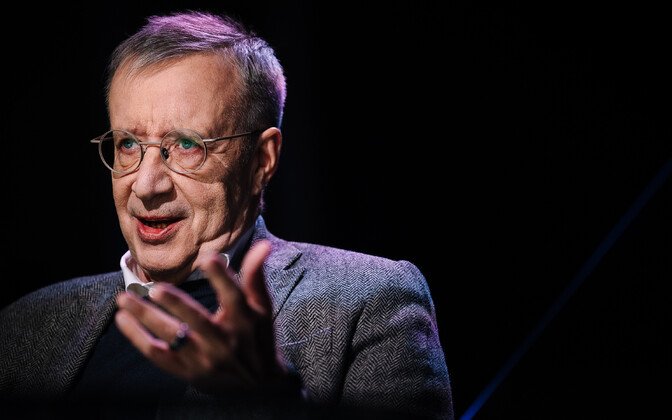
President Toomas Hendrik Ilves delivered the lecture “The Draghi Report and the Competitiveness of the European Union” at the Delta Economic Conference in Tartu.
—