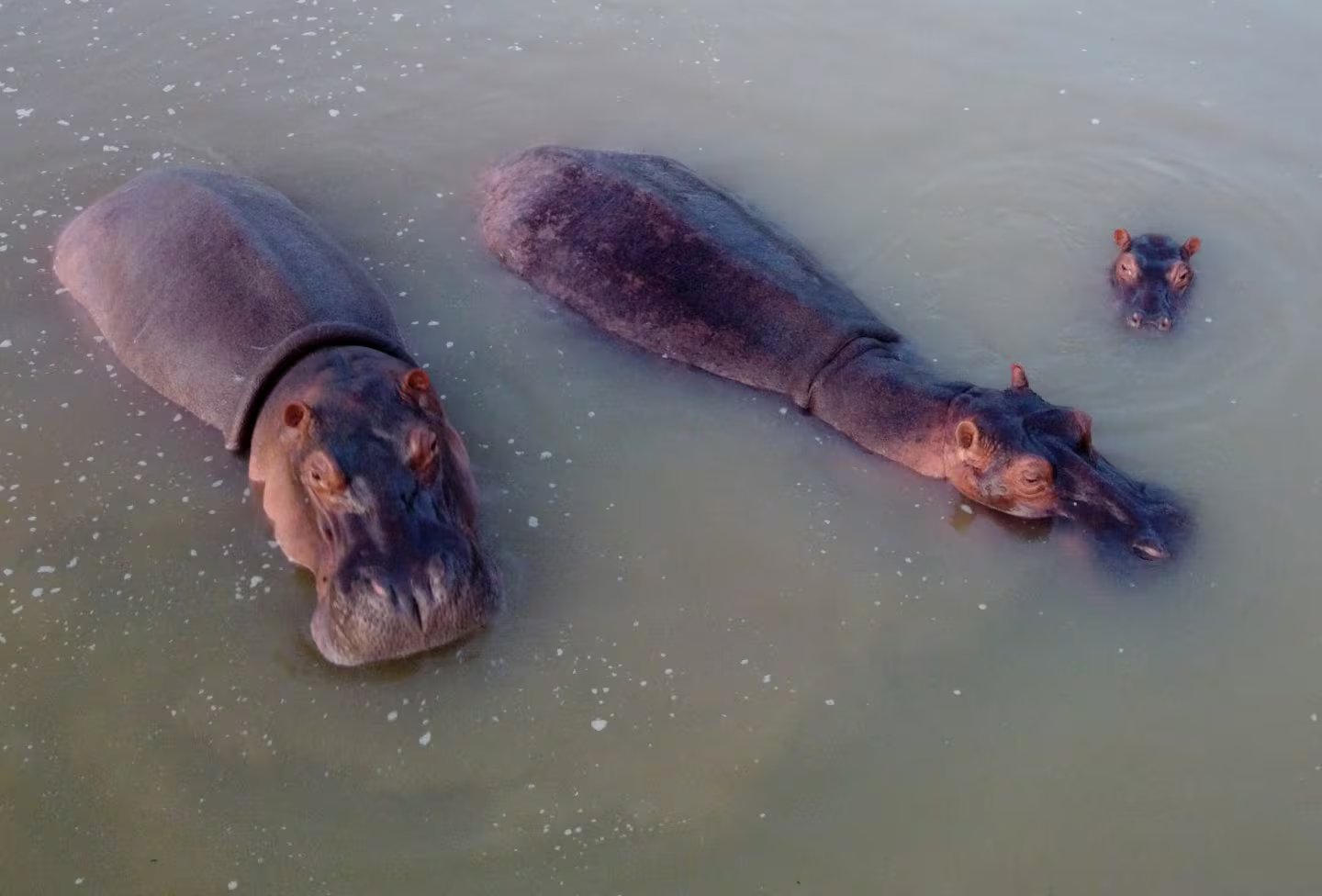
He Government of Colombia announced this Monday, April 13, a shock plan to contain the spread of invasive hippos. The strategy includes euthanasia, translocation and territorial actions. The population exceeds 200 individuals.
The initiative will have an investment of ¢7.2 billion. The resources will be in charge of the Regional Autonomous Corporations (CAR). The execution will be carried out through the Life and Biodiversity Fund from the second half of 2026.
The interim Minister of the Environment, Irene Velezpointed out that the country faces a scenario without simple alternatives. He indicated that the international relocation is not advancing due to lack of official permits.
International transfer without authorization
The Government held talks with at least seven countries. Among them are Ecuador, Peru, Philippines, India, Mexico, Dominican Republic, South Africa and Chile. Some zoos and sanctuaries showed interest.
However, no country granted authorization under the Convention on International Trade in Endangered Species (CITES). The minister explained that, without this endorsement, it is not possible to transport the animals.
The official added that the decision depends on each State. The interest of international centers is not enough to complete the shipments.
Genetic problems aggravate the situation
The population of hippos in Colombia comes from four initial individuals. This condition generated inbreeding and genetic poverty. According to the Government, this limits its eventual reintroduction in Africa.
Intervention of 80 hippos in 2026
The plan establishes intervening at least 80 individuals this year. This figure responds to estimates of costs and operational capacity.
The actions will be concentrated in critical areas such as the Hacienda Napoles and the so-called Island of Silence. Several environmental authorities agree in these areas.
The plan also includes interventions near urban centers. The presence of these animals generates risks for communities.
The CARs will have a central role in monitoring. The project includes a pedagogical component and permanent monitoring of the species.
Euthanasia with defined protocols
The Government made official the euthanasia protocol. The measure contemplates two methods: physical and chemical.
The director of Forests, Biodiversity and Ecosystem Services, Natalia Ramirezindicated that the procedures follow technical and health criteria. The medications have expert approval.
The protocol includes the final disposition of the bodies. The objective is to avoid impacts in the areas where the measures are applied.
Accelerated growth and environmental risk
In 2022 they registered 169 hippos. Currently, the number exceeds 200. Projections indicate that they could reach 500 in 2030 already 1,000 in 2035.
The Government insisted that science supports the need for population control. The authorities consider the actions taken to be indispensable.
The impact of the species affects aquatic ecosystems. Alterations in water quality and threats to species such as the manatee and the river turtle.
Stricter measures in the face of previous limitations
The plan is part of the national strategy adopted in 2024. This included control hunting, confinement, translocation and early warnings.
Colombia is the only country outside Africa with hippos in the wild. The absence of natural predators favors its expansion in the river basin. Magdalena River.
The limitations of sterilization and the lack of progress in international transfers led the Government to prioritize stricter measures.
In addition to the environmental impact, the expansion increases the risk of dangerous encounters with people in several regions of the country.
*The creation of this content was assisted by artificial intelligence. The source of this information is from Grupo de Diarios América (GDA) media and reviewed by an editor to ensure its accuracy. The content was not generated automatically.