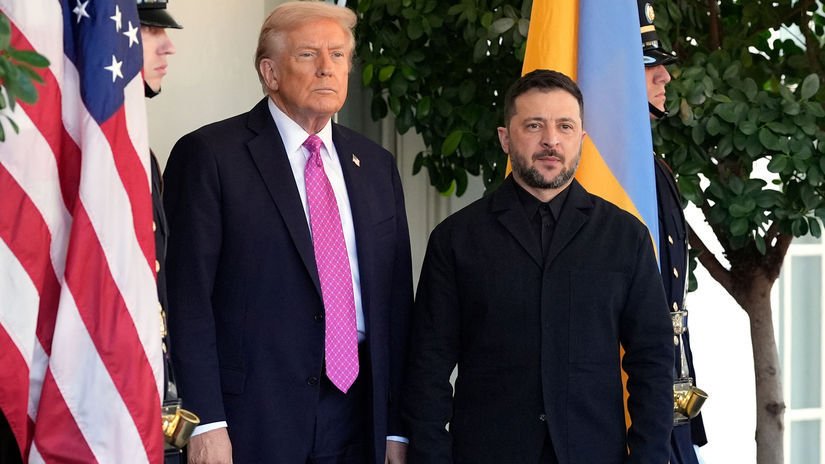
According to Phillips Payson O’Brian, historian and professor of strategic studies, Kiev’s attitude towards Donald Trump is changing significantly. For a long time after his return to the White House, Ukraine tried to appear conciliatory and believed that it could win over the American president, despite his repeated expressions of sympathy for Vladimir Putin, restrictions on military aid and sharp attacks on Volodymyr Zelensky.
Kiev, according to O’Brian, who expressed himself in a comment for The Atlanticinvolved in Trump’s peace initiatives, although he perceived them as set up in favor of Moscow. Zelenskyj also approached agreements on mineral resources and publicly praised Trump, as the Ukrainian leadership counted on the fact that a welcoming tone could help retain at least some of Washington’s support.
But O’Brian says that strategy has run its course. Ukraine is relying less and less on the United States and is actively looking for new diplomatic and military partners. As examples, he cites the sharing of experience from drone warfare with the Persian Gulf states or the deepening of arms cooperation with Germany.


According to the author, the change can also be seen in Zelenský’s public statements. When the Trump administration eased the pressure on the Russian oil sector, Zelensky declared that Russia had once again outwitted the Americans and the US president himself. Later, he also warned that if the United States were to withdraw from NATO, Europe would have to build security with the help of countries such as the United Kingdom, Norway, Turkey and Ukraine.
O’Brian sees in this an open admission of what many European leaders have so far refused to name. According to him, Ukraine’s rhetoric was mainly changed by the restriction of American arms supplies, Trump’s reluctance to punish Russia harshly, and the pressure on Ukraine to give in to Moscow in the framework of a possible agreement on the issue of the territory and the people of Donbass.

At the same time, the American historian reminds that the change in tone is also related to developments on the battlefield. Ukraine relies to a greater extent on its own drone industry, it can attack deep in the Russian rear and further limits Russian activity in the Black Sea. It is these capabilities, according to the commentary, that have strengthened Kyiv’s belief that it is not entirely dependent on American help.
However, O’Brian, in a comment for The Atlantic, also emphasizes that Ukraine would still rather have the US on its side than on Russia’s side. American military support between 2022 and 2024 was crucial for its survival. However, O’Brian’s conclusion is clear: in Kyiv, the conviction is growing that even the loss of American support does not automatically mean defeat, because today Ukraine has more faith in its own capacities and European partners