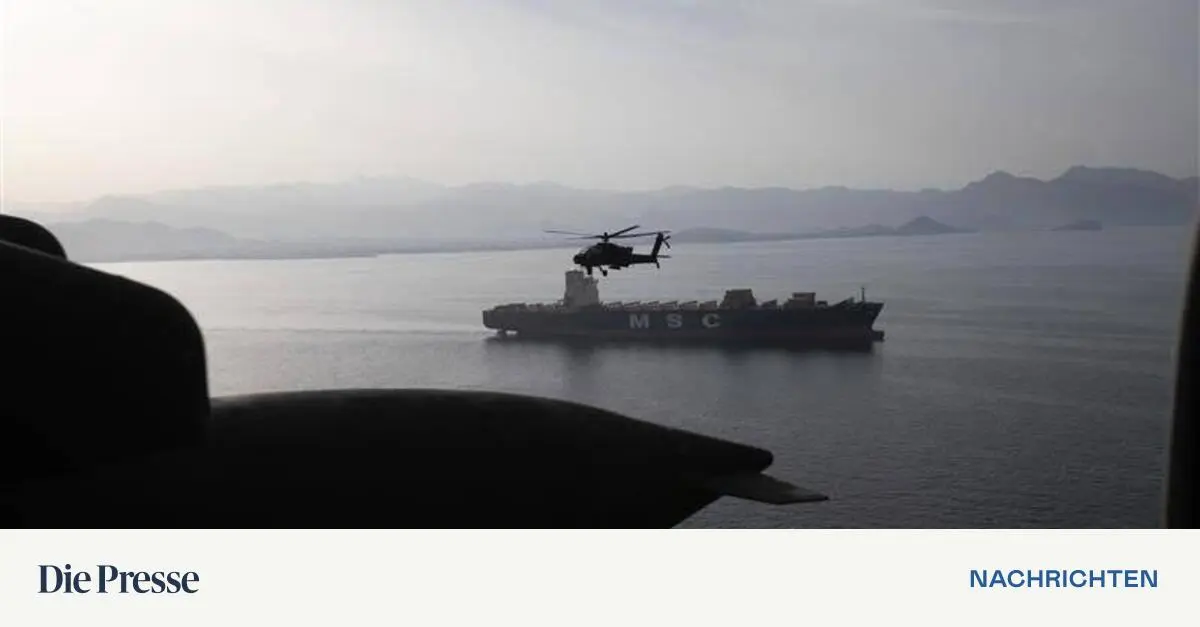
Attack helicopters take off in the darkness from the deck of a US warship off the Iranian coast. Shortly afterwards they hover over the Iranian container freighter “Touska”. Marines rappel onto the freighter and take control of it. On Monday night, the US military captured on video how American soldiers boarded an Iranian ship for the first time.
The US planned a new meeting with Iranian negotiators in Pakistan on Monday, but the confrontation in the sea off the Strait of Hormuz threw the negotiations into question. Iran hesitated to accept the meeting and said it fired drones at American warships.
US President Donald Trump had ordered Iranian ships to be captured to enforce the American naval blockade of Iranian ports. Washington is thus stumbling into a so-called escalation trap: America is becoming increasingly involved in a conflict that it actually wants to end.
According to the Reuters news agency, Trump indicated on Monday that he would end the naval blockade. Pakistani Chief of General Staff Asim Munir told the president on the phone that the US blockade was an obstacle to the planned peace negotiations. Trump then promised to think about it.
The US Central Command responsible for the Middle East said that the crew of the Touska had been warned but had not stopped the ship. A US destroyer then fired several shells into the freighter’s engine room, bringing the ship to a standstill.
The marines then boarded the freighter, which, according to Iranian sources, came from China and was headed for the Iranian port of Bandar Abbas. It was not known what the “Touska” was carrying. Iranian forces responded by firing drones at US ships, state media reported.
The high command of the Iranian army said that the military would refrain from attacking the US soldiers on the ship until further notice out of consideration for family members of the crew on board the “Touska”. Once the crew members and their families are safe, the “terrorist US military” on the ship will be targeted.
Trump linked the announcement of new peace talks with the attack on the Touska because he wants to force Iran to make concessions. Before the attack, he said his deputy J.D. Vance and other US negotiators would arrive in Pakistan on Monday evening for the planned second round of negotiations with Iran. Trump threatened that the meeting would be the last chance to prevent the war from continuing.
The current ceasefire expires this Wednesday. Both sides had spoken of progress in their contacts in recent days. The aim is to reach a framework agreement that should contain limits on Iran’s nuclear program, the opening of the Strait of Hormuz and the dismantling of economic sanctions against Iran.
Experts doubt that the Iranian regime will be impressed by Trump’s threats. Since the beginning of the war, the US President has threatened to destroy Iran several times, but then switched to negotiations. Trump’s hint of a U-turn on the naval blockade could be a new example. If the talks fail, Iran wants to completely close the Strait of Hormuz again and begin new attacks on the oil and gas industries of the Arab Gulf states. Global oil prices rose again on Monday.
Trump’s demand that Iran submit to all US conditions will strengthen the Iranian Revolutionary Guard’s determination to resist the US, wrote political scientist Robert Pape from the University of Chicago on X. “This is an escalation trap that is unfolding before our eyes.”
The Iranian government said on Monday that it had not yet decided whether or not to send a negotiating delegation to Islamabad. Host Pakistan nevertheless prepared the luxury Hotel Serena in Islamabad for the negotiations. The first American-Iranian meeting had already taken place in the Hotel Serena.
Basically, Iran has an interest in reaching an agreement with Trump. A peace agreement could bring the Islamic Republic a non-aggression guarantee from the USA, the release of frozen billions in assets and the necessary calm for the reconstruction of the war-torn infrastructure. President Masoud Pezeshkian said on Monday that all options for a diplomatic solution should be exhausted, even if suspicion of the US is appropriate.
This distrust comes as Trump ordered attacks on the Islamic Republic twice – last June and late February – during ongoing negotiations with Iran. The leadership in Tehran fears that the negotiations in Islamabad could also be a diversionary tactic for the Americans before new attacks, says Vali Nasr, Iran expert and former advisor to the US State Department. Intentionally or unintentionally, Trump “undermined diplomacy and made a new war more likely,” Nasr wrote on X.