What will people be talking about at the Venice Biennale, which starts next week with preview days for invited audiences and the press? Most rarely about art. On Thursday, the protests escalated further: the Biennale jury, chaired by Brazilian curator Solange Farkas, resigned as a unit. The week before, it had already announced that it would not award the Golden and Silver Lions to countries whose heads of state had arrest warrants from the International Court of Human Rights. So Israel and Russia.
The 61st edition of the world’s oldest art biennale is more politically dominated than ever. With 99 participating nations, from Russia to Iran to Israel, Qatar and the USA, of course, it serves as a mirror of the world in minimundus format – unlike the Olympic Games, for example, in terms of content as well as physically, i.e. architecturally, in the form of the country pavilions.
While most of the country contributions are rented somewhere in Venice’s urban space, 29 nations have their permanent pavilions in the historic Giardini, which also belong to the respective countries themselves. By the way, there has been one more country there since this year: Qatar has bought in and, next to the central book pavilion, has built the first new country pavilion in this area since the 1980s.
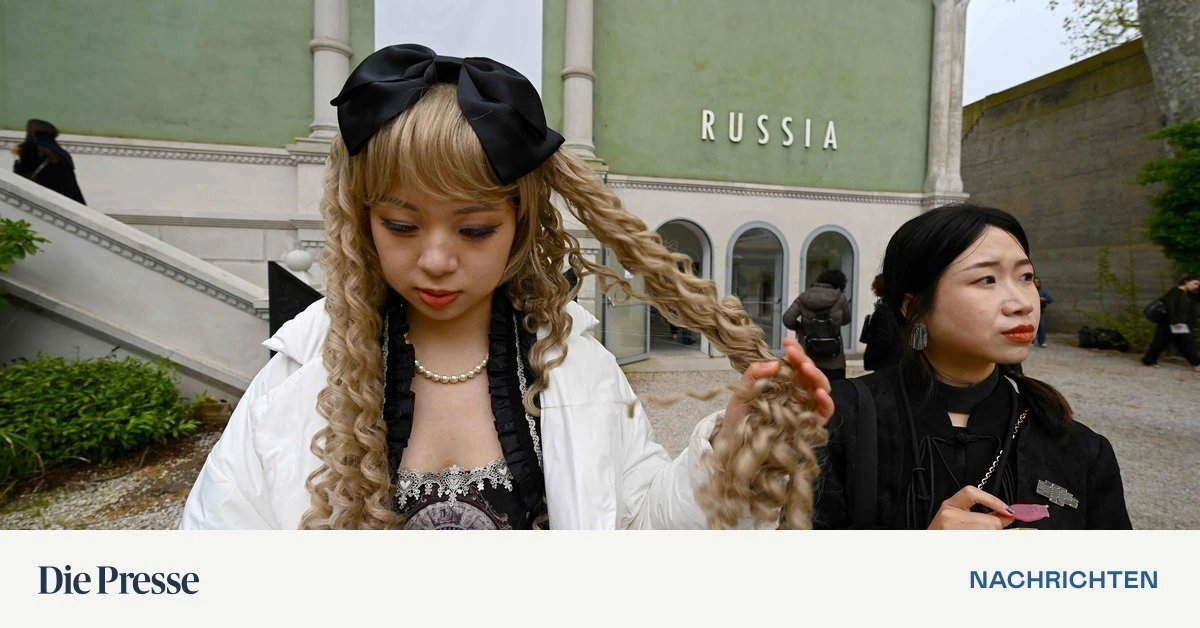
Even this decision by the Biennale Foundation, which is worth discussing, will not be the focus of the debates. But the Russian pavilion, which was closed or rented out for the last two editions of the Biennale. In 2022, shortly after the war of aggression against Ukraine began, the already selected Russian Biennale representatives withdrew their contributions and the gates remained closed. In 2024, Russia let its friendly Bolivia use the pavilion.
Next week, the doors of the mighty confectionery building will open again under the Russian flag. Which caused violent protests and discord, including within Italy. The government of Giorgia Meloni accused the right-wing president of the Biennale Foundation, Pietrangelo Buttafuoco, who she appointed herself, of making Russia’s participation possible. The Italian Minister of Culture will therefore – for the first time in 20 years – stay away from the opening of the Venice Biennale. The EU announced that it would freeze the two million euros in funding for the biennale. 22 EU countries also protested against Russia’s participation, including Ukraine.
When asked by the “Presse”, the Biennale and Buttafuoco also argued legally: The Biennale Foundation “does not have the authority to stop a country from participating”. This is also written in their statutes, as you can read.
Any nation that recognizes Italy as such is free to take part in the Biennale (there are 99 this year). Each country bears the costs and responsibility for the content itself. The fact that Russia did not take part in 2022 and 2024 was its own decision, according to the Biennale management.
Buttafuoca himself compared the Venice Biennale with the Venice Biennale in a conversation with right-wing Italian politicians quoted by the media United Nationswhere all countries are also represented. Which is at least a more plausible idea than the one expressed elsewhere: the Biennale represents a “diplomacy of beauty”.
Can this be found in the Russian Pavilion? There is less visual art to be seen there, as we learn via Instagram, than music to be heard. The first four days of the preview will feature mainly traditional music groups, primarily from non-Russian countries, performing here. The pavilion will then close again. However, videos of these performances should run under the windows and thus remain visible to Biennale visitors
As in 2024, there was also strong opposition to Israel’s participation; 200 artists, curators and workers from the biennale environment called for exclusion in a letter. While the Israeli artist Ruth Patir herself made a statement in 2024 by not opening her contribution in the pavilion, this year’s participant, sculptor Belu-Simion Fainaru, was not only contractually prohibited from doing so by Israel. He doesn’t want it at all, he finds both the requested exclusion and the jury’s decision “discriminatory” and wanted to take legal action against it. He welcomed the jury’s resignation.
For the first time, protests were also made against the participation of the USA in a letter signed by 70 artists and curators. What Donald Trump probably leaves it unmoved. Those around him commissioned a former luxury dog food saleswoman to act as commissioner for the pavilion. The largely unknown, monumental US sculptor Alma Allen will be exhibiting there. After all, he lives and works in Mexico, of all places. One can hope he has a valid residence permit there.

At the Biennale two years ago, Russia rented its pavilion in the Giardini to its friendly Bolivia. IMAGO/IPA/ABACA