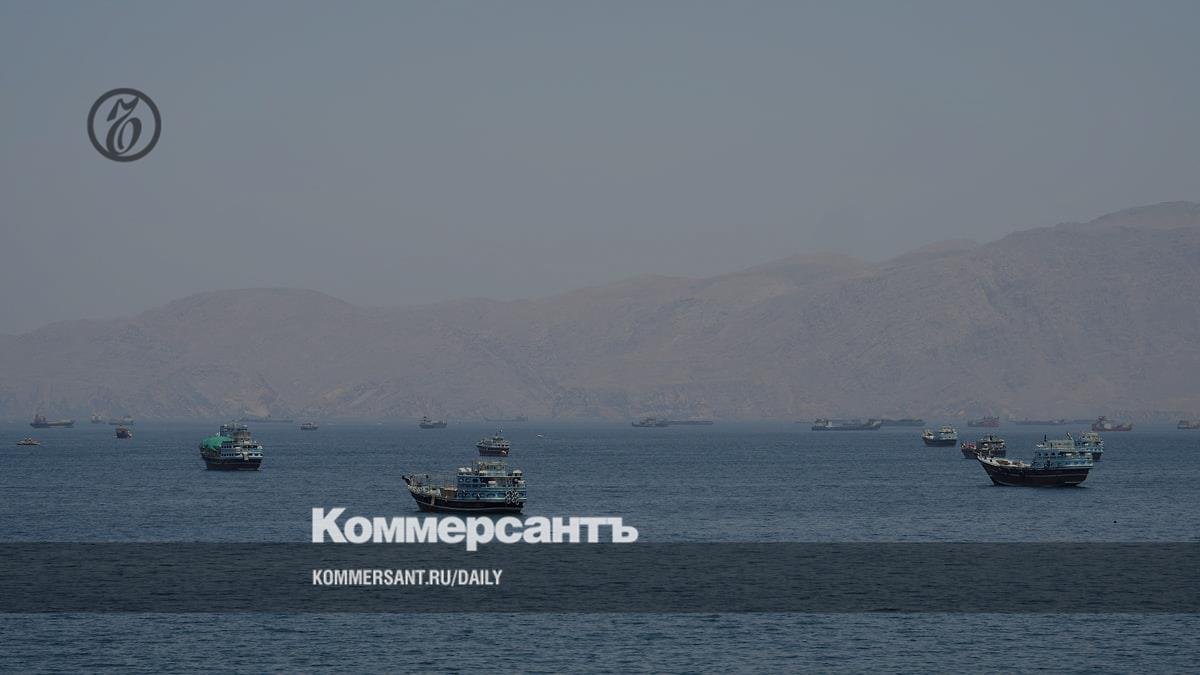
On the night of May 6, US President Donald Trump announced the freeze of Operation Freedom Project, which was aimed at restoring commercial shipping in the Strait of Hormuz. This happened just two days after its official start. At the same time, Washington decided to continue the naval blockade of Iranian ports, introduced on April 13. As stated by Secretary of State Marco Rubio, the US Navy will focus on economically depleting the enemy. However, according to American media, the freezing of the Freedom Project is associated with the progress of US-Iranian negotiations on the signing of a peace memorandum.
Donald Trump announced his decision to freeze the operation aimed at freeing merchant ships stuck in the Persian Gulf on the night of May 6 on the Truth Social social network. “In connection with the request of Pakistan and other countries (mediating in the conflict.— “Kommersant”), due to the tremendous military successes we have achieved in the campaign against Iran, as well as significant progress towards reaching a full and final agreement with the representatives of Iran, we have mutually agreed that for the time being the blockade will remain in place and the Freedom Project (ensuring the passage of ships through the Strait of Hormuz) will be suspended for a short period of time to determine whether the agreement (with Iran) can be completed and signed.— “Kommersant”),” said the US President.
A few hours before this statement, Marco Rubio managed to give a press conference where he announced that the military operation against Iran “Epic Fury” was completed, as the US President told Congress on May 1. But the “Freedom Project” continues, the head of the State Department said.
“This is not an offensive, but a defensive operation,” explained Mr. Rubio. “It’s very simple: there is no shooting unless they shoot at us first. We are not attacking them (Iranian forces.— “Kommersant”)…But if they attack us or (trade.— “Kommersant”) ship, you need to answer this.”
According to him, the US Navy has already proven itself by destroying part of the Iranian “mosquito fleet” – the so-called group of fast military boats used by the Islamic Revolutionary Guard Corps.
The Secretary of State cited estimates that economic pressure on Iran (the US Treasury Department calls this campaign “Economic Rage”) is having an effect. “Today, inflation in Iran has reached 70%, and their currency is in a state of complete and absolute decline,” said Marco Rubio. “The strengthening of US sanctions is increasing. This comes in unison with a naval blockade aimed at disrupting Iran’s ability to generate, move and receive revenue. The sanctions directly target the regime’s main sources of income.” According to the head of American diplomacy, the blockade of sea ports costs Iran $500 million a day. “90% of all Iranian trade has been stopped, which is causing irreparable damage to Iran’s oil infrastructure because its wells are being forced to shut down,” Mr. Rubio added.
However, Tehran is confident that it is the master of the situation. How reported Press TV, a television channel close to Iran, the authorities of the Islamic Republic officially launched a new mechanism for regulating maritime traffic through Hormuz, forming the management of the strait. The government agency will ensure that all merchant ships that want to pass through the most important shipping artery of the Middle East receive special instructions for passage. De facto, the draft, which Iranian officials call a “sovereign governance system,” clarifies the rules for payment for passage through the Strait of Hormuz.
By words sources of the Axios portal, the freezing of Operation Freedom Project is associated with progress in the US-Iranian negotiations. According to these data, the White House believes that it will be able to reach agreements with Iran in the coming days. This will not be a full-fledged agreement, but a memorandum of understanding. The draft document provides for the cessation of hostilities “on the ground” and the start of a 30-day period of negotiations on an agreement on a comprehensive settlement.
The Iranian blockade of Hormuz and the US blockade of Iranian ports will be gradually eased during this 30-day period, Axios clarifies.
In the memorandum of understanding, Iran will commit to never seeking or engaging in nuclear weapons activities. Much depends on the duration of the moratorium, within the framework of which Iran must abandon uranium enrichment. Tehran favors a five-year ban, while US negotiators are pushing for a period of 12 to 15 years. After the expiration of the moratorium, the Iranian side will be able to begin enriching uranium to a level of 3.67%. The same cap was agreed to under the terms of the Joint Comprehensive Plan of Action, the multilateral nuclear deal with Iran that the United States withdrew from in 2018, during Trump’s first term.
Axios sources believe that the main shift is Iran’s willingness to give up its highly enriched uranium, buried during the 12-day war in June 2025 under the rubble of nuclear facilities. At the same time, even the transportation of this material to American territory is discussed. In addition, the United States wants to persuade the Iranians to abandon the operation of their nuclear infrastructure, located deep underground.
As part of the memorandum, the Trump administration is ready to abandon one of the main points of its foreign policy agenda – economic pressure on Iran – and gradually lift sanctions against it, up to the unlocking of frozen international accounts. If the memorandum is signed, the Iranian leadership can undoubtedly present this step as evidence of its absolute victory.