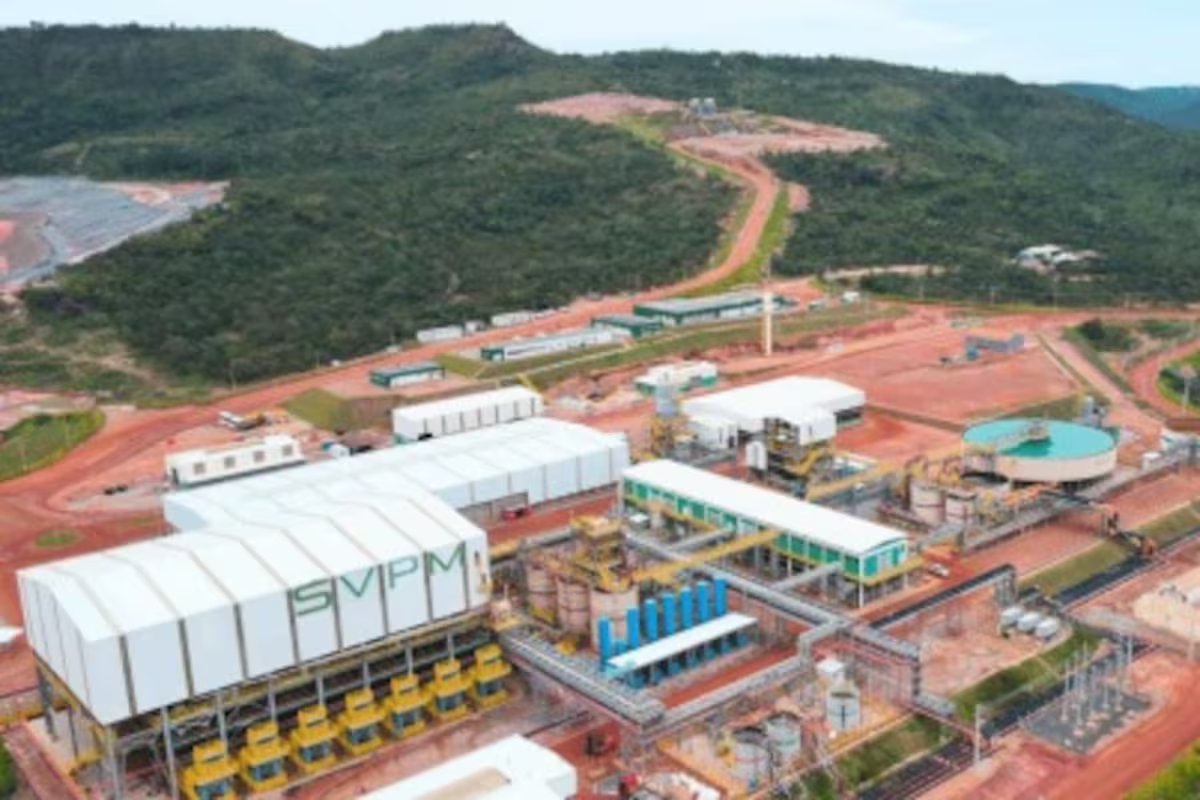
BRASILIA.– In the silent immensity of the state of Goiás, in the center-west of Brazil, 300 kilometers from Brasilia and far from diplomatic offices, The United States has just executed a movement of pieces that redefines the architecture of power in Latin America.
Confirmation of the purchase of the mining company Serra Verde by an American consortium is not a simple market transaction, but Capturing life insurance for Washington’s military industry.
By securing the only scaled rare earths operation outside of Asia, Donald Trump’s administration plants a flag in the Brazilian subsoil to break the monopoly that China exercises over the minerals that define the technology of the 21st century.
The operation, valued at about 2.8 billion dollarsmarks a point of no return. The company USA Rare Earth took control of this strategic reserve backed by direct financing from the Development Finance Corporation (DFC), the investment arm of the US government. For analysts, the presence of the DFC eliminates any patina of “private business.”
“We are not facing a mere commercial movement, but rather an extension of White House policy“, the professor explains to LA NACION Roberto Goulart Menezesfrom the University of Brasilia (UnB).
The stated objective of this acquisition is to create a multinational company capable of leading the entire production chain: from the extraction of rare earths in central Brazil, through the complex stages of separation and processing of these elements, to the final manufacturing of supermagnets. These components are today the technological heart of electric car motors, wind turbines and, fundamentally, of the latest generation military fighters and missiles.
To shield this flow, the contract establishes an exclusivity regime for fifteen years, a period that guarantees that Serra Verde’s production primarily feeds the North American industry.
The intention to reduce the critical dependence of US industries on China is also declared. The Asian giant currently concentrates all stages of the process, responding for almost 80% of the extraction of rare earths, 89% of their separation and more than 90% of the global production of supermagnets.
For Maurício Santoropolitical scientist and expert on relations with China, this scenario places Brazil in a privileged but dangerous place. “The largest reserve in the world is in China and the second is in Brazil. Rare earths have become a weapon in geopolitical disputes; “They are the oil of the 21st century,” says the professor at the State University of Rio de Janeiro (UERJ). For Santoro, this agreement is a prelude to the tensions that will dominate the coming years, where Brazil acts as a faithful player in the global technological balance.
However, the government of the president Luiz Inácio Lula da Silva tries to show a “non-alignment” that generates short circuits with Washington. Goulart Menezes highlights that Planalto’s position does not seek a rupture, but rather a negotiation based on the national strategy itself. “Brazil does not tend to become, with Lula, an unconditional ally or an alternative to the Chinese. It wants international partnerships, but guided by its own development strategy”says the UnB professor.
This strategic advance in Goiás occurs at a time of greatest institutional friction between Brasilia and Washington. The recent crisis over the withdrawal of credentials from intelligence and security agents is, for experts, a symptom of a loaded and ideological agenda. The friction escalated after the arrest of the former deputy in Orlando Alexandre Ramagemformer intelligence chief of Jair Bolsonaro, a fugitive there after having been sentenced to more than 16 years in prison for having been part of the coup plot to prevent the inauguration of Lula da Silva.
The episode led to a serious accusation from the United States: Washington maintains that A Brazilian agent of the Federal Police (PF) carried out illegal espionage against Ramagem in US territory to provoke his arrest.
According to this version, the agent acted motivated by political motivations dictated from Brasilia, which broke the bilateral cooperation protocols and led the White House to revoke his immunity and expel him from the country.
The Brazilian government, in an act of reciprocity, responded by withdrawing the credential from the ICE representative in Brasilia, deepening what Santoro describes as an “unprecedented” incident in the history of police cooperation in both countries.
But there is one factor that keeps Lula’s advisors awake: the possibility of direct interference by Donald Trump in the Brazilian presidential elections in October. The mistrust is so deep that even sources within the North American diplomatic apparatus admit the risk.
“It’s a very real possibility. Will he do it? We don’t know, it’s an unknown”a senior US diplomat with an office in Brasilia pessimistically acknowledges when asked by LA NACION.
For Santoro, foreign policy will be, for the first time in decades, a central issue of the campaign. “There is speculation that Trump could declare the Brazilian cartels (First Capital Command and Red Command) as terrorist organizationswhich would benefit the opposition and greatly harm Lula,” he warns.
President Lula tries to navigate this storm with a speech of sovereignty, contrasting his “peace and food” agenda against the logic of “war” that he attributes to Trump’s management.
Brazil is facing an uncomfortable fissure. While their leaders exchange gestures of diplomatic hostility and withdraw credentials in a choreography of mutual distrust, a forced alliance, in the deep lands of Goiás, will force Brasilia and Washington to coexist, even with their backs turned, for the next fifteen years.