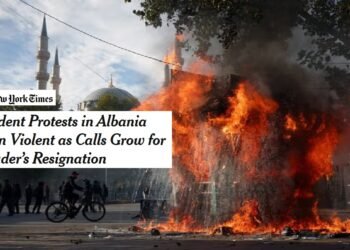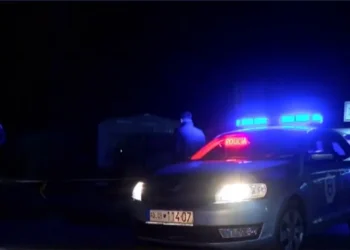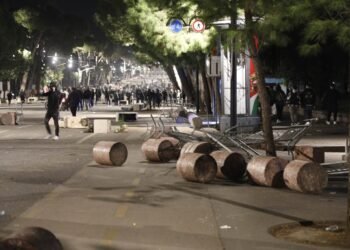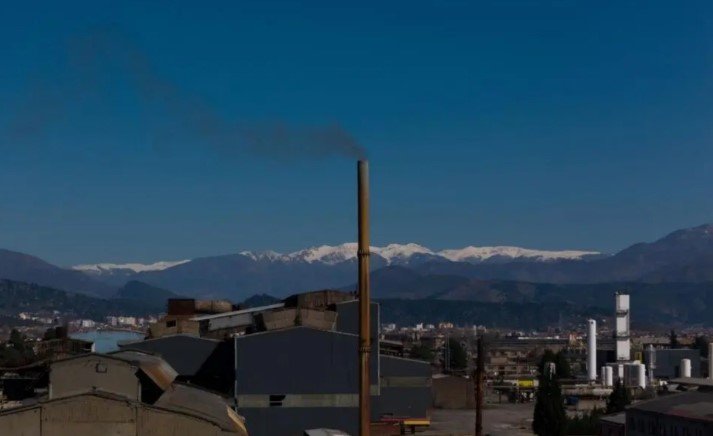
Environmental inspectors rushing to address two fires discovered 318 tons of toxic industrial dust that had been stored for months at the chrome plant, AlbChrome, without transfer contracts for its safe treatment or disposal. The location, owned by the Turkish Yildirim group, was temporarily closed. It is the latest in a string of disasters to hit one of Europe’s most darkened industrial cities, constantly shrouded in deadly smoke from similar fires.
The residents of Elbasan have been victims of environmental crimes since Chairman Mao’s China helped Albania’s then-communist dictator Enver Hoxha set up the vast “Party Steel” complex of 500 factories in their fertile valley in the 1970s.
The country’s third largest city has also become a symbol of the corruption that has followed Albania’s painful transition to capitalism, with Albanians paying with their health for repeated scandals.
An incinerator project to help clean up the ecological disaster turned out to be a huge multi-million dollar scam involving a “ghost” incinerator for the capital city of Tirana, which was never built. Its tentacles reached into the heart of the Albanian government, with senior officials, including an environment minister, jailed for corruption. The former deputy prime minister of the country is on the run.
Environmental agency officials are also accused by anti-corruption prosecutors of being involved in the trafficking of toxic waste from Elbasan.
The EU dream in danger
A fire that lasted several days in July 2025 in a garbage dump near houses on the outskirts of Elbasan revealed concentrations of toxic furans, dioxins, methane and volatile organic compounds “more than 7 times” above safety limits, said Professor Besnik Baraj of the Academy of Sciences of Albania.
“I almost died from a severe (asthma) attack,” said Fatmira Serjani, a resident of the area, recalling “terrible nights and crushing mornings,” her voice breaking between puffs of her inhaler.
Repeated fraud and environmental failures could also slow Albania’s hopes of joining the European Union in 2030, analysts warn, with neighboring Montenegro seen as pushing ahead.
EU Enlargement Commissioner Marta Kos raised alarm bells this year when she said that “you can have the best legislation to fight corruption, but if it is not accepted in the country, then you have another problem”.
Cancers and harmful gases
In the first case of its kind in Albania, Serjani, who suffered from asthma, is taking the city of Elbasan and the manager of the Eco-Elb waste depot, where the 2025 fire broke out, to court for the air pollution it caused.
Her lawyer, Gentian Serjani, said the fire was “probably intentional” – a frequent allegation about blazes in and around the old steel complex.
Waste depot manager Leli Kaja was arrested on Monday on corruption charges, with SPAK anti-corruption prosecutors claiming he was caught “red handed” taking bribes.
Environmental engineer and former Elbasan councilor Ahmet Mehmeti said some factories in the country turn off filters in their chimneys to save money, adding new layers of toxic dust to the 2 million tons of hazardous materials inherited from the communist era.
An AFP team saw a chimney spewing black smoke at the site, which in some places resembles a black lunar landscape, in March 2025. But when a cameraman readied a drone to film up close, the smoke suddenly stopped.
“Waste stored since the communist era or produced by current factories contain chromium, nickel and zinc,” said Mehmeti. “The discharge seeps into the water, flows into the nearby river that irrigates the farmland, and ends up on the fruits and vegetables on our plates.”
“The situation is serious in villages like Balldre and Bradashesh near factories that release large amounts of harmful gases into the air,” said Anila Jance, professor of biochemistry at the University of Medical Sciences in Tirana.
“Air quality indicators show high concentrations of fine particles (PM2.5). Chronic exposure to PM2.5 is closely related to a higher incidence of chronic respiratory diseases, especially chronic bronchitis and obstructive pulmonary diseases,” she added.
In Bradashesh, retired teacher Lirie Curri, 61, showed AFP X-rays of her damaged lungs.
“Even the sun here is as black as my lungs,” she said. “It’s unbearable. We can’t open the windows, not even the oranges in the garden and the dried clothes are covered in black dust.”
Pollution from chimneys is worse at night, locals insist, when the smoke can’t be seen as clearly. Curri’s 8-year-old granddaughter, Ermi, said that “all the children cough” in their neighborhood. And when she catches a cold and they clean her nose with a napkin, it “is black”, added her mother, Mirela Kabashi, a police officer in Elbasan.
There is no air monitoring
Genetic diseases and cancers have been on the rise in the region for years, environmental experts told AFP.
“Lead emissions have caused brain damage, especially in children, but also genetic problems in livestock and poultry,” said Beqir Kila, a well-known environmental expert.
The Albanian authorities did not respond to AFP’s questions about how the pollution has affected the health of people in Elbasan.
However, the US-based Health Effects Institute estimated in a 2023 report that the death rate from air pollution in Albania is 3 times higher than the European average.
There are no official statistics because the country has not had a single air monitoring station in operation for some time, despite the EU paying €400,000 to equip 4 of them in 2011.
The equipment delivered to the National Environment Agency in 2013 has been out of order for 12 years due to a lack of maintenance and money to put it into operation, according to the EU delegation in Tirana.
The Elbasan council paid for its own stations in 2017, but they “were quickly demolished or forced to be demolished,” Mehmeti said.
“More than a lack of money, it’s a problem of misappropriation of public funds, not to mention the lack of transparency aimed at hiding the truth about pollution,” said Albanian biologist Olsi Nika, winner of the Goldman Environmental Prize.
The “phantom incinerator” scandal is the most widespread, critics say.
Nearly 150 million euros of public funds were spent on the project to overhaul the country’s waste management system with waste incinerators in Elbasan, the capital Tirana and Fier in the south.
The Elbasan incinerator, which cost 26 million euros, is now a rusting ruin after barely functioning, while the Fier plant (23 million euros) has never functioned.
Tirana’s incinerator worth 100 million euros was never built. Contracts were signed, but the money went up in smoke in corruption, embezzlement and money laundering.
The scandal of the incinerators
Former environment minister Lefter Koka was jailed for accepting 3.7 million euros in bribes in this case. Other senior officials have been implicated, with former deputy prime minister Arben Ahmetaj, who fled to Switzerland, denying any wrongdoing.
The anti-corruption agency SPAK launched new proceedings against 12 more people in July, accusing them of “money laundering within a criminal group”.
At its head, prosecutors say, are two businessmen who have been on the run since 2024 and are wanted by Interpol, Mirel Mertiri and Klodian Zoto. According to the first case file by AFP, their consortium used fictitious companies and Albanian and foreign nationals, especially Dutch and Italian, to hide the identity of the real owners of the concessions.
They received about 120 million euros at the current exchange rate for the Tirana incinerator.
The first documents from AFP show that Mertiri and Zoto were the “de facto” owners of a company registered in the Netherlands, Integrated Energy BV SPV. A branch in Albania with the same name was created on August 30, 2017, a few days before the agreement for the Tirana incinerator was signed with the former minister of the environment.
Trafficking of waste
A second major scandal erupted in 2024 when Thai authorities turned back a shipment of toxic waste from Elbasan, which had been labeled as legitimate iron oxide, following a tip from the environmental advocacy group the Basel Action Network.
The shipment of more than 100 containers containing 2,100 tons of toxic waste was sent back to Albania. The containers are now piled up next to houses in the southwestern town of Vrina.
Prosecutors have issued 33 arrest warrants against customs officers and employees of the National Environment Agency for their suspected involvement in the scheme. Three Turks and one German are also wanted.
Analysis of samples from the cargo by an Italian laboratory revealed the presence of “dangerous and toxic” dust from the electric arc furnace of a steel plant in Elbasan operated by Turkish company Kurum International and two Albanian firms, investigators said.
“Not an isolated crime”
Prosecutors insisted that “this is not an isolated crime, but a series of illegal acts with serious consequences for the environment, health and customs”, which include the trafficking of prohibited goods, abuse of power and money laundering.
The European Commission told AFP that “the fight against corruption is a key element for a country to be able to join the EU,” after praising Albania’s “tangible progress” in a report last year.
He added that “Albanian legislation will have to be aligned with the EU” before the essential environmental elements of Chapter 27 of the accession talks, related to waste management, water and air quality, “can be closed”.
Last month, Prime Minister Edi Rama said that a national waste treatment operator was being created to meet European standards.
But analyst Tefta Kelmendi, of the Jacques Delors Institute think tank, said the latest high-profile cases represented a “major test” of Albania’s accession prospects, after Rama sacked Deputy Prime Minister Belinda Balluku in March after she was indicted in another corruption probe.
“Many things will depend on how much SPAK manages to remain independent,” she said, adding that the anti-corruption agency is increasingly under pressure. ©AFP, adapted in Albanian by LAPSI.al