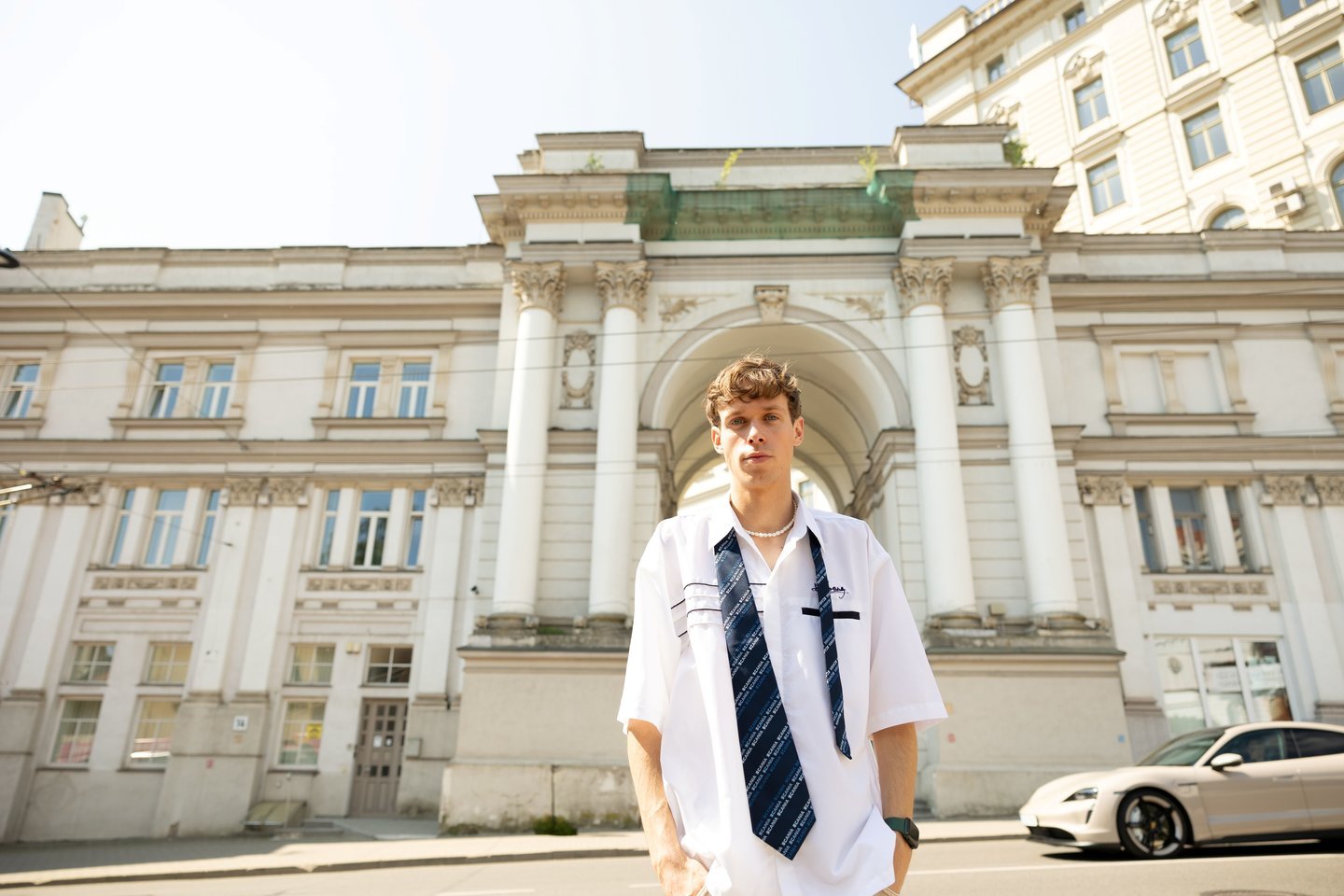
Jakŏb admits that his young age, a relatively small age difference, and the same digital environment in which today’s teenagers live, also help him to connect with students. However, according to his belief, the most important thing is still not technology, but the ability to be a person who not only teaches, but also listens, understands and creates a safe environment for growth.
You can make an impact not only in the classroom, but outside of it as well
J. Širvinskas, a student of pedagogy of professional studies at VMU Education Academy, has been working at the school for about five years, of course, with certain breaks. At one point, he had gone abroad to study, had decided to withdraw from pedagogy, but eventually returned to school. Today, he says he realized that this is where he wants to be and work.
According to the interviewee, the biggest motivation for this work is not only the transfer of knowledge, but the opportunity to contribute to the growth and development of young people.
“For me, it is important not only to teach a subject. A teacher can contribute to the formation of attitudes, values, self-confidence. He can have that influence not only in the classroom, but also outside it,” he says.
According to him, not only lessons help to create a relationship with students today. It is important to understand how young people live, what they are interested in, what they live in, what kind of environment they spend their time in.
“I believe that my young age, because I myself have finished school relatively recently, really has an influence. I am closer to students my own age than many of my colleagues, so it is natural that there are more interests and common themes with the younger generation.
When I go to events, various concerts, I also meet my students there. That commonality of interests makes it easier to establish a mutual relationship”, says J. Širvinskas.
Students are not used to seeing what the teacher does after class
Social networks create even stronger bonds between him and his students. Before starting work at the school, Jakūbas already had experience in creating content for various brands and opinion leaders, so he was no stranger to the social media environment.
 More photos (5)
 Photo of personal album.
While working at a school, he noticed that students get most of their information from TikTok, so he decided to try this platform himself.
“Students talked a lot about TikTok. I realized that they not only have fun there, but also learn a lot of new things. I thought that maybe the teacher should also be there,” he recalls.
The first videos created by Jakūb attracted a lot of interest, and eventually social networks became a place where the teacher shares not only the daily life of the school, but also the moments of his personal life – trips, sports, cycling or other leisure activities.
“Students are not used to seeing what the teacher does after class. They usually only know that person in the classroom. And when you share something from your life, common topics emerge. For example, after the cycling trip, students asked how it went on that track, they said they would like to try it themselves. In such situations, a conversation starts very naturally.”
According to him, social networks today can become not only an entertainment platform, but also a means to show the teaching profession from another side – more human, closer to a young person.
“There are not many teachers who share the daily life of a teacher not only in the classroom, but also outside the school. When I started receiving messages from schoolchildren or students who are considering pedagogy, I realized that there is meaning in it. If it encourages at least one person to think about the path of a teacher, then it is worth it,” he has no doubts.
According to J. Širvinskas, the most important thing at school is creating a safe environment. He remembers one of his first experiences when he unexpectedly had to substitute for an English teacher.
“Students then said that they were afraid of English lessons. My goal was not to teach the entire English grammar or vocabulary in a few months, but to make them not afraid to come to those lessons. Later, some said that they learned more in those four months than in four years. It seems to me that a lot is determined not only by the methods, but also by the atmosphere, the relationship with the person,” says the interviewer.
The microclimate of the school is no less important
Jakov describes himself as an empathetic and positive teacher, for whom a sense of humor and the ability to sometimes show serious things in a fun, simpler way are important.
“It is very important for students to feel that the teacher is empathetic and understanding, human. I am not afraid to share my experiences, to talk about difficulties or failures. I think this helps build trust,” he says.
 More photos (5)
 Photo of personal album.
Speaking about today’s challenges in education, J. Širvinskas admits that one of the biggest problems is the turnover of young teachers. A large part of them, having come to work at the school and facing various difficulties, leave the school after a few years.
According to Jakūbs, in order for a young person to want to stay working at the school, not only the salary is important, but the microclimate of the school is no less important.
“It is very important for a young teacher to feel accepted. I have heard stories from some colleagues that the older generation of teachers put pressure on the younger generation, are skeptical of young specialists. In my opinion, school should be a place where a young teacher can grow, try, make mistakes and feel supported,” J. Širvinskas is convinced.
Jakūbas is currently studying the pedagogy of professional studies at VMU Education Academy and says that the university gives him not only theoretical knowledge, but also a very important sense of community.
“The biggest value is sharing experiences. When you realize that you are not the only one facing challenges, you gain more self-confidence. Sometimes just a bad first experience can put a person off working at school, but it is very important not to give up too quickly,” he says.
Although his work as a teacher is also full of challenges, today Mr. Širvinskas says that he feels he is where he should be. “Now I know for sure that I want to work here and stay for a long time,” he smiles.