In my family the matter of the name could not go wrong. We had to stay in the genealogical thread that guaranteed that we were posterity and ancestors at the same time: I had to be Lucia like my grandmother and my future hypothetical granddaughter. The name was a gift to be received without interpretation.
So my sister had to be Maria like her maternal grandmother, younger in the line of succession.
If my mother derailed by calling her second daughter Maria Rita, the matter didn’t make a wrinkle, she didn’t raise the sound of a voice. He said she was his Saint, the one of impossible things. There wasn’t even a need for an explanation.
In the midst of the economic boom, in Puglia, ten kilometers from the town where a stigmatized friar attracted hordes of pilgrims, only the statue of Saint Rita stood up to that of Padre Pio, with his alert and knowing sulk. The black silhouette of the loosely pleated tunic, the white wimple under the black veil showed the pure oval of a woman who had survived the troubles, not a virgin.
Still beautiful, with the twist of a half smile earned with wild patience. In the middle of the forehead is the thorn of a mystical third eye of an oriental goddess. The thorn and the rose in the crown of the head, in the bouquet in the hands, in the cushion placed at the feet.
Santa Rita was like in the fairy tale of Belinda and the monster: he wanted a rose, a single winter rose. For that rose Belinda had had to deal with the Beast.
Women busy with the animals of their domestic menagerie: husbands, children, relatives have always turned to Saint Rita. They knelt to put down the thorn and take the rose.
Santa Rita didn’t need to be asked specific questions. She knew everything anyway.
It was necessary to approach asking for the path, not the pause, the restlessness, not the peace.
Rita’s real name was Margherita. Dragged by a ferocious earthly passion – as cited in the first biography printed in 1610 by the Augustinian Cavallucci of Foligno – Rita reluctantly married a ferocious husband who stopped her in speaking and frightened her in conversation. She remained a widow, heartbroken by the death of her two little children who ascended to Heaven before they became murderers, avenging their father.
Alone and outcast, she was rejected three times by the nuns of the monastery of Santa Maddalena in Cascia for obscure reasons – the plots of the Evil One, city feuds, the shame of disfiguring herself among virgins.
Rita deviates from the predictable constraints of fate and her species with the wonderful agility of the saints. Fly. Opens passages. He opens the doors and crosses the threshold. He makes the roses and fig trees in his garden grow again out of season. Rita is the saint of impossibilities.
Already at fourteen my sister Maria Rita was among the most beautiful in the country. They gave her the nickname: beautiful and impossible.
The name Rita reminds me of my sister’s beauty: a shape recognizable as classic yet capable of reinventing itself modern every time, without previous markings.
Rita is a saint who neither spoke nor wrote. Like the heroines of the myth, everyone can invent their own legend. What the flowery hagiographies report reduce her to the size of a good wife, a painful mother, an irreproachable nun. As always, for impossible women, you have to look for what isn’t said or shouldn’t be known. To be honest, Rita is a very modern saint, sanctified only in the fateful year of 1900, which inaugurated the millennium. It was Pope Leo XIII, attentive to social challenges, who wanted a saint who would become the shepherd of the women who came from the countryside to the big cities, earned their wages, talked about emancipation and perhaps divorce. Sheep already escaped from the pen. With the encyclical Arcanum divinae sapientiae of 1880 the Pope denounced the disintegration of the family as the undermining of the order that had held the earth together with the celestial glue. Rita had to become the saint capable of speaking to women in the reckless transition from the agricultural to the industrial world with an old but always usable language of understanding: female, wife, mother. The pontiff’s devotion to the Most Holy Heart of Jesus would have given further arguments. It is known that the heart is the driving force of the female soul: an open pulsating concave.
Leo XIII referred to seventeenth-century cartouches. The funeral sarcophagus could be dated to the year 1457: the solemn coffin with the painting of the redeemed Christ, Magdalene in red with loose hair, the jar of myrrh in her hand, Rita with a halo of rays around her head and the thorn on her forehead. Inside is a simple wooden chest like a cradle to contain the small dark mummy, halfway between the doll and a precious larva. Of the same year the Codex miraculorum annotated by the Cascia notary Domenico Angeli of Primocaso.
The party would have happened on May 22nd.
In the family lexicon, saying “I miss going to the Scoglio di Santa Rita” is like having reached the last resort, when all you need is a miracle.
Indeed, when you desperately have to hold on to something so as not to fall in life.
Saint Rita is not only the advocate of impossible causes, but also of extreme requests. Those which for a woman are the fear of something that could happen because it has already happened.
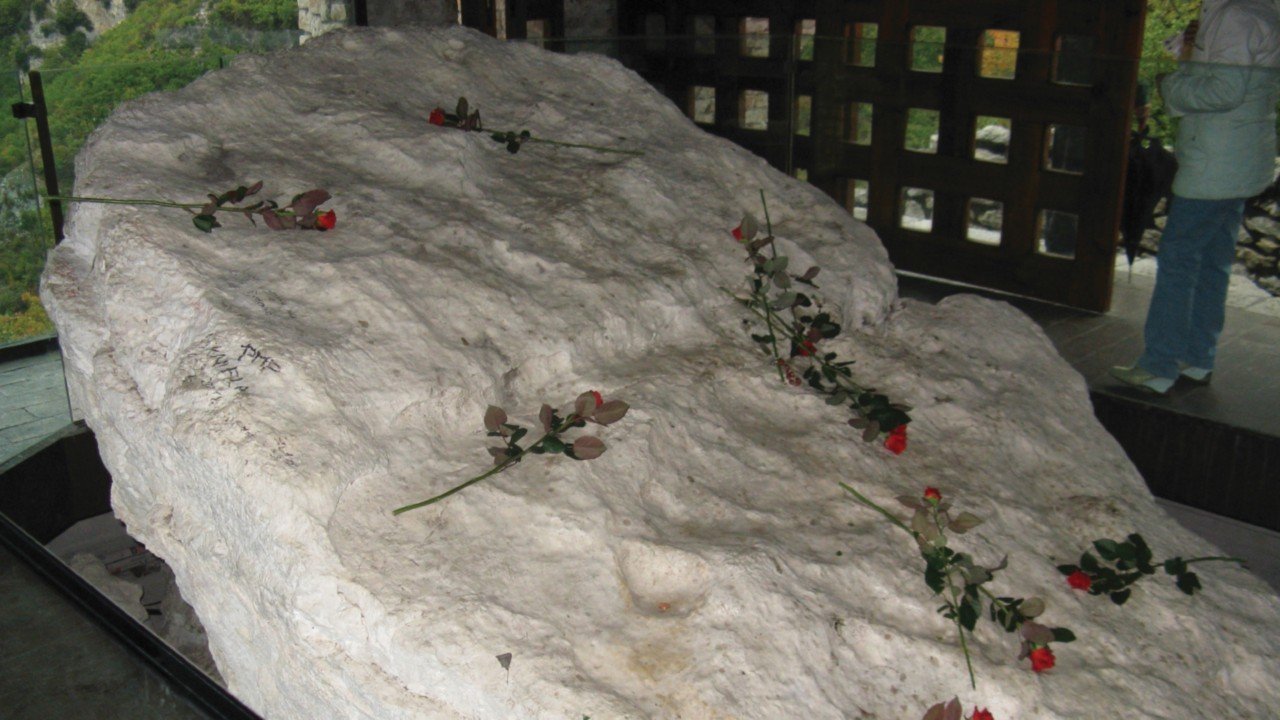
The Scoglio, otherwise known as the Schioppo or Gran Sasso, is the corner of a high, thin mountain, vaguely Tibetan in morphology, which stands out close to Roccaporena, the small village where Rita was born. Legend says that it broke away from the other mountains at the time of Our Lord’s death, when petrae scisserunteven the stones were taken by heartbreak.
In Rita’s time it was a ruined and inaccessible monolith, where perhaps a hermit like a stylobate lived. To the natives it aroused a fearful restlessness, a formidable bulwark for saints and devils. Even on all fours, defying the horror of the landslides, it would have been possible to reach the top. How could it be that a woman who was no longer young, a widow, stripped of her flesh by mourning, could ascend the Rock? Rita did it flying. In the same way, again at night, he flew from the hilltop inside the monastery of Santa Maddalena after the triple refusal. With the honor escort of Saint John, Saint Augustine and Saint Nicholas of Tolentino.
In those same years another woman flew like her, cured ailments, gave shelter to lonely and endangered women, calmed violent husbands, brought peace to homes.
Her name was Matteuccia di Francesco and she was burned at the stake in the square of Todi.
For Matteuccia, her vertical athleticism as a flying sibyl, her confidence in things of nature, her propensity for miracles were interpreted as sure signs of witchcraft. It was one of the first trials in Europe, in the symbolic disaster that marked the immense female genocide destined to erase millenary knowledge and practices of communities, education in the subtle senses, above all the faith in the glorious body of the earth with its natural miracles.
Today, after having venerated the precious little dark mummy of Saint Rita in the too modernist basilica of Cascia, we should go to the natural wilderness of the Scoglio. The road winds in serpentine hairpin bends to be followed with the silent pilgrim’s tread. The more you climb, discovering the immense vastness of everything, the more you enter into intimacy with the fairy nut of the soul. The Saint makes us a den.
And in that moment the real miracle is knowing that we have escaped, the diehards of the species, we women, the impossible devotees of the Saint.
by Lucia Tancredi
Writer