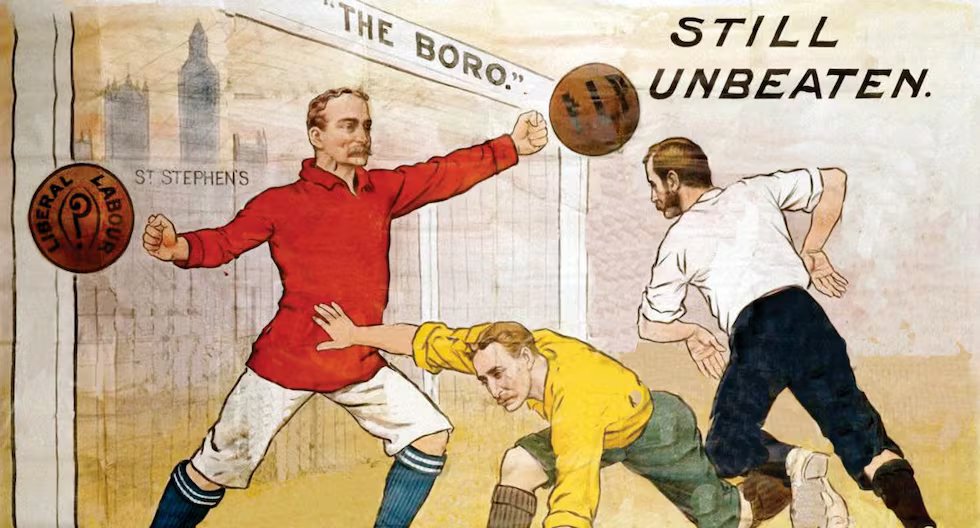

Why has football become a universal passion? It is more than a sporting fact, and often becomes the reason for a social and cultural explosion. We can suggest some explanations.
Football releases our homicidal instincts. In a time when wars are no longer desirable, we lack the channels for releasing our destructive drives. The natural need to destroy the rival within a tribe finds a way of expression in football. Since we live in a time without wars, we need to replace them. There are terms common to football and war such as “shooting”, “attackers”, “strategy” and others. That is why it also gives us heroes, that species in extinction in other areas. Football is a war with regulations. Some paint their faces and carry flags in the stands. They shout, they shout, they protest in the stands, what they cannot do in their lives. The cry is an expression of war that sells us an absurd illusion. If your country’s team wins, it is because its inhabitants are superior.
That is why duels with a war history have an absurd meaning. When Spain beat England one to zero in the 1950 World Cup, the president of the Spanish Football Federation, Armando Muñoz, dedicated a message to the leader Francisco Franco: “We have defeated the perfidious Albion.” He was referring to Great Britain and the history of wars with that country.
In a sense too, football ritualizes the struggles of life. Unlike sports where points are scored very quickly, in soccer scoring a goal is an exceptional event. You have to fight a lot to achieve it. Perhaps it reminds us of lives in which the daily struggle does not give results and only from time to time we can notice some important achievement. A great article by Alfonso Tealdo that I read in my childhood compared the unfair rulings of referees with the injustices of life.
But football also makes us forget life. It creates its own space and time that makes us ignore the time and space in which we live. It kidnaps us in a fictional reality simpler than reality. It doesn’t matter if the games are played during the day or at night. The clock time is replaced by the game time.
It is not surprising that many artists and poets have been football fans, since art performs a similar operation to the game. In his wonderful and recent book “Numbered Heroes”, Juan Villoro reviews the elements of the game and refers to the ball (“the talisman of heroes”) as that which expresses “the unattainable illusions of the species.”
The story began on October 26, 1863, at the Freemason Tavern in London. It was then that a group of representatives from universities and colleges drafted the first regulations for a sport that prohibited the use of hands. At first it had only one meaning. It was a separation from rugby.
More than a century and a half later, converted into a theater of individual and collective drives, football opens a new time frame. We must see it and see ourselves in those modern stadiums: the television rooms. The games continue into a third period, when we continue talking about them. A happy and barbaric ritual, which is renewed.