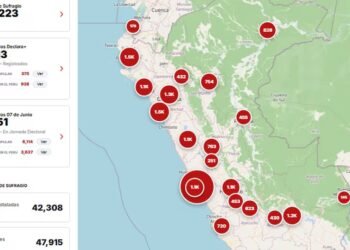

The presidents of the National Confederation of Private Business Institutions (Confiep), Jorge Zapata, and of the National Society of Industries (SNI), Felipe James, considered that they must still wait for the final count of the results after the second presidential round, compared to the figures revealed at the exit poll, where Keiko Fujimori of Fuerza Popular obtained 50.53% and Roberto Sánchez of Together for Peru, 49.47%, according to the pollster Datum Internacional.
“It is a very close result. You cannot say anything, because it is an exit poll. You have to wait calmly and calmly,” said Zapata in the special electoral broadcast carried out by Grupo El Comercio.
LOOK | Petro-Perú fires officials committed to the reorganization and embarks on another controversy
In turn, James indicated that the quick count (where Sánchez obtained 50.14% and Fujimori 49.86%, according to Datum Internacional) provides a better vision of the presidential results. Meanwhile, the Exporters Association (Adex) asked to wait for the election results.
As the ONPE count progresses, Zapata considered that the worst thing the country can do is seek political instability with various presidential changes and uncertainty.
For its part, Adex pointed out that it is important that competent authorities guarantee the transparency, impartiality and proper development of the electoral process until the official results are announced.
James said that one of the urgent issues for the next government is to quickly confront the threat posed by the El Niño phenomenon.
Likewise, he considered that in the first 100 days of government the main changes should be made for a five-year administration. These measures are, for example, the reduction of bureaucracy and ministries, in addition to establishing alliances with other political parties.
Precisely, Zapata commented that there are nearly 200 procedures in progress to obtain permits for mining investmentwhere there is a portfolio of more than US$64,000 million. In addition, microenterprises face problems obtaining operating licenses from municipalities, he added.
“Large investments from around the world go where there is a friendlier environment and Peru does not have it due to all its bureaucratic obstacles, delays in licenses and permits to obtain. If we do not do something about it, these large investments will go to other neighboring countries, such as Chile, Colombia or Argentina,” added James.
A topic that the head of the SNI added is laying the foundations for closing social gaps.
Zapata also commented that a priority is the citizen insecurity and a comprehensive reform of the State. The latter in order to address the problems of inefficiency and corruption in the public sector.
“Peru has produced sufficient income during the last 20 and 30 years, thanks to the economic chapter of the Constitution, but those resources have been squandered, thrown into the water. We have S/75,000 million in paralyzed works,” said the head of Confiep.
On the other hand, James considered that, to treat the economic and labor informality In the country, the four tax regimes must be unified into one and with staggered ranges according to the size of the companies.
Added to this is new labor regulations in dialogue with workers, unions and unions, adding that the hiring and firing of workers should be easier in the country.
Asked about a possible increase in minimum wageJames maintained that at this time it would not be ideal, given that it would especially harm micro and small businesses.
In fiscal matters and regarding the relationship with Parliament, Zapata considered that the next government should file an appeal before the Constitutional Court to establish that no spending initiative by Congress is allowed.
Another key aspect mentioned by both union presidents is the economic growth. As James said, the macroeconomic figures in Peru are among the best in the region, with a stable exchange rate, net international reserves of more than US$100 billion and controlled inflation.
LOOK | Elmer Cuba: “Not investing in people is as serious as not carrying out large mining projects”
In a context where the country has the highest terms of trade in the last 70 years, James expressed that Peru should grow at least at a rate of 5%. Having lower growth, of 3.2%, is due to political instability and regionalization problems, he added.
“We have to reach growth levels above 4.5% and 5%. Without growth, we can’t do anything,” he noted.
In that sense, he maintained that the economic engines of industry and tourism must be turned on, both activities being those that create a middle class and that allow social gaps to be closed.
“Tourism reaches very distant places. And with the industry, due to the labor it requires, which is qualified labor and provides better salaries, that social gap is closed, but it will not be achieved without infrastructure,” said the head of the SNI.
“This infrastructure gap, of US$150 million, must be addressed with productive executions such as roads, ports and airports; also with social buildings such as schools, hospitals, medical posts, water and sanitation,” he explained. This also implies the creation of a Ministry of Planning and Infrastructure, he commented.
In turn, Zapata pointed out that the country has the potential to grow between 5% and 6%, even with the possibility of reaching 7%.