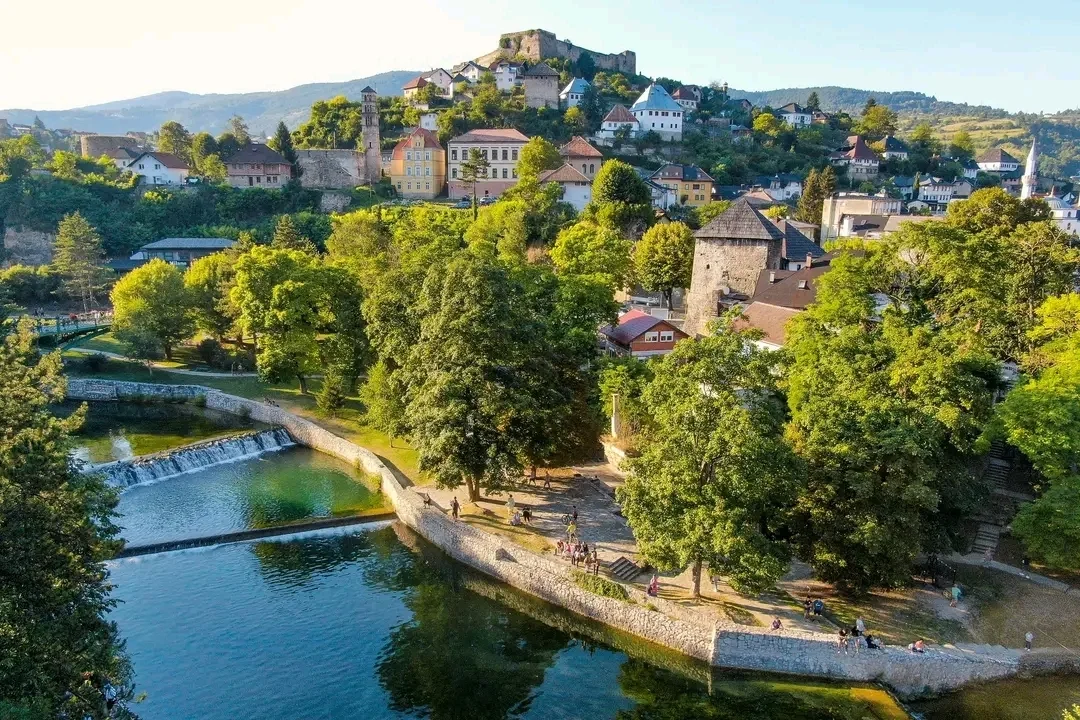
A sight that can rarely be seen anywhere in the world can be found precisely in Bosnia and Herzegovina. While walking through the city streets, suddenly a magnificent 22-meter-high waterfall appears in front of you, located in the very center of the city. This is exactly what Jajce is known for, a city that CNN once declared one of Europe’s best-kept secrets.
Jajce is often on the lists of the most beautiful cities in Bosnia and Herzegovina. Numerous foreign media wrote about its rich history and natural beauty, noting that it is surprising that it is not yet among the most famous European tourist destinations.
The city was first mentioned in the 14th century, although its roots go back much further. It was the capital of medieval Bosnia and the last seat of the Bosnian kings, and in recent history it was remembered as the venue for the Second Session of AVNOJ.
A waterfall in the heart of the city
The biggest symbol of Jajce is the waterfall created at the confluence of the Pliva and Vrbas rivers. It is located almost in the very center of the city, which makes it one of the few such natural phenomena in the world.
It is assumed that the waterfall was created about 50,000 years ago, and today it is one of the most photographed locations in Bosnia and Herzegovina.
A fortress that dominates the city
Above the town rises the old town and the fortress from the 13th century, which offers an impressive view of Jajce and its surroundings.
One of the biggest attractions inside the complex are the catacombs, which were carved by Duke Hrvoje Vukčić Hrvatinić at the beginning of the 15th century. Over the centuries, the catacombs had different uses – from sanctuaries in the Ottoman period to warehouses during the Austro-Hungarian administration.
Medvjed-kula also attracts special attention, the origin of whose name is still followed by several interesting legends.
Mithraeum – traces of antiquity
Among the many historical sights is Mithraeum, a temple dedicated to the god Mithras, the Persian sun deity. It dates from the period between the second and fourth centuries and is considered one of the best-preserved mithraeums in Europe.
In Jajce there is also the AVNOJ Museum, as well as the Franciscan Museum of Jajce, where the remains of the last Bosnian king Stjepan Tomašević are kept.
Pliva lakes and famous water mills
Only a few kilometers from the city are the Great Plivsko jezero and Malo Plivsko jezero, favorite excursion spots of local and foreign tourists.
The famous Pliva water mills, known as Mlinčići, give this area a special value. It is about twenty renovated wooden mills up to 400 years old, located on a travertine barrier between two lakes.
Together with the river Pliva and the lakes, the mills have been declared a national monument of Bosnia and Herzegovina.
The combination of natural beauty, rich history and unique sights makes Jajce one of the most special cities in Bosnia and Herzegovina, but also a destination that, for a reason, attracts more and more attention from tourists from all over the world.