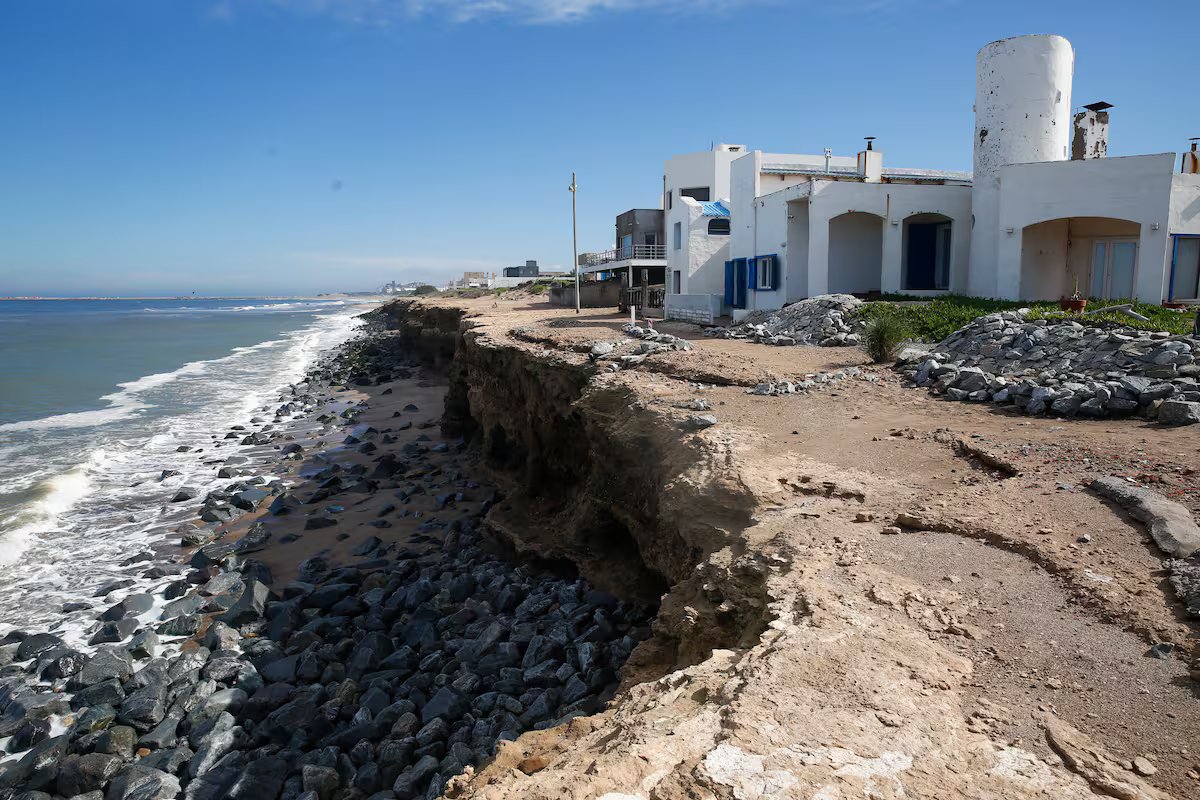
QUEQUÉN (Special Envoy).- As if that were not enough, daily and constant punishment from waves and windthat portion of cliffs and as if it were a Swiss-style cheese is shown with a perforation next to another, the work of the burrowing parrots that abound in multitudes on this coastline, they generate thousands of nests there, musicalize the environment with choral squawks and also contribute, pinch by pinch of land, to a coastal erosion process that worsens day by day north of the mouth of the Quequén River.
The intervention of birds is the most picturesque side of a serious problem that is palpitating, living and suffering more and more in this landscape of what is known as Bahía de los Vientos.a natural paradise facing the immensity of the sea, about five kilometers north of the city of Necocheaprofiled in recent decades as a new major focus of tourist attraction and, particularly since the post-pandemic, the scene of a thriving and innovative real estate development.
The abundance of beach surface that this district has always boasted lost territory in this specific area for almost 20 yearswhen a work was inaugurated that extended into almost 400 meters from the South Jetty of the powerful and very active port of Quequén, Since then it has become a greater obstacle for the sand that, at the rate of coastal drift, should supply the coast.
The result, after almost two decades, was the almost complete disappearance of at least 2,500 meters of space used as a spafrom the northern end of the current Las Olas parador to a tongue of cliffs that slopes towards the sea and that the locals know as Punta Carballido.
The tons of rocks thrown in recent years at the foot of the cliffs, arranged parallel to the coast with the intention of making a stronger wall, have been of little use.. The ocean gains ground, predominates over these defenses, moves them from here to there with its powerful energy and begins to put properties on the seafront at risk. Some with a long history there, when that postcard was a wasteland only visited by fishermen; and others of recent construction, born as accommodation for visitors who are beginning to discover a scenario characterized by tranquility and, increasingly, as a destination with a higher quality of life as an added value.
The solution, according to the neighbors who appear to be the main victims of the loss of sand, is in the hands of the Quequén Port Management Consortium. The entity was responsible for that work inaugurated in 2008. In those days it was already anticipated that remediation work would have to be carried out on the nearest beaches. The recipe being evaluated today is called reflated: It is the rescue of sand retained on the eastern margin of the breakwater or product of dredging of the access channel to dump it on the coast through pipes.
The work, which would also have financing guaranteed by this port administration, It would be very similar to the one that took place in 1998 in Mar del Platawhen with this methodology The sand surface was expanded from Playa Grande to Punta Iglesias. The problem there too is the obstacle that the South Jetty represents for natural drift.
The current president of the Quequén Management Consortium, Mariano Carrillo, confirmed a month and a half ago that this work is in the most immediate plans. “We are committed to moving forward with the environmental impact study “which will allow us to carry out the refloating and recover our beaches,” he confirmed during the anniversary event of this port. He then said that “It is a necessary work to return Quequén to all its greatness”.
The port of Quequén has a strong participation in the movement of cereals and that work to extend its South Breakwater contributed to the operation with larger vessels, which at the same time implied greater activity and greater resources. It is expected from these incomes that the funds for the refulation will arise.if this methodology is considered to provide a first solution to this situation.
THE NATION consulted on the progress status of the environmental impact study planned as a first step towards the possibility of reflushing work. There were no details due to emergencies that the terminal was going through with a protest by truckers that kept the operation paralyzed for the last three weeks. and it was the main focus for the board of directors in charge of that administration.
“The process of advance of the sea is super acceleratedit is exponential and it will get worse,” he tells THE NATION Néstor Diez, civil engineer and one of those who bet on this artificial planting of sand as a suitable alternative. “It is reflushed to recover surface and breakwaters to retain sand.”he explained. One without the other, he warns, will mean a matter of time before everything goes back to how it is today.
The voices of complaint are multiplying, but they do not have the tone of conflict with the port administration but rather of impulse to advance in what they understand to be a commitment already assumed to undertake the work. “There is good will and it will be done to the extent possible,” Diez acknowledged. THE NATION.
Time passes and the face of cliffs recedes more and more, as the sea advances. For example, a section of Costanera Avenue or 500 Street was definitively lost, which at the height of the intersection with 549 has an abrupt end only to reappear several hundred meters later.
Verónica Bertoldi has lived in Bay of the Winds. “When we got here the cars stopped in front of our complex, today there was nothing left,” he says. Even long before there was a street and a bus line ran through it. Now it shows the limit of the park in front of its cabins with a cliff that falls on top of it. “When there is a southeast storm, the waves are right here and reach the building itself.“, he assures THE NATION.
Those who have been here for much longer recognize that the area had become a virgin beach front which allowed you to travel on foot and on sand for several hundred meters. “Today soon one encounters stone defenses and In certain sectors you cannot advance directly because the water is against the cliff“explains Martín Palleiro, who began spending the summer in Quequén 50 years ago and settled 26 years ago, with operations linked to the commercialization of cereals.
Bay of the Winds In these times, it looks like new and modern constructions with other pioneering and marine-style buildings that show danger in that first line, such as “La mejillonera” or “Viento Norte”, just some of those that have witnessed the good old times and these more recent ones, of threat and possible risk due to landslides.
Investments there multiply and for this reason there is also concern because the value of the place appears much more solid to the extent that it offers a nearby beach and, above all, keep at a distance the sea that has in its DNA that tendency to advance and gain ground.
Some of the ongoing projects are beginning to show high-rise buildings. The limit of the Urban Planning Code for Bahía de los Vientos was established at a maximum of four floors. These apartments, just over 200 meters from the coast, offer a full view of the sea. The original houses not only see it from their windows: they begin to feel it closer and closer to their foundations.